
Last updated October 30, 2026
How to Hire a Insulation Contractor in Van Nuys: A Step-by-Step Guide
In California, a contractor with a general B-license can legally install insulation. That means the person quoting your Van Nuys attic job may have done three of them total, learned on YouTube, and never once pulled a HERS verification on a completed project. Meanwhile, your cooling bills climb every July while heat pours through a ceiling that was “insulated” two years ago. This guide walks you through exactly how to vet a contractor, read a bid, spot the short-cuts, and hire someone who will actually solve the problem. By the end, you’ll know more about hiring an insulation contractor than most people who claim to be one in the San Fernando Valley.
Quick Answer
The right way to hire an insulation contractor in Van Nuys is to verify a California C-2 Insulation and Acoustical license, confirm the contractor stocks multiple material brands rather than one product line, require a bid that includes air sealing and attic hatch insulation, and ask who performs the HERS verification. A dedicated insulation specialist with a C-2 license and multi-brand material access will nearly always outperform a generalist HVAC or roofing company bundling insulation as an add-on.
Table of Contents
- Step 1: Check the License Classification Before Anything Else
- Step 2: Ask the Question That Separates Specialists From Generalists
- Step 3: Understand Why Material Choice Matters in Van Nuys
- Step 4: Read the Bid Like an Inspector, Not a Shopper
- Step 5: Spot the Red Flags Before You Sign
- Step 6: Know What Permits and HERS Verification Actually Require
- Step 7: Ask These Questions During the Walkthrough
- Step 8: What to Expect After the Job Is Done
Step 1: Check the License Classification Before Anything Else
California divides contractor licenses by trade. The one that matters for insulation is the C-2 Insulation and Acoustical Contractor classification. A C-2 holder has passed a trade exam covering insulation materials, installation methods, moisture control, and acoustical applications. That’s not a formality. The exam tests knowledge of building science that a general contractor never has to demonstrate.
In Van Nuys, you’ll encounter three types of companies quoting insulation work:
- Licensed C-2 insulation specialists who do insulation every day and nothing else.
- General B-license contractors (often HVAC or roofing companies) who can legally install insulation as part of a larger project but may have limited insulation-specific training.
- Unlicensed operators who show up after heat waves, quote cash jobs, and disappear when the utility bill doesn’t drop.
You can verify any California contractor license in about 60 seconds on the Contractors State License Board website. Enter the license number, check it’s active, and confirm the classification says C-2. If the person quoting your job holds a B license and tells you insulation is “part of what we do,” that’s not disqualifying on its own, but it changes the questions you need to ask. A generalist doing three attic jobs a year doesn’t stock multiple material brands and doesn’t have the installation reps visiting job sites to troubleshoot problems. Those reps only show up for contractors who move volume. That access is part of what you’re paying for, and it’s invisible until something goes wrong.
We’ve walked into Van Nuys homes after a roofing company “insulated” the attic during a re-roof. Baffles missing at the eaves. Air leaks completely unsealed. Fiberglass batts compressed to half their rated R-value. The homeowner paid for insulation and got decoration. The roofer was licensed. The work was legal. It just wasn’t good, because insulation was an afterthought on a roofing job rather than a trade performed by someone accountable to it.
Step 2: Ask the Question That Separates Specialists From Generalists
Here’s the question that reveals more than any other during a first phone call: “Which insulation brands do you carry, and why those?”
A generalist will name one product line, usually whatever their supplier stocks cheapest. A specialist will answer differently. We carry eight brands across three installation methods because no single material is correct for every attic in Van Nuys. Johns Manville and Knauf fiberglass are excellent for open attic floors with standard joist spacing. Rockwool mineral wool matters when fire resistance or moisture resistance is a priority, which comes up in older Van Nuys construction more often than people expect. CertainTeed products have specific applications where their batt sizing and facing options work better for unusual cavity depths. Each brand exists in our inventory because it solves a specific problem better than the alternatives, not because we got a volume discount.
This matters practically. If a contractor only installs one brand of fiberglass batt, then every attic they touch gets fiberglass batt, whether or not that’s the right call. A home with a low-slope roof and tight eaves might benefit from closed-cell spray foam. A home with existing settled insulation and a homeowner on a budget might be better served by blown-in cellulose over the top. But the single-brand contractor can’t offer that. Their recommendation isn’t driven by your house. It’s driven by their inventory.
When you call a Van Nuys insulation contractor, ask what brands they install and what methods they offer. The answer tells you whether you’re hiring a specialist who will match material to problem or a generalist who will match your problem to the one product they happen to carry.
Step 3: Understand Why Material Choice Matters in Van Nuys
Van Nuys sits in California Climate Zone 9, where cooling dominates the energy conversation. Summer temperatures routinely climb past 95 degrees, and attic temperatures can reach 140 degrees or more. The California Energy Code sets minimum R-value requirements for attic insulation in this climate zone, currently R-38 for most residential attics. That number is a floor, not a ceiling. Many Van Nuys homes built before the 1980s have R-11 or less, which means they’re losing a massive share of their cooling load through the ceiling.
But R-value isn’t the whole story. The material that achieves that R-value matters in three specific ways in the Valley:
- Air movement resistance: Fiberglass batts slow conductive heat transfer but do almost nothing to stop air movement. If your attic has recessed lights, plumbing penetrations, or a whole-house fan, air will move through and around batts. That’s why attic insulation in Van Nuys done correctly almost always includes air sealing as a separate step, not optional.
- Settling over time: Blown-in fiberglass and cellulose settle, losing R-value over years. Dense-packed applications or stabilized products reduce this, but it’s a real factor in 20-year-old Valley homes where the insulation has compacted to half its original depth. Our blown-in insulation work in Van Nuys accounts for settling in the initial depth calculation, because quoting a depth without accounting for compaction means underinsulating from day one.
- Moisture behavior: Van Nuys isn’t a humid city like Houston, but winter rain and occasional humidity spikes affect attic moisture. Fiberglass loses R-value when wet and dries slowly. Mineral wool absorbs almost no water and retains its performance. Closed-cell spray foam performs as both insulation and an air and vapor barrier, which matters in specific attic configurations. A contractor who understands these differences will make a recommendation based on your attic’s actual conditions, not a preference.
This is why method selection matters. Some Van Nuys attics are best served by batts. Some need blown-in. Some genuinely benefit from spray foam insulation in Van Nuys, particularly when the attic is being converted to conditioned storage or when air sealing is a primary goal. A specialist who offers all three methods can tell you why one makes sense for your specific roof geometry, existing insulation, and budget. A generalist with one method will sell you that method. The distinction sounds subtle, and it costs homeowners real money.
Step 4: Read the Bid Like an Inspector, Not a Shopper
Most Van Nuys homeowners compare insulation bids the same way they compare bids for any home service: they look at the bottom line. That’s a mistake. Insulation bids vary dramatically in scope, and the low bid is frequently low because it omits work that a legitimate job requires.
A complete insulation bid should include these line items, in writing:
- Air sealing description: The bid should state where air sealing will occur (top plates, electrical penetrations, plumbing penetrations, recessed light enclosures, duct chaseways). If the bid doesn’t mention air sealing, the contractor is planning to skip it, which in a Van Nuys attic means the new insulation will underperform from week one.
- Attic hatch insulation treatment: The access hatch is a hole in your ceiling. An insulated hatch cover, weatherstripping, and latches should be in the scope. Low bids omit this because it’s fiddly work with no visible result.
- Baffle and venting assessment: The bid should state whether baffles will be installed or repaired at eave vents, and whether existing attic ventilation is adequate. If there’s no mention of venting, the contractor didn’t look at it. In Van Nuys summer attics, inadequate venting plus new insulation can create a hot, short-lived assembly that prematurely degrades roofing materials.
- Depth and R-value targets per area: A legitimate bid specifies R-value for the attic floor, not just “insulate attic.” It should also address sloped ceiling sections if any exist.
- Material and brand specified: “Fiberglass batt” is not specific. “R-38 Owens Corning or Johns Manville unfaced batt, two cross layers” is specific. Specificity forces accountability.
- Cleanup and disposal: Old insulation removal (if needed), debris cleanup, and disposal should be itemized. The low bidder who says “we’ll just blow over it” may be leaving failed insulation and rodent debris underneath, which is a legitimate health consideration in older Van Nuys attics.
- HERS verification plan: California Title 24 requires verification of insulation installation in many retrofit scenarios. The bid should state who performs the HERS verification and whether it’s included in the price. More on this in Step 6.
If you receive a bid that’s $800 cheaper than another and the only difference is the missing air sealing line item, the cheaper bid isn’t cheaper. It’s incomplete. You’ll pay for that gap in energy costs for the life of the insulation.
Step 5: Spot the Red Flags Before You Sign
The San Fernando Valley has seasonal patterns for insulation solicitations. The first heat wave of the year brings a wave of door-to-door insulation pitches. After the 1994 Northridge earthquake and again after any significant seismic event, “free attic inspections” spike. The pattern exists because homeowners are suddenly aware of their homes’ vulnerabilities, and that awareness translates into urgency. Some of that urgency is legitimate. Some of it gets exploited.
Red flags specific to Van Nuys:
- Door-to-door insulation sales after a heat wave or seismic event that pressure you to sign that day. Legitimate insulation contractors in Van Nuys are busy all year. They don’t need a heat wave to generate work and they don’t dispatch sales teams to knock on doors after an earthquake.
- Cash-only quotes with no license number on the paperwork. If the license number isn’t on the bid, that’s either negligence or intentional. Neither is acceptable.
- “We’ll blow insulation over your old stuff, no removal needed.” Sometimes topping off existing insulation is correct. Sometimes the old insulation is rodent-infested, moisture-damaged, or partially degraded. A refusal to even look in the attic before promising no removal is a shortcut, not a savings.
- No mention of air sealing or hatch treatment. If the bid doesn’t include it and the contractor gets defensive when you ask, walk. This is the single most common scope gap we see on bids from generalist contractors in Van Nuys.
- Promised percentage energy savings. No contractor can promise a specific percentage reduction in your utility bill. Anyone who does is either guessing confidently or overselling. The right language is “based on your current R-value and our proposed scope, this should meaningfully reduce cooling load” not “save 40% on your energy bill.”
- Pressure to skip permits or HERS verification. A contractor who suggests you’ll save money by not pulling permits is telling you they’re willing to do undocumented work. The same contractor will disappear when the HERS verification fails.
- Vague answers to material questions. If you ask what brand they’re installing and the answer is “whatever’s available” or “the good stuff,” that’s a contractor without real material relationships. In 2026 supply chains, that means delays and substitutions you won’t know about until the truck arrives.
One more localized note: Van Nuys has a significant stock of 1950s and 1960s tract homes with original or near-original attic insulation. If your home is one of them, and the contractor doesn’t mention checking for vermiculite or degraded materials, that’s a knowledge gap. Vermiculite insulation from that era may contain asbestos and should not be disturbed without testing. A specialist knows this because they’ve done hundreds of these attics. A generalist may not. The difference matters.
Step 6: Know What Permits and HERS Verification Actually Require
California’s energy code requires that most insulation retrofits in existing homes be verified by a certified HERS rater. The rater inspects the completed installation, verifies the R-value and coverage, and files documentation with the state. This isn’t a suggestion or an upsell. It’s the legal compliance path for the work.
In Van Nuys, the permitting path for an insulation retrofit typically involves:
- The contractor pulls a building permit from the Los Angeles Department of Building and Safety (LADBS) if required for the scope. Pure insulation retrofits sometimes proceed under HERS verification without a full permit, but any structural changes or access modifications may change that.
- The insulation is installed to the R-value specified in the energy compliance documentation.
- A HERS rater inspects the job and verifies the installation meets Title 24 requirements.
- Documentation is filed, and the homeowner receives confirmation of compliance.
The lowest bid in the Valley often reflects a plan to skip this process entirely. The contractor installs insulation, collects the check, and disappears. You get no verification that the R-value is correct, no documentation for your home’s resale file, and no recourse if problems surface. When you sell your home, the missing documentation can become a disclosure issue. You’ll pay to fix it then, with less leverage and more urgency.
Ask every contractor you interview: “Who performs the HERS verification, and is it included in your bid?” The answer should be immediate and specific. If the contractor hesitates, doesn’t know what HERS verification is, or tells you it’s “not necessary for this job,” that’s the end of the conversation. You’re talking to someone who doesn’t operate in compliance with the building code that governs the work you’re hiring them to do.
Step 7: Ask These Questions During the Walkthrough
The walkthrough is where hiring decisions actually get made. A contractor who rushes through it, never goes into the attic, or spends more time on the sales pitch than the house is showing you their priorities. Here’s what to ask while they’re at your Van Nuys home:
- “What R-value is in my attic right now?” If the contractor hasn’t looked, they can’t know. If they can’t estimate existing R-value by measuring depth and identifying the material, that’s a knowledge problem.
- “What R-value will you install, and where?” The answer should be specific: R-38 on the attic floor, R-19 in the walls if applicable, specific treatment for kneewalls or sloped ceilings. General answers indicate a general approach.
- “How will you handle my recessed lights?” Recessed can lights in the attic are heat sources and air leakage points. Non-IC-rated cans can’t be covered with insulation. IC-rated cans can, but still need proper air sealing. If the contractor doesn’t have an answer for this in a 1960s Van Nuys home with original ceiling fixtures, they haven’t done this work properly before.
- “What’s your plan for the existing insulation?” Remove it, top it off, or leave it? The answer depends on condition, which requires inspection. A contractor who answers without looking is guessing.
- “Will you air seal before installing insulation?” The only correct answer is yes, with an explanation of where. Air sealing is the highest-value work done in most Van Nuys attics, and insulation without it is a partial job.
- “What access do you need from me on install day?” A professional contractor tells you: attic access cleared, driveway space for the truck, power requirements for the blower, containment setup if removal is happening. This question tests whether they’ve actually done this in a Van Nuys neighborhood with a shared driveway and a 1950s garage.
We’ve done enough attic work in Van Nuys to know that no two attics are the same, even in identical-looking tract homes on the same street. Different duct layouts, different venting, different prior work, different rodent history. The questions above are designed to reveal whether your contractor is treating your attic like a specific place or a generic job.
As a dedicated insulation contractor working across Van Nuys, we’ve seen firsthand how much difference these details make. Our team works through these decisions on every job, which is why we stock multiple brands and offer full attic insulation services in Van Nuys rather than a single-product pitch. The questions you ask should reflect the standard we’ve described, because that’s the standard the work actually requires.
Step 8: What to Expect After the Job Is Done
A proper insulation job in Van Nuys produces several documented results. You should receive: a description of what was installed, at what R-value, in which areas; confirmation of the HERS verification and any permit documentation; photos of the completed work in your attic (any competent contractor takes them for their own records and yours); and a reasonable explanation of what changed and what you should notice.
What you should notice over the following months: more stable indoor temperatures, especially on hot Valley afternoons; a reduction in the run time of your air conditioner during peak heat; fewer drafts near ceiling fixtures and attic hatches; and if spray foam was part of the scope, a noticeable difference in noise transfer as well.
What you should not accept: a contractor who goes dark after the job, no verification documentation, visible gaps between insulation and framing when you peek into the attic, or a utility bill that doesn’t shift at all through a full cooling season. Some improvement is gradual, but a correctly installed R-38 attic over an R-11 attic in Van Nuys produces a measurable difference within the first summer. If it doesn’t, something was wrong with the scope or the installation.
For homeowners considering spray foam as an alternative insulation method in Van Nuys, the post-installation expectations differ: faster temperature stability, lower air leakage, and a different maintenance profile. The verification process is the same. The documentation matters the same. Don’t accept less from one method than the other.
Common Mistakes to Avoid
- Hiring based on the lowest bid without comparing scope. The $700-cheaper bid usually omits air sealing, hatch treatment, or HERS verification. You’ll pay the difference later in energy costs and resale issues.
- Accepting a generalist’s insulation add-on during an HVAC or roofing project. The roofer or HVAC tech is there for a different job. Insulation gets rushed, scopes get cut, and you end up with a partial result that’s hard to fix without redoing the work.
- Skipping the license check because the contractor “seemed professional.” The CSLB database is free and takes a minute. A professional who checks out will welcome the verification.
- Not asking about air sealing. This is the single highest-value step in most Van Nuys attic retrofits, and it’s the step generalists skip most often. Insulation without air sealing is like installing a quieter fan in a room with the window open.
- Ignoring the attic hatch. A 4-square-foot uninsulated hatch in a Van Nuys attic floor is equivalent to leaving a small window open year-round. Contractors skip it because it’s detail work. Don’t let them.
- Believing door-to-door pitches after heat waves. The heat wave generated urgency, not expertise. Companies that knock after a 100-degree week in Van Nuys are selling fear, not insulation.
- Choosing material based on brand recognition alone. A recognized brand installed incorrectly performs worse than a commodity product installed correctly. The contractor’s installation competence matters more than the label on the batt.
When to Call a Professional
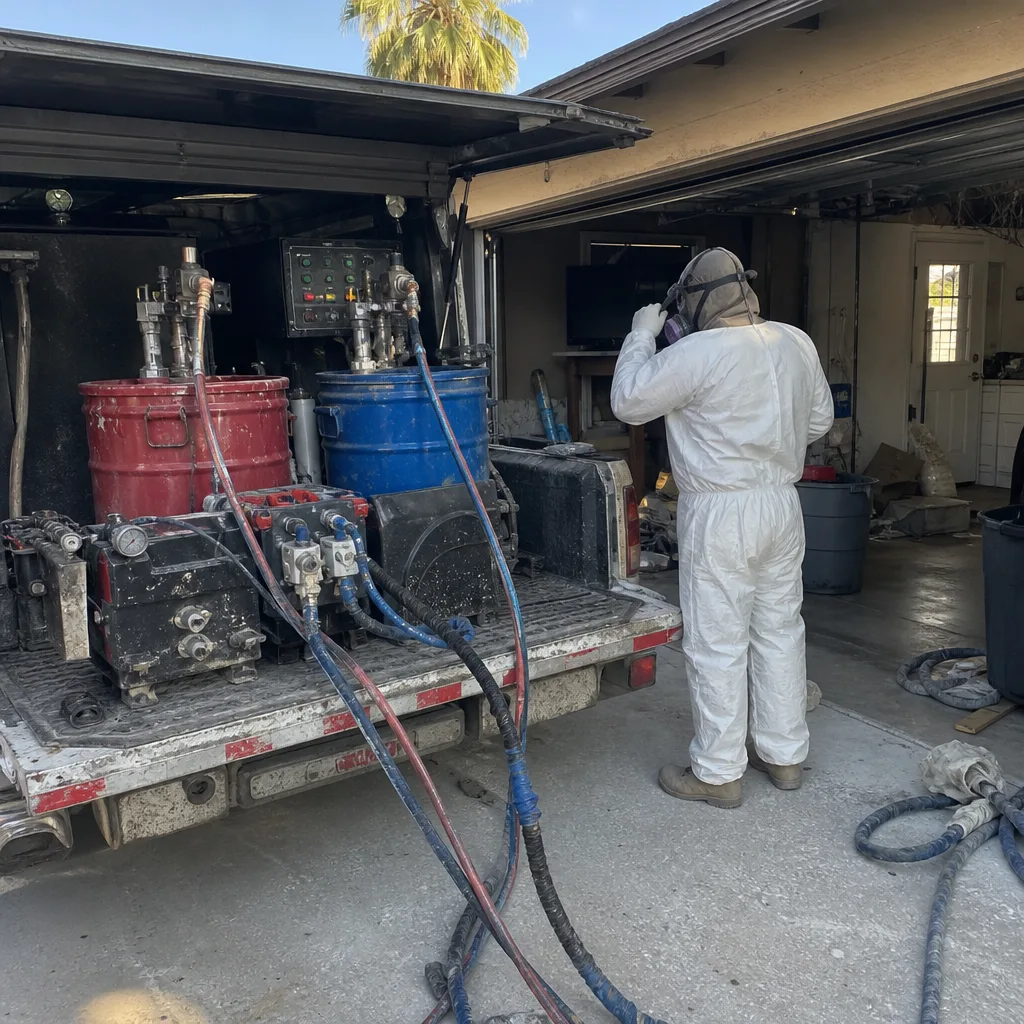
Insulation work seems simple. It isn’t. Attic work in Van Nuys summer heat is physically demanding and potentially dangerous. High attic temperatures, limited footing, electrical hazards, and the presence of old materials all argue against DIY. If your attic has vermiculite that may contain asbestos, do not disturb it at all. If your home has recessed lighting that’s not IC-rated, insulation around those fixtures requires specific knowledge to avoid creating a fire hazard. If you’re considering spray foam, the application requires professional equipment, proper ventilation during installation, and trained installers who know the material’s behavior. Thermal Insulation Co offers free estimates in Van Nuys, covering attic insulation, blown-in insulation, and spray foam. Call (855) 382-3451 to schedule a walkthrough. You’ll get specific answers about your home, not a generic pitch.
Frequently Asked Questions
A C-2 Insulation and Acoustical contractor has passed a California trade exam specific to insulation materials, installation methods, and building science. A general B-license contractor can legally install insulation but hasn’t demonstrated insulation-specific competency through the licensing exam. For attics in Van Nuys where air sealing, venting, and material selection all affect the outcome, the C-2 classification is a meaningful quality signal.
Attic insulation in Van Nuys typically falls between $1,500 and $4,000 depending on attic size, existing conditions, material choice, and whether removal is required. Air sealing adds to that range and is not optional for correct performance. Get a written bid that itemizes air sealing, hatch treatment, material specifications, and HERS verification. Call (855) 382-3451 for an exact quote on your attic.
Many insulation retrofits in California require HERS verification, and some scopes require a permit through LADBS. Your contractor should tell you which applies to your specific project and include the compliance path in the bid. If a contractor tells you permits and verification “aren’t needed,” get a second opinion from a C-2 licensed specialist.
If your existing insulation is dry, clean, and simply thin, topping off with additional material is often the right call. If it’s rodent-infested, moisture-damaged, or contains vermiculite, removal and replacement is the better path. A proper attic inspection tells you which situation you have. Any contractor who skips the inspection and quotes a “top-off” is guessing.
There’s no single best material for every Van Nuys attic. Fiberglass batts work well in open attics with standard joist spacing. Blown-in products handle irregular spaces and top-offs efficiently. Spray foam addresses air sealing and space constraints in ways batts can’t. The right material depends on your attic’s geometry, existing conditions, and performance goals. A contractor who stocks multiple options can match material to your house; one with a single product line will match your house to their product.
For insulation specifically, a dedicated company like Thermal Insulation Co brings more relevant expertise than a generalist. Specialists stock multiple material brands, install multiple methods, and handle insulation every day. Generalists add insulation to larger projects where it’s rarely the focus. The difference shows up in air sealing quality, material selection, and long-term performance.
The Bottom Line
Hiring an insulation contractor in Van Nuys comes down to three disciplines: verify the license, read the bid’s scope line by line, and choose a specialist over a generalist. The C-2 classification matters because it signals demonstrated trade knowledge. The bid’s line items matter because the cheapest quote is usually the most incomplete quote. And the specialist-versus-generalist distinction matters because insulation is a building science discipline, not a side service bundled into an HVAC or roofing job. We carry multiple brands, we install three methods, and we do this work every day in Van Nuys. If your attic needs attention, start with a walkthrough. Call (855) 382-3451 for a free estimate and specific answers about your home.
Written by the team at Thermal Insulation Co, serving Van Nuys since 2012.