
Last updated October 30, 2026
DIY vs Professional Insulation: The Van Nuys Homeowner’s Decision Guide
You can walk into any big-box home improvement store in the San Fernando Valley, rent a blown-in insulation machine, and have fiberglass in your Van Nuys attic by sundown. It’s legal. It’s permitted under California code in many cases. What the store won’t tell you is that without HERS verification and a paper trail, the work you do this weekend may not satisfy a lender when you sell the house in five years. This guide walks through exactly where the line sits between what a careful homeowner can tackle and what genuinely needs a licensed contractor, what Van Nuys’s climate does to that equation, and where most self-installations quietly fall short. For how to hire a insulation contractor in Van Nuys: a step-by-step guide, see our dedicated resource.
Quick Answer
For most Van Nuys homeowners, small batt insulation jobs in accessible attics are manageable DIY projects, but anything involving spray foam, HERS-verified compliance, air sealing, or work in a summer attic that hits 120°F by mid-morning is better left to a professional insulation contractor. The real cost difference shrinks significantly once you factor in equipment rental, personal protective gear, disposal fees, and the energy losses DIY installs typically miss.
Table of Contents
- What DIY Insulation Actually Involves in Van Nuys
- The Three Materials That Are Not DIY-Viable in California
- Van Nuys Climate and the Attic Heat Problem
- What DIY Gets Right and What It Misses
- Permits and HERS Verification: The Paperwork Question
- Real Cost Comparison: DIY vs Professional
- Common Mistakes to Avoid
- When to Call a Professional
What DIY Insulation Actually Involves in Van Nuys
Before you decide whether to tackle insulation yourself, it helps to know what the job actually requires. Most Van Nuys homes fall into one of two eras: post-war ranches built between 1945 and 1965 with shallow attic cavities and minimal existing insulation, and 1970s-through-1990s construction with R-11 or R-19 fiberglass batts that are compressed, dirty, and underperforming by today’s Title 24 standards.
A basic DIY batt installation in an accessible attic involves:
- Measuring the attic floor area and calculating the R-value you need to reach Title 24 compliance (for most Van Nuys attics, that’s R-38 minimum for new work, R-30 for retrofit additions in many LA County jurisdictions).
- Clearing the attic floor of debris, old insulation, and rodent droppings (common in Van Nuys neighborhoods with mature trees and older rooflines).
- Air sealing every penetration: plumbing vents, electrical boxes, recessed can lights, HVAC registers, and the attic hatch itself.
- Laying unfaced batts or blowing in loose-fill to the correct depth, keeping insulation off of unrated recessed fixtures to avoid fire risk.
- Installing baffles at eaves so soffit vents don’t get blocked, which would trap moisture and promote mold growth.
- Documenting everything: material receipts, photos, depth measurements, and the R-value achieved for future resale disclosure.
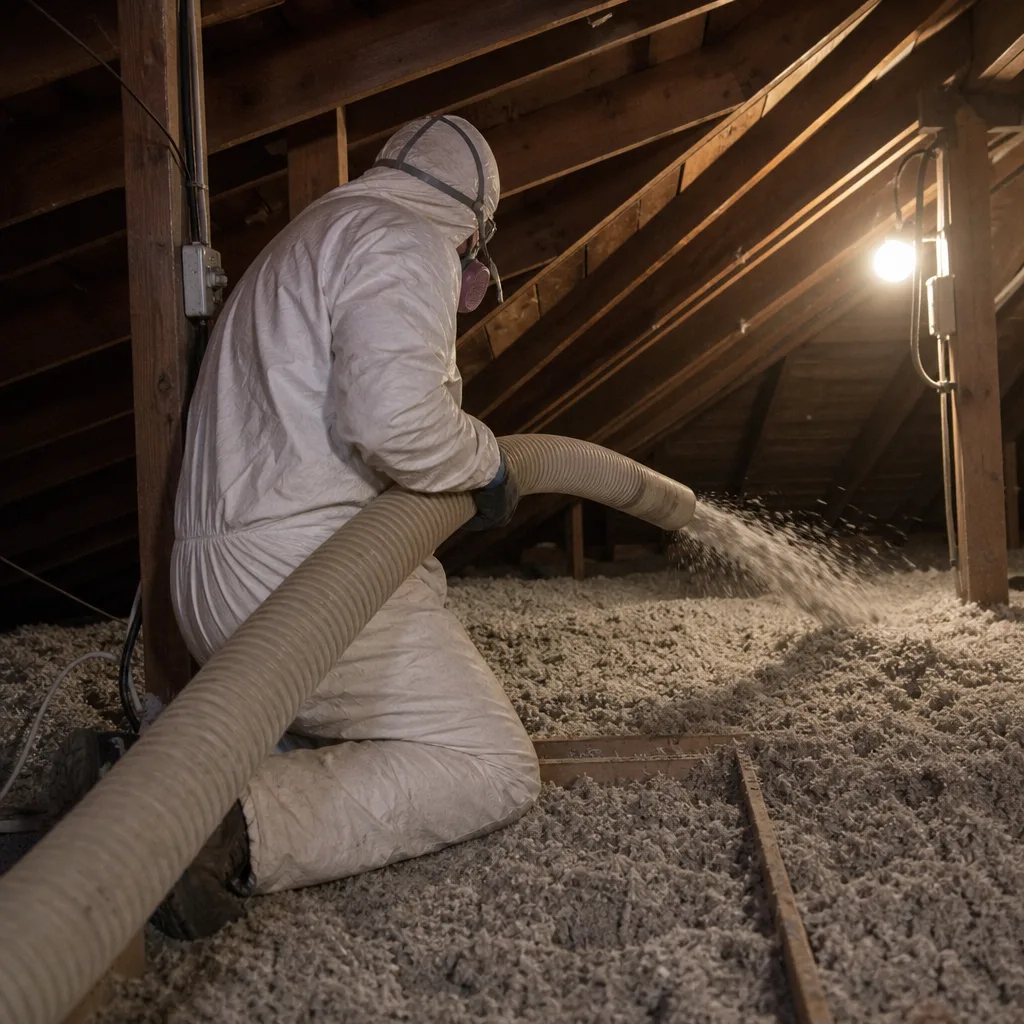
None of these steps is individually complicated. The challenge is doing all of them correctly while crouched in a 140°F attic in mid-July, in a space where one misstep can put a foot through the drywall ceiling below. That’s the Van Nuys-specific problem most generic DIY guides gloss over.
The Three Materials That Are Not DIY-Viable in California
Some insulation products are simply off the table for a homeowner working without a license, regardless of skill level or ambition. In California, three specific categories fall into this bucket.
Spray polyurethane foam. Open-cell and closed-cell spray foam both require a licensed applicator in California. The chemicals involved (isocyanates and polyol resins) are classified as hazardous during application, and the equipment requires calibration and training to apply safely. Improperly mixed foam can off-gas for months or fail to cure entirely. At Thermal Insulation Co home, we install Icynene and Demilec spray foam with trained crews because this is not a product that responds well to experimentation.
Any product claiming a fire-resistance rating. If a material’s spec sheet includes a fire-assembly rating or is being installed as part of a fire-rated wall or ceiling assembly, California code requires that installation to be inspected and signed off. Rockwool mineral wool, for example, carries excellent fire-resistance properties, but if a Van Nuys homeowner installs it as part of a fire-rated garage-to-living-space conversion, the inspector needs to see it done correctly by someone who understands assembly requirements.
Anything requiring HERS verification. The California Home Energy Rating System (HERS) program requires third-party verification for certain insulation installations, particularly in new construction, additions, and some retrofit programs. A DIY install can’t be HERS-verified because the verifier is certifying both the material and the installation quality. This matters most when you’re trying to qualify for utility rebates or when selling a home where the buyer’s lender requires energy-efficiency documentation.
Batt fiberglass from Johns Manville or Knauf, blown-in cellulose from GreenFiber, and similar materials remain accessible to DIYers. The products aren’t the problem. The verification and application requirements are.
Van Nuys Climate and the Attic Heat Problem
Van Nuys sits in a flat, inland pocket of the San Fernando Valley where summer temperatures routinely reach the mid-90s by noon. Attic temperatures run significantly hotter. By 10:00 am on a typical July day, a poorly ventilated Van Nuys attic can already be past 120°F, and by mid-afternoon it can exceed 140°F. That’s not a comfort problem. That’s a heat-illness risk.
The practical implications for a DIY project are significant:
- Working hours are limited. A DIY attic project in July or August realistically needs to happen between 6:00 am and 9:00 am. After that, the attic becomes dangerous for sustained physical work.
- Heat stress reduces precision. Air sealing, the most important part of an insulation retrofit, requires careful, detail-oriented work with caulk guns, foam cans, and attention to tight spaces. Doing that work while sweating through a Tyvek suit and respirator leads to rushed, incomplete sealing.
- Protective gear becomes non-negotiable. Fiberglass particles, a respirator, full-coverage clothing, and gloves become genuinely miserable in a hot attic. Many DIYers start removing gear to cope, which defeats the safety purpose.
- Material performance gets affected. Certain spray foam formulations behave differently in extreme heat, which is one more reason professional application with controlled equipment matters for that product.
If you’re committed to a DIY install, the window between October and April is far more workable in Van Nuys. But it’s a factor many homeowners don’t account for until they’re already on the ladder.
What DIY Gets Right and What It Misses
Fair is fair: some parts of an attic insulation project are well-suited to a careful DIYer. Laying unfaced fiberglass batts between exposed ceiling joists in an open, empty attic is straightforward. Blowing in loose-fill cellulose or fiberglass with a rented machine is mechanically simple. A homeowner who takes their time, measures carefully, and follows manufacturer depth charts can achieve correct R-value coverage.
What DIY typically misses is less visible but more consequential.
Air Sealing: Where Most Energy Loss Actually Happens
Most self-installations skip air sealing entirely. The homeowner blows in R-38 worth of fiberglass or cellulose, and the attic looks full and correct. But insulation slows conductive heat transfer. It does not stop air movement. Every recessed can light, plumbing vent, electrical wire penetration, and drywall joint in the ceiling below allows conditioned air to flow into the attic, carrying heat or cool air with it. That bypasses the insulation entirely.
We regularly see Van Nuys attics with thick, fresh insulation and Black & Decker thermal imaging showing a 20-degree temperature anomaly around every single penetration. The homeowner spent a weekend and $800 on materials and got maybe 60% of the energy benefit they would have received from a proper install that sealed those gaps first.
R-Value Depth Verification
Blown-in fiberglass settles. The manufacturer’s coverage chart assumes a certain installed density, which is difficult to achieve with a rental machine if you’re moving too quickly. A professional installer uses depth markers and checks coverage as they go. A DIYer often eyeballs it and ends up with 12 inches in some spots and 7 in others, which creates uneven thermal performance that’s hard to spot without a depth gauge.
A complete Attic Insulation in Van Nuys job includes:
- Air sealing all top-plate junctions, wire penetrations, and plumbing chases
- Building a proper attic hatch dam and weatherstripping the access point
- Installing or repairing baffles at every soffit vent bay
- Sealing and insulating around recessed lighting with rated covers
- Documenting material specs and final R-value for resale
Most DIY projects cover the insulation part and skip two or three items on that list. That’s the gap between “adding insulation” and “insulating a home.”
Permits and HERS Verification: The Paperwork Question
Many Van Nuys homeowners assume insulation is a permit-free project. That’s partially true and partially a trap. In Los Angeles County, adding insulation to an existing home’s attic generally does not require a building permit so long as you’re not altering the structure, electrical, or ventilation systems. Laying batts or blowing in loose-fill over an existing attic floor sits on the permit-exempt side.
Here’s how to handle the process if you do pull a permit as a homeowner-builder in Los Angeles County:
- Visit the LA County Building and Safety permit portal and confirm your project type falls under the owner-builder exemption (single-family, owner-occupied, no structural changes).
- File for a residential insulation permit if required by your project scope (additions, new construction, or attic conversions always trigger this).
- Schedule a HERS rater if your project includes Title 24 compliance verification, as most new permitted work in California does.
- Complete the installation and call for inspection. The inspector checks insulation type, depth, and fire-safety clearances around fixtures and flues.
- Keep all documentation: permit, inspection sign-off, HERS certificate, and material receipts. This file is part of your home’s resale package.
The permit question gets complicated when you’re doing more than just adding insulation. If your DIY project includes air sealing with spray foam around recessed lights, installing new baffles that require cuts to existing sheathing, or working around a gas flue or fireplace chase, you may have crossed into work that triggers a permit review. In Van Nuys, where many homes are 60-80 years old, disturbing old wiring or asbestos-containing materials during an insulation retrofit becomes a real possibility. That’s the point where most homeowners call someone who does this every day.
For sprayed applications and closed-cell foam work specifically, Spray Foam Insulation in Van Nuys is a licensed-trade category, and the product performs correctly only when applied with calibrated equipment to the right thickness and temperature.
Real Cost Comparison: DIY vs Professional
The sticker-price gap between DIY and professional insulation looks large until you itemize what a complete, code-appropriate job actually costs—our insulation cost breakdown: the Van Nuys homeowner’s reference for 2026 breaks this down in detail.
For a typical 1,200-square-foot Van Nuys attic insulated to R-38 with blown-in fiberglass:
- Material: 20 bags of blown-in fiberglass – $450 to $600 at retail
- Machine rental – free with material purchase at many stores, otherwise $75 to $150 per day
- Personal protective gear – respirator, goggles, Tyvek suit, gloves: $60 to $120
- Air sealing materials – caulk, expanding foam cans, foam board for hatch: $50 to $100
- Lighting and ventilation – work lights, fans: $50 to $80
- Disposal costs – old insulation removal if needed: varies widely, $100 to $400
- Your time – one to two full days at $0 per hour but real physical cost
Total DIY cost: roughly $700 to $1,300, plus your labor.
A professional installation of the same scope in Van Nuys, including air sealing, baffle repair, depth verification, and documentation, typically runs higher. But the comparison isn’t apples to apples. The professional job includes the air sealing work that most DIYers skip, uses higher-density material that resists settling, and produces the paperwork that matters at resale time. If you subtract the cost of redoing air sealing later, the premium narrows significantly.
For Blown In Insulation in Van Nuys, the material cost is only part of the equation. The machine, the technique for maintaining consistent density, and the experience to know when an attic needs baffle work before the blower even starts all factor into why professional installation produces better thermal results per dollar spent.
Materials We Carry and Why They Matter for Cost
CertainTeed and Johns Manville fiberglass offer predictable performance at accessible price points, which is why we carry both lines. Knauf and Rockwool serve different needs: Knauf for specific batt dimensions that fit older Van Nuys framing, Rockwool for fire-resistance and moisture-resistance applications where standard fiberglass falls short. Having access to all of them means the recommendation is driven by what your attic actually needs, not what’s sitting in a warehouse.
Common Mistakes to Avoid
- Skipping air sealing before insulating. Adding insulation on top of an unsealed attic floor is like putting a heavier coat on over a hole in your shirt. Seal the penetrations first, or the insulation is doing half its job.
- Blocking soffit vents with insulation. In Van Nuys attics, blocking soffit ventilation traps heat and moisture, leading to premature roof decking failure and potential mold growth. Baffles are not optional.
- Insulating over recessed lights without rated covers. Older non-IC-rated can lights need clearance from insulation. Burying them creates a fire hazard. This is one of the most common findings in Van Nuys home inspections.
- Compressing batt insulation. Fiberglass batts work by trapping air. Forcing them into cavities that are too shallow or shoving them under wires and pipes cuts their R-value dramatically. A compressed R-30 batt performs closer to R-20.
- Failing to document the work. Without material receipts, depth photos, and an R-value record, the insulation work you do today may not be recognized by a buyer’s home inspector or lender later. Documentation is part of the job, not an afterthought.
- Ignoring the existing insulation’s condition. Just blowing new material over wet, moldy, or rodent-soiled insulation traps the problem underneath. In older Van Nuys homes, removal and sanitization sometimes needs to happen first.
- Assuming one material works everywhere. The right insulation for a vented attic is not necessarily the right product for a cathedral ceiling, a crawl space, or a wall cavity. Using the wrong product in the wrong application wastes money regardless of who installs it.
When to Call a Professional
Call a professional when any of these apply: your attic hits 120°F or higher during the months you could do the work, your project involves spray foam or fire-rated assemblies, you need HERS verification for a sale or rebate program, your attic has evidence of moisture damage or rodent infestation, or you’re simply not certain whether the existing ventilation is adequate for the insulation you’re adding. None of these is a failure of DIY skill. They’re situations where the job’s requirements exceed what self-installation can deliver. For insulation emergency preparedness for Van Nuys homes and other situations where the job’s requirements exceed what self-installation can deliver, Thermal Insulation Co offers free estimates in Van Nuys. Call (855) 382-3451 and we’ll take a look, explain what your attic actually needs, and give you a straight answer even if the answer is that you can handle it yourself.
Frequently Asked Questions
Yes, for most existing single-family homes in Van Nuys, adding fiberglass batts or blown-in loose-fill insulation to an accessible attic is legal without a permit, and the homeowner can perform the work themselves under California’s owner-builder provisions. However, spray foam, fire-rated assemblies, and projects requiring HERS verification are not legal for DIY installation. If you’re not sure which category your project falls into, call (855) 382-3451 and we’ll walk you through what your specific home requires.
Professional attic insulation in Van Nuys typically ranges from $1,800 to $4,500 depending on attic size, existing insulation condition, access difficulty, and whether air sealing and baffle work are included. Variables like choosing batt versus blown-in versus spray foam shift the number significantly, and a free site assessment is the only way to get an accurate figure. Call (855) 382-3451 for a no-cost estimate based on your actual attic.
Technically yes, but practically it’s unsafe and inefficient. Van Nuys attics reach 120°F to 140°F during summer months, which creates heat illness risk and degrades the quality of work, especially air sealing. The workable DIY window is October through April, or early mornings between 6:00 am and 9:00 am in summer. If a summer install is unavoidable, a professional crew with the right equipment and schedule is the safer route.
For most Van Nuys homes, R-38 is the recommended attic insulation level under current Title 24 guidance for new work and major retrofits, while R-30 is the common minimum for retrofit additions to existing attics. Your specific home’s framing depth, ventilation setup, and existing insulation condition all factor into what’s actually achievable and appropriate. A quick attic inspection gives us the answer.
Only if it’s documented and verifiable. A DIY install with no receipts, no depth verification, and no air sealing will not impress a home inspector or a buyer’s lender. A professional install with HERS verification, material documentation, and a paper trail becomes a selling point. That’s the difference between insulation as an expense and insulation as an asset. Call (855) 382-3451 if you want the paperwork done right.
The best material depends on your attic’s specific conditions: vented attics with open floor joists do well with blown-in fiberglass or cellulose, cathedral ceilings and tight spaces often call for spray foam, and areas needing fire or moisture resistance are where mineral wool from Rockwool earns its place. There’s no universal “best” material, which is why we carry products from eight manufacturers including Johns Manville, Knauf, Rockwool, and CertainTeed, and recommend based on what your home actually requires.
The Bottom Line
DIY insulation in Van Nuys is viable for a specific slice of projects: accessible attics, batts or blown-in fiberglass, cooler-season work, and a homeowner willing to air seal correctly and document everything. Once the project involves spray foam, HERS verification, fire-rated materials, or a summer attic, the calculus shifts decisively toward professional installation. The people who get burned aren’t the ones who lack the skill to insulate. They’re the ones who didn’t realize what the full job actually required. Now you know the line. Whatever side of it you land on, the information is yours to use.
Written by the team at Thermal Insulation Co, serving Van Nuys since 2012.