
Last updated October 30, 2026
The Complete Guide to Insulation in Van Nuys
Van Nuys recorded 117°F in September 2020, yet most insulation guides written for “Southern California” are calibrated for the coast, not the Valley floor. The San Fernando Valley operates under its own thermal rules: summer attic temperatures routinely exceed 150°F, winter nights drop into the low 40s, and homes built before 1980 were framed when insulation was an afterthought. This guide explains what actually works in Van Nuys, why Climate Zone 10 demands more than coastal Los Angeles, and how to choose between fiberglass, mineral wool, cellulose, and spray foam without wasting money on the wrong application. For Insulation Cost Breakdown: The Van Nuys Homeowner’s Reference for 2026, see our detailed pricing guide.
Quick Answer
The right insulation for a Van Nuys home depends on three factors: where the heat enters (the attic accounts for the largest share), what the house is built from (stucco over wood frame behaves differently than newer construction), and what climate zone you’re actually in (Van Nuys is ASHRAE Climate Zone 10, not the milder coastal Zone 6). Most Valley homes built between 1950 and 1975 are under-insulated by at least 40% compared to what the climate actually requires. The highest-return upgrade is almost always the attic first, using either blown-in fiberglass, cellulose, or open-cell spray foam applied to specific performance targets.
Table of Contents
- Why Van Nuys Is a Different Thermal Beast Than Coastal LA
- Climate Zone 10: What It Means for Your R-Value Targets
- The Attic-First Priority Rule
- Material Performance in Valley Heat: Spray Foam vs. Blown Fiberglass vs. Rigid Board
- 1950s – 1970s Tract Homes: What Changes
- Tile Roofs, Stucco, and Radiant Heat: Material Selection Logic
- Three Installation Methods and Where Each Makes Sense
- Common Mistakes to Avoid
- When to Call a Professional
- Frequently Asked Questions
- The Bottom Line
Why Van Nuys Is a Different Thermal Beast Than Coastal LA
Van Nuys sits on the floor of the San Fernando Valley, roughly 15 miles inland from Santa Monica. That distance changes everything. Coastal neighborhoods get the marine layer, the afternoon sea breeze, and a natural buffer against temperature swings. The Valley gets trapped air, inversion layers, and day-over-day heat accumulation that doesn’t release overnight the way it does at the beach.
In practical terms, a Van Nuys attic in July can hold 150°F to 160°F for hours at a time. That heat doesn’t stay in the attic. It radiates downward through the ceiling into living spaces, forcing the air conditioner to run longer and harder. The opposite happens in December and January, when nighttime temperatures drop into the low 40s and heat escapes from the home through the same ceiling plane in reverse.
Most generic California insulation advice is written for the coastal climate, where the temperature difference between indoors and outdoors is relatively mild year-round. Van Nuys is not a mild climate. It is a high-swing climate that demands higher R-values, better air sealing, and material choices that hold up under sustained heat load.
One thing we see frequently in Van Nuys homes: insulation that was “good enough” for a previous owner works fine from November to April, then fails exactly when it matters most. The homeowner doesn’t notice until the first heat wave, when the AC can’t hold temperature below 80°F. By then, the attic has been cooking all day and the insufficient insulation above the ceiling is the bottleneck.
Climate Zone 10: What It Means for Your R-Value Targets
Van Nuys falls under ASHRAE Climate Zone 10, which sets different insulation requirements than most of Los Angeles County. The California Energy Code (Title 24) and ASHRAE both recognize that inland Valley locations face higher cooling loads than coastal zones. That translates directly to higher recommended R-values for attics, walls, and floors.
Here’s what Climate Zone 10 means in practical terms for a Van Nuys homeowner:
- Attic insulation requirements are higher than coastal LA. While coastal zones may meet code with R-30, Climate Zone 10 homes benefit from R-38 to R-60 in the attic, depending on the insulation type and whether the attic is vented or unvented.
- Cooling performance matters more than heating performance. In Van Nuys, the dominant energy load is air conditioning. Insulation is the first line of defense against heat gain, not just heat loss.
- Air sealing becomes non-negotiable. High temperature differentials between attic and living space mean any air leak is a channel for hot air to enter or cooled air to escape. Insulation without air sealing underperforms in Zone 10.
- Radiant barriers have measurable value here. The same roof that does little on the coast absorbs intense solar radiation in Van Nuys. A radiant barrier or reflective surface under the roof deck can reduce attic temperatures by 15 to 25°F on peak days.
If you’re comparing insulation quotes, ask each contractor what R-value target they’re designing to. A bid that says “add insulation to code minimum” is not the same as a bid that says “bring this attic to R-49 because it’s a Zone 10 cooling-dominated climate.” The second contractor is designing for Van Nuys. The first is designing for anywhere.
The Attic-First Priority Rule
In a Van Nuys home, the attic is the single largest surface area separating conditioned space from unconditioned space. Heat rises. In summer, the sun beats on the roof deck, superheats the attic air, and that heat presses down into the home through the ceiling. In winter, interior heat rises and escapes through the same ceiling if the attic isn’t insulated properly.
The attic-first rule is simple: before you insulate walls, before you replace windows, before you add weatherstripping to doors, fix the attic. Here’s the logic in sequence:
- Measure the existing attic insulation. Most Van Nuys homes built before 1980 have 4 to 6 inches of settled fiberglass or cellulose, which translates to R-11 to R-19 instead of the R-38 to R-49 that Climate Zone 10 actually calls for.
- Air-seal the attic floor. Every penetration, recessed light, ceiling fan box, and wall top plate is a potential air leak. In a Valley home, these leaks act as chimneys for hot attic air in summer.
- Bring the attic to the target R-value. This is where material selection matters. Blown-in fiberglass, cellulose, and open-cell spray foam all have different installed depths, air-sealing properties, and costs.
- Address the attic hatch or stairs. An uninsulated attic hatch in a Van Nuys ceiling is a hole in your thermal envelope. It’s often overlooked and easy to fix.
Starting anywhere else is the wrong sequence because walls and windows sit between conditioned interior and outdoor air. Their temperature differentials are smaller than the attic-to-living-space differential. That means the attic delivers the fastest, largest thermal improvement per dollar spent. We cover the full Attic Insulation in Van Nuys process separately, but the principle stands: start at the top.
Material Performance in Valley Heat: Spray Foam vs. Blown Fiberglass vs. Rigid Board
When an attic deck above a Van Nuys home hits 150°F, different insulation materials behave differently. Here’s a comparison of what actually happens in sustained heat, based on the products we install and what we’ve observed in Valley attics.
- Blown-in fiberglass. Fibers don’t absorb moisture and won’t settle more than a few percent if installed to the right density. It performs consistently at high temperatures, but it does nothing to stop air movement through the insulation. If the attic floor isn’t air-sealed first, hot air bypasses the fiberglass entirely.
- Blown-in cellulose (GreenFiber). Denser than fiberglass and slows air movement more effectively. Cellulose holds its R-value well in heat and offers better sound control. For Van Nuys homeowners with sustainability priorities, it’s the recycled-content option.
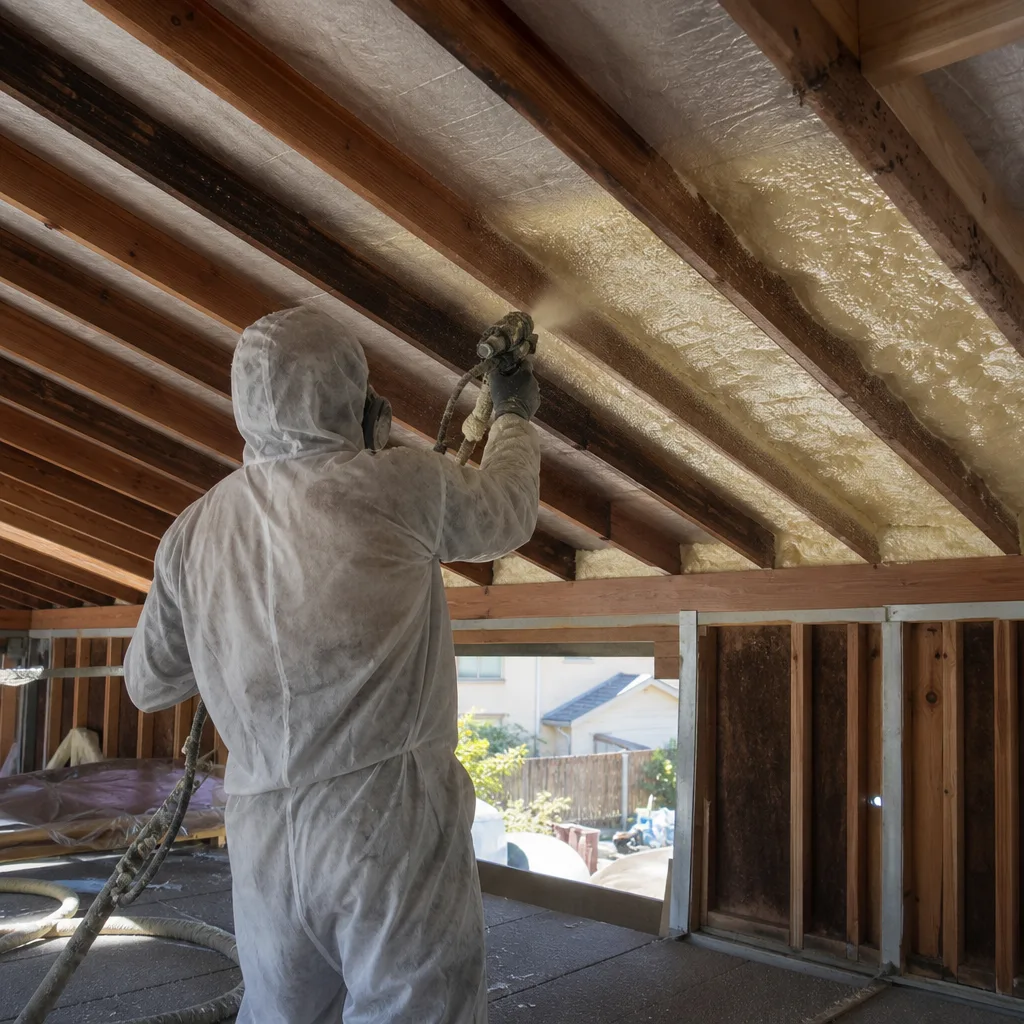
- Open-cell spray foam (Icynene). Expands to fill cavities and acts as an air barrier, which is a major advantage in a Zone 10 attic where air leaks matter as much as R-value. Open-cell foam is best applied to the attic floor or roof deck in vented attics and performs well in Valley temperatures.
- Closed-cell spray foam (Demilec). Higher R-value per inch than open-cell, adds structural rigidity, and acts as a vapor barrier. It’s the premium option for unvented attic conversions or areas where space constraints limit insulation depth. In Van Nuys attics with limited headroom, closed-cell foam delivers more R-value in less space.
- Rigid board. Foam board panels (polyiso or XPS) are often used on attic hatches, knee walls, and exterior sheathing. They handle heat well but require precise cutting and sealing at seams to avoid gaps that compromise performance.
The important point for a Van Nuys homeowner: there is no single “best” material. A 1950s tract home with a vented attic and plenty of headroom may be best served by blown-in cellulose at R-49. A 1970s split-level with a shallow attic and ductwork running through it may need open-cell spray foam to air-seal and insulate in one pass. The material should be selected for the specific attic, not the other way around.
For a deeper look at foam applications, see Spray Foam Insulation in Van Nuys. For loose-fill details, see Blown In Insulation in Van Nuys.
1950s – 1970s Tract Homes: What Changes
Van Nuys grew fast between 1950 and 1975. Thousands of single-family tract homes were built during that window, and most share common insulation weaknesses. If your home dates from this era, here’s what you’re likely dealing with:
- Original insulation is minimal or degraded. Many homes were built with R-11 batts in the attic, or sometimes nothing at all in the walls. Any fiberglass installed in 1965 has settled, compressed, and lost effectiveness over 60 years.
- No air sealing. The concept barely existed when these homes were framed. Attic floors are full of electrical penetrations, plumbing vents, and gaps around the chimney chase that allow air to move freely.
- Single-pane windows and uninsulated doors. These are secondary problems, but they compound the thermal load. Insulation is the first fix. Windows come later.
- Original HVAC ductwork in the attic. Many Valley homes have ducts running through unconditioned attic space. Those ducts may be leaking cooled air into a 140°F attic in summer, which is a direct energy loss that insulation alone won’t fix. Duct sealing and insulation should be part of the attic upgrade conversation.
- Knee walls and cathedral ceilings. Some 1960s and 1970s Van Nuys homes have finished attic spaces or vaulted ceilings that create insulation challenges a simple blown-in application won’t solve. These often require a combination of batt insulation, foam board, or spray foam to address properly.
The good news: these homes are predictable. We’ve seen enough of them to know where the gaps are before we even open the attic hatch. A 1958 ranch house in Van Nuys, a 1963 split-level near Victory Boulevard, a 1972 two-story near Sepulveda Basin, they all follow similar framing patterns. That predictability makes the upgrade straightforward when the contractor understands the original construction.
Tile Roofs, Stucco, and Radiant Heat: Material Selection Logic
Van Nuys housing stock is dominated by two exterior finishes: stucco walls and tile roofs. Both affect how a home absorbs and radiates heat, and both should influence insulation choices.
Clay and concrete tile roofs are excellent thermal mass. They absorb solar radiation all day, then re-radiate that heat into the attic long after the sun goes down. A Van Nuys home with a tile roof can have an attic that stays over 100°F until 10 p.m. in July. This is why radiant barrier strategies and properly vented attics matter more here than in neighborhoods with asphalt shingle roofs.
Stucco over wood frame creates a different problem: thermal bridging. The stucco absorbs heat, and the wood studs in the wall transfer that heat directly into the home through conduction. Wall insulation between studs helps, but it only addresses the cavities. A continuous layer of rigid foam board on the exterior sheathing (or closed-cell spray foam in the wall cavities) would address the bridging, but that’s an expensive retrofit on an existing home. For most Van Nuys homeowners, the practical answer is: maximize attic insulation first, address wall insulation as a secondary improvement, and use window coverings or exterior shading to reduce stucco heat gain.
Material selection logic for tile-roof, stucco-wall Van Nuys homes:
- Attic: blown-in cellulose or fiberglass at R-49, with a radiant barrier if the roof is dark tile and unshaded. The insulation slows conductive heat transfer from attic to ceiling. The radiant barrier reflects a portion of the roof’s longwave radiation back out through the ridge vents.
- Walls: if accessible (during a remodel or re-pipe), dense-pack cellulose or injection foam. For exterior walls that are closed up, the benefit is modest compared to attic upgrades, but it helps with comfort and noise from traffic on major arteries like Van Nuys Boulevard or Sepulveda Boulevard.
- Floors over crawlspaces: R-19 to R-30 batts if the home sits on raised foundation. Many Van Nuys homes have crawlspaces, and the floor is a secondary heat loss path in winter.
We carry Rockwool mineral wool for applications where fire resistance or moisture resistance matters, CertainTeed and Owens Corning fiberglass for standard batt and blown applications, Icynene and Demilec spray foam for air-sealing and high-R-value-per-inch needs, and GreenFiber cellulose for recycled-content attic work. The reason we carry multiple brands across categories is simple: a stucco-and-tile home in Van Nuys has different needs than a wood-siding home in Sherman Oaks. The material should fit the house, not the other way around.
Three Installation Methods and Where Each Makes Sense
Thermal Insulation Co installs insulation three ways: attic batts and blankets, blown-in loose-fill, and spray foam (both open-cell and closed-cell). Each method has a clear role in Van Nuys homes.
1. Attic Batts and Blankets
Fiberglass or mineral wool batts are the traditional approach. They work well in attics with consistent joist spacing and no obstructions. In Van Nuys attics, batts are most appropriate for new construction, attic floor replacement, or areas where the attic will be used for limited storage. The limitation is air sealing: batts don’t stop air movement, so they must be paired with a thorough air-sealing pass to meet Zone 10 expectations.
2. Blown-In Loose-Fill
Blown-in fiberglass or cellulose is the most common retrofit method for existing Van Nuys homes. It’s fast, it fills irregular cavities, and it achieves high R-values at lower cost per square foot than spray foam. We recommend blown-in for standard vented attics where the attic floor is accessible and air sealing can be completed before the loose-fill goes in. GreenFiber cellulose is a strong choice here for homeowners who want a recycled product with better air-slowing properties than fiberglass.
3. Spray Foam (Open-Cell and Closed-Cell)
Spray foam is the most versatile method and the only one that combines insulation and air sealing in a single application. Open-cell Icynene is ideal for attic floors and vented attics where air leaks are the primary issue. Closed-cell Demilec is used for unvented attic conversions, cathedral ceilings, and any application where maximum R-value per inch matters. In a Van Nuys attic with limited headroom or ducts running through the space, spray foam often outperforms loose-fill despite the higher upfront cost.
One of the reasons we carry all three methods is that no single one is right for every home. A contractor who only installs blown-in will tell you blown-in is best. A contractor who only sprays foam will tell you foam is best. The reality: a 1962 tract home in Van Nuys with a vented attic and standard framing is a blown-in job. A 1980s contemporary with a low-pitch roof and vaulted ceilings may need spray foam. The method should be selected for the application.
Common Mistakes to Avoid
- Skipping air sealing before adding insulation. Blowing R-49 over a leaky attic floor in Van Nuys is like putting a heavier blanket over a hole in the roof. The insulation slows some heat transfer, but the air leaks keep pumping hot air into the house. Seal first, then insulate.
- Insulating to “code minimum” without checking your climate zone. Code minimum for a coastal zone is not the same as a Zone 10 Valley home. Ask for the design R-value, not just “code compliant.” In Van Nuys, an R-38 attic is better than nothing, and still underperforming.
- Blocking soffit vents with insulation. Many Valley attics rely on soffit-to-ridge ventilation to stay below 130°F in summer. When loose-fill blocks the soffit vents, attic temperatures climb and the insulation’s job gets harder. Baffles solve this, but they need to be installed before the insulation goes in.
- Ignoring the attic hatch. A 24 by 48 inch attic hatch with no insulation is a hole in the ceiling. It’s tempting to skip, but in a Van Nuys summer, that opening leaks cold air into a 150°F attic every time the AC runs. Insulate and weatherstrip it.
- Choosing material on price alone. The cheapest quote is rarely the best-performing. Blown-in fiberglass at R-30 installed cheaply will still leave the home hot in August. Ask what R-value you’re getting, what air sealing is included, and whether the attic ventilation is being addressed.
- Insulating the walls before the attic. We see this in Van Nuys remodels: the walls get opened for new drywall, insulation goes in, and the attic stays at R-11. The wall insulation helps, but the attic is where the largest heat gain happens. Prioritize the ceiling plane.
- Not accounting for the tile roof thermal mass. Clay and concrete tile hold heat for hours after sunset. If your attic isn’t vented properly or lacks a radiant barrier, the house keeps absorbing heat long after the sun goes down. This is a Van Nuys-specific problem that generic insulation guides miss.
When to Call a Professional
Insulation in Van Nuys is not a DIY weekend project when the attic is involved. Working with blown-in insulation requires specialized equipment and careful air-sealing knowledge. Spray foam requires training, proper ventilation during application, and an understanding of expansion rates and curing times. Attic work in Valley summers is physically demanding, and the risk of stepping through a ceiling or disturbing old wiring is real. If your attic has vermiculite insulation (common in homes built before 1970), that’s a potential asbestos concern that requires professional evaluation before any work is done. If your home has knob-and-tube wiring, insulation must be installed with clearance from the conductors. Thermal Insulation Co offers free estimates in Van Nuys. Call (855) 382-3451 and we’ll inspect the attic, measure the existing insulation, and give you a straight answer on what your home actually needs.
Frequently Asked Questions
Attic insulation in Van Nuys typically ranges from $1.50 to $3.50 per square foot for blown-in fiberglass or cellulose, and $4.00 to $7.00 per square foot for spray foam, depending on the R-value target, air sealing scope, and attic accessibility. Material choice (fiberglass, cellulose, open-cell, or closed-cell foam) moves the price more than any other single factor. Call (855) 382-3451 for a specific quote based on your attic.
Van Nuys sits in ASHRAE Climate Zone 10, which calls for attic insulation at R-38 to R-60 depending on the application. Most existing homes in Van Nuys are significantly below that, often at R-11 to R-19. The exact target depends on your home’s construction, attic ventilation, and whether the attic is vented or unvented.
We schedule free estimates in Van Nuys throughout the week, and depending on the scope of work, installation can often be scheduled within days, not weeks. Larger insulation projects or spray foam applications may require additional lead time. Call (855) 382-3451 to check availability this week.
For Van Nuys homes with leaky attics, ductwork in the attic, or limited space for loose-fill, spray foam delivers measurable benefits: air sealing and insulation in one step, higher R-value per inch, and better performance in a 150°F attic. If your attic is vented, has plenty of headroom, and the air sealing can be done separately, blown-in cellulose or fiberglass will hit the same R-value at a lower cost. The right answer depends on your attic.
Most Van Nuys homes built between 1950 and 1975 still have their original fiberglass batts, and those batts are typically compressed and underperforming. We regularly find R-11 batts in attics where R-49 is the current Zone 10 target. It’s worth measuring before assuming the insulation is adequate.
Most attic insulation projects in Van Nuys take one day for blown-in fiberglass or cellulose, including air sealing and baffle installation. Spray foam applications take one to two days depending on the attic size and whether open-cell or closed-cell is used. Larger homes or those with multiple areas (walls plus attic) may take two to three days.
The Bottom Line
Van Nuys is a high-swing thermal climate that demands more from insulation than coastal Los Angeles. The attic is the first priority and the highest-return upgrade in virtually every home built here before 1980. Material selection should follow the home’s construction: blown-in cellulose or fiberglass for standard vented attics, spray foam for air sealing and tight spaces, mineral wool for fire or moisture resistance applications. Air sealing is not optional. Tile roofs and stucco walls amplify heat gain in ways that generic guides miss. If you’re unsure where to start, get an attic inspection and measure what’s actually there before spending on anything else. Explore more guides & resources on our blog.
Thermal Insulation Co installs attic insulation, blown-in insulation, and spray foam across Van Nuys. We carry products from Owens Corning, Johns Manville, Knauf, Rockwool, CertainTeed, Icynene, Demilec, and GreenFiber because different homes need different materials, and no single brand makes sense for every application. Call (855) 382-3451 for a free estimate and a straight answer on what your home needs. Learn more about Thermal Insulation Co home and our full range of services.
Written by the team at Thermal Insulation Co, serving Van Nuys since 2012.