
Last updated October 30, 2026
Choosing the Right Insulation Brand: A Buyer’s Guide for Van Nuys
Two products both labeled “R-38 blown fiberglass” from different manufacturers can have different installed density requirements, different settling rates, and different fire ratings. The brand name on the bag tells you almost nothing about which one belongs in your attic. What actually matters is the engineering data behind the product, the application method it’s designed for, and whether your contractor can choose between manufacturers rather than being locked into whatever their distributor happens to stock. This guide teaches you how to read the numbers that matter, compare brands honestly, and understand why Thermal Insulation Co home takes a deliberately brand-agnostic approach to insulation selection in Van Nuys.
Quick Answer
The right insulation brand for your Van Nuys home depends on the application: attic, walls, floors, or crawlspace. For blown-in fiberglass in attics, Johns Manville, Knauf, and CertainTeed all produce comparable products when installed to the same settled R-value, and the differences come down to coverage rates and warranty terms. For spray foam, the difference between Icynene and Demilec chemistry matters more than any label difference between fiberglass brands. The smartest choice is a contractor who stocks multiple lines and can specify by performance data, not brand habit.
Table of Contents
- Why Brand Loyalty Rarely Serves the Homeowner
- Comparing the Major Fiberglass Brands
- Why Spray Foam Brand Selection Is Different
- When Mineral Wool Earns Its Price
- How to Read a Product Data Sheet
- Verifying the Product Installed Matches the Product Specified
- What Insulation Brand Choice Means for Your Van Nuys Budget
- Common Mistakes to Avoid
- When to Call a Professional
- Frequently Asked Questions
- The Bottom Line
Why Brand Loyalty Rarely Serves the Homeowner
Most insulation contractors carry one or two product lines because their distributor carries one or two product lines. That’s logistics, not expertise. When a contractor tells you one brand is “the best,” what they often mean is “this is the brand I buy at the best margin and my crew knows how to install it without thinking.”
We stock products from eight manufacturers for a reason: Owens Corning, Johns Manville, Knauf, CertainTeed, Rockwool, Icynene, Demilec, and GreenFiber. Not because all eight are equal in every application, but because all eight have specific products within their lines that are the right tool for specific jobs. Rockwool mineral wool handles fire-rated assemblies and high-moisture areas in ways no fiberglass batt can. GreenFiber cellulose dense-packs into walls where fiberglass struggles to fill irregular cavities. Icynene open-cell spray foam performs differently at ceiling lines than Demilec closed-cell does at rim joists.
In Van Nuys, where summer attic temperatures routinely exceed 140 degrees, the wrong product choice shows up on your electric bill within a month. The right product choice often goes unnoticed, which is exactly what good insulation does. We’d rather spec a mid-tier Knauf product where it performs equivalently to a premium line than charge you for a brand name when the thermal data says it won’t change your comfort or your bills.
That’s the core of this guide: teaching you to evaluate the product inside the bag, not the logo printed on the outside. For a broader look at the topic, see The Complete Guide to Insulation in Van Nuys. Brand matters only to the extent that certain manufacturers specialize in certain product categories. Once you understand what to compare, the brand question mostly answers itself.
Comparing the Major Fiberglass Brands
The Complete Attic Insulation Guide for Van Nuys Homeowners starts with this fact: fiberglass insulation in the attic remains the most common material in Van Nuys homes, and for good reason—it’s proven, affordable, and performs well in our climate when installed to the correct depth and density. The three dominant blown-in fiberglass brands we install, Johns Manville, Knauf, and CertainTeed, all manufacture products that meet ASTM C764 standards. That’s the baseline. What separates them is what you find in the fine print.
Johns Manville Climate Pro is formulated for consistent coverage and carries a limited lifetime warranty when installed by a certified contractor. It performs well in high-temperature attic environments, which matters in Van Nuys where August attic temps can degrade inferior materials over time. The product settles predictably, and the coverage chart on the bag is reliable under real-world installation conditions.
Knauf Insulation Jet Stream is engineered for higher installed density, meaning it resists settling better than some competitors when blown to equivalent R-values. The product also has a lower dust profile during installation, which matters if you’re having work done while living in the home. Knauf’s warranty structure is straightforward: limited lifetime for homeowners, prorated over 20 years for rental properties, which we flag for Van Nuys landlords who are spec’ing insulation for apartment buildings.
CertainTeed InsulSafe differentiates on fire resistance. The product carries a Class 1 fire rating and is manufactured in California, which means it meets the state’s stricter manufacturing environmental standards. For homes in wildfire-adjacent zones around Van Nuys, including parts of the hillside communities, that fire rating is worth noting.
The honest comparison? All three can hit R-38 in a 12-inch blown depth. The difference is in what you need: maximum durability (Knauf), fire performance (CertainTeed), or consistent coverage at scale (Johns Manville). That’s the kind of distinction that matters more than which name is on the bag.
Why Spray Foam Brand Selection Is Different
Spray foam insulation introduces a different comparison entirely. Fiberglass products from competing manufacturers are broadly similar: glass fibers, resin binders, similar thermal performance per inch. Spray foam chemistry varies more between manufacturers because the formulations themselves are proprietary, and the performance difference between an open-cell and closed-cell foam from the same brand is often larger than the difference between two brands of the same cell type.
Take Icynene and Demilec, the two spray foam brands we install for Spray Foam Insulation in Van Nuys projects. Both offer open-cell and closed-cell products, but they’re built around different chemistry and application characteristics.
Icynene open-cell (classic and similar lines) is a light-density, water-blown foam that expands significantly during application, filling irregular cavities in attic rooflines and walls where air sealing is the priority. It’s what we often recommend for Van Nuys homes with complicated roofline geometry, recessed lighting, and multiple penetrations where air leakage drives much of the cooling load. The open-cell structure allows moisture vapor to pass through, which matters in certain ceiling assemblies.
Demilec closed-cell (such as Heatlok HFO) is a higher-density foam that acts as both insulation and a structural air barrier. At roughly R-6.5 to R-7 per inch, it delivers more thermal resistance per inch than open-cell’s R-3.7, along with a Class II vapor retarder. In crawlspace applications or unvented attic designs common in newer Van Nuys construction, closed-cell is often the right spec.
Why does brand matter here more than with fiberglass? Because the foam chemistry affects installation quality directly. A crew trained on one foam system can’t automatically run another at the same quality. The mixing ratios, temperature windows, and spray techniques differ. When we spec Icynene versus Demilec for a Van Nuys project, we’re choosing based on the assembly design, moisture drive, R-value targets, and the home’s ventilation profile, not picking a brand off a shelf.
Open-Cell vs. Closed-Cell: The Van Nuys Decision
- Open-cell (both Icynene and Demilec lines): Best for attic rooflines and interior walls where air sealing is the priority and vapor permeability is acceptable. Lower cost per board foot. R-3.5 to R-3.8 per inch.
- Closed-cell (Demilec Heatlok and similar): Best for crawlspaces, rim joists, and unvented attic assemblies where you need more R-value per inch and a vapor barrier. Higher cost per board foot. R-6.5 to R-7 per inch.
In our experience across Van Nuys homes, the failure point is rarely the foam itself. It’s the specification. Wrong cell type for the assembly, wrong thickness for the climate zone, or an installer who sprays to visual coverage rather than measured depth. Brand choice matters, but only after the cell type and thickness decision is correct.
When Mineral Wool Earns Its Price
Rockwool products occupy a specific niche in Van Nuys that neither fiberglass nor spray foam fills well: fire resistance and moisture tolerance.
Rockwool mineral wool insulation, whether in batt form for walls or rigid boards for exterior applications, is made from basalt rock and recycled slag. It doesn’t burn. It doesn’t absorb water. It doesn’t support mold. Those three properties make it genuinely superior to fiberglass in specific Van Nuys applications, and those properties are why we stock it.
Here’s where we recommend Rockwool in Van Nuys homes:
- Garage-to-habitable-room conversions: Building code requires fire-rated assemblies between garages and living spaces. Rockwool batts meet the fire separation requirements without extra drywall layers, which saves headroom and labor.
- Addition walls on hillside lots: Van Nuys homes on the slopes of the Sepulveda Basin or up toward Sherman Oaks often have drainage and moisture challenges. Rockwool doesn’t wick moisture and retains its R-value even if wet, unlike fiberglass which loses performance when saturated.
- Soundproofing between units: For duplexes and ADUs throughout Van Nuys, Rockwool’s density provides markedly better acoustic performance than standard fiberglass batts. Tenants notice, and so do homeowners sharing walls with a home office.
- Exterior rigid insulation under stucco: Rockwool Comfortboard provides continuous insulation and drainage plane performance that fiberglass simply cannot match in exterior applications.
The pricing honesty: Rockwool costs more than comparable fiberglass batts. In many standard walls, that premium buys you nothing measurable. In the applications above, the premium is the difference between a durable assembly and a future problem.
How to Read a Product Data Sheet
Here’s the skill that separates informed homeowners from easy marks: reading the three numbers on an insulation product data sheet that actually predict performance in Van Nuys. These are on every manufacturer’s published technical data sheet, and every reputable contractor should be able to hand you the sheet for the product they’re quoting.
Step 1: Find the installed R-value at settled density, not the nominal R-value.
Blown-in fiberglass is advertised by nominal R-value: R-38, R-49, whatever. But the actual thermal performance depends on thickness installed and density achieved. The data sheet lists “R-value per inch” and “minimum settled thickness” for each target R-value. If you want R-38, the sheet should tell you the contractor needs to blow 12.4 inches of that specific product to achieve it after settling. If your quote just says “R-38 blown fiberglass” with no thickness specification, the number is a hope, not a commitment.
Step 2: Check the coverage rate (square feet per bag at target R-value).
Coverage rate tells you how many bags of material the job actually requires. A product that covers 64 square feet per bag at R-38 versus one that covers 58 square feet per bag means a 10% difference in material cost, and that difference should show up in your quote. It also clues you into density: higher coverage rates at equal R-value generally mean lower installed density, which means more future settling. For Van Nuys attics where we deal with high summer temperatures constantly cycling the insulation, we lean toward products with slightly higher density and slightly lower stated coverage.
Step 3: Review the warranty terms for your specific application.
Every major manufacturer offers a limited lifetime warranty to the original homeowner for properly installed product. But read the conditions: some warranties are voided by attic conditions common in Van Nuys, like sustained temperatures above a threshold or the presence of certain ventilation configurations. Some warranties transfer to a second owner, some don’t. For Van Nuys landlords, this matters: Knauf’s warranty structure treats rental properties differently from owner-occupied homes. A contractor who knows these distinctions is worth more than a contractor who just says “lifetime warranty.”
If you’re working through a mountain of technical jargon, here’s the shortcut: ask your contractor for the product data sheet and the three numbers above. If they can produce them and explain them, you’re talking to a specialist. If they deflect, that’s information too.
Verifying the Product Installed Matches the Product Specified
This is the step most homeowners skip, and it’s the one that determines whether your research pays off. You can spec the perfect product, but if the crew shows up with a different bag from the warehouse, none of it matters.
Here’s what to check before and during installation:
- Check the bag label before blowing begins. Every blown-in insulation bag must show the manufacturer name, product name, R-value per inch, coverage chart, and the date of manufacture. If the product name doesn’t match what’s on your quote, stop the job. No exceptions on this one, and we tell every Van Nuys homeowner we work with the same thing.
- Verify the coverage chart on the bag matches the square footage installed. Your attic is, say, 1,200 square feet. To achieve R-38, the product’s coverage chart dictates a specific number of bags. Count the bags the crew brings up. If they’re short, they’re either skimping on depth or they’ll be back mid-job, and both scenarios are problems.
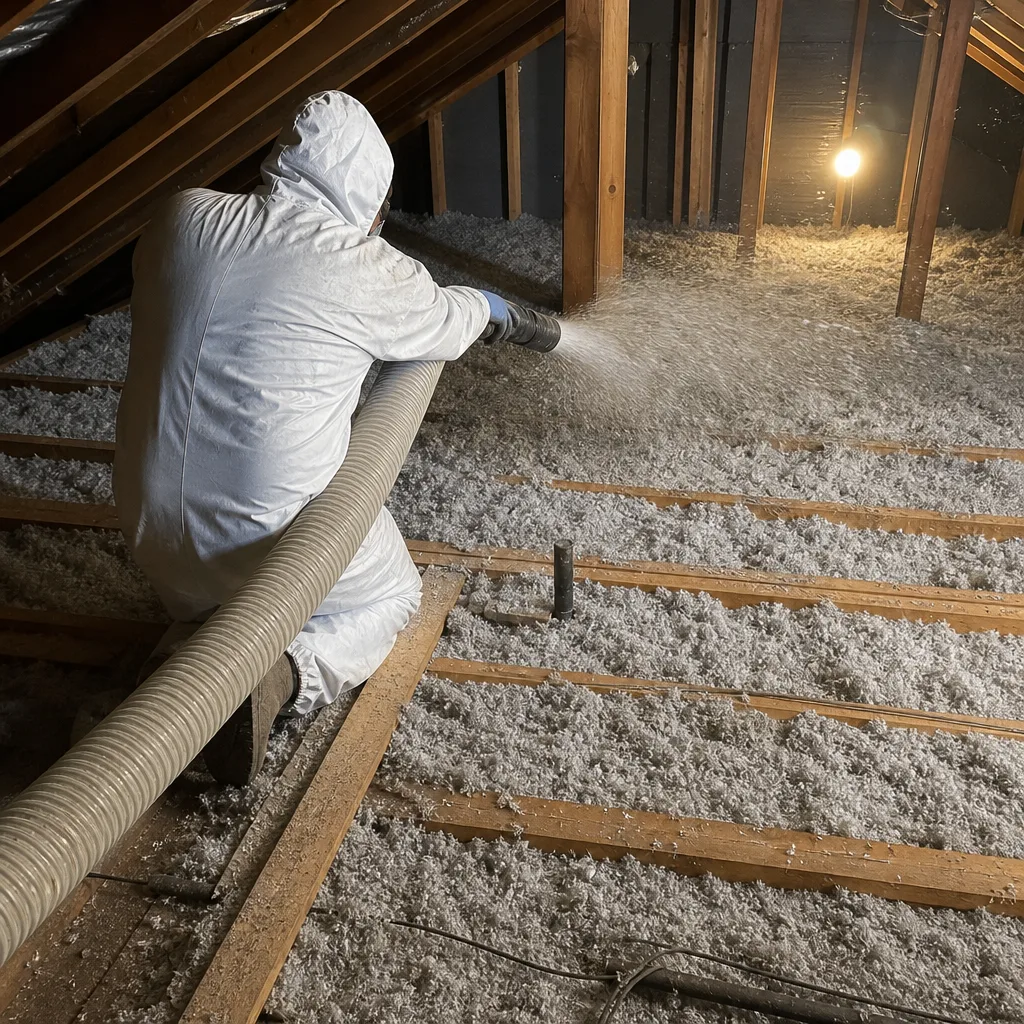
- Insist on depth markers during installation. A competent blown-in insulation crew installs vertical rulers or depth markers throughout the attic before blowing begins. These show exactly how deep the material is being installed everywhere, not just in the easy-to-reach spots. If there are no depth markers, there’s no way to verify even coverage.
- Request documentation for your records. After the job, you should receive a document that specifies: the product name, the number of bags installed, the target R-value, the final settled thickness, and the installation date. This is what you’ll need for warranty claims, for a future home sale, and for any building permit records. The City of Los Angeles Department of Building and Safety, which covers Van Nuys, wants insulation verification on many remodeling permits, and this documentation is what proves compliance.
- Photograph the attic before and after. Not because you don’t trust the crew. Because documentation is cheap insurance and makes future claims or questions easy to resolve. Every reputable insulation contractor welcomes this level of diligence.
For attic batt and spray foam projects, the verification steps differ. Attic Insulation in Van Nuys using batts should include visible product labels still attached to the facing. Spray foam jobs should include documentation of the foam type, thickness applied, and coverage area. If your insulation contractor won’t provide documentation, find one who will.
What Insulation Brand Choice Means for Your Van Nuys Budget
Brand selection does affect cost, but not the way most homeowners assume. The most expensive product on our roster isn’t the one with the best marketing. It’s the one whose chemistry and performance justify the price in a specific application.
Here’s the realistic breakdown for Van Nuys homes as of 2025:
- Blown-in fiberglass (attic): $1.80 to $3.20 per square foot installed, depending on target R-value, attic accessibility, and existing insulation removal. Brand differences (Johns Manville, Knauf, CertainTeed) shift this by maybe 5-8% in either direction. The real cost driver is depth, not brand.
- Mineral wool batts (walls, ceilings): $2.50 to $4.50 per square foot installed. Rockwool runs higher than fiberglass batts, but in fire-rated or moisture-prone assemblies, the alternative is additional drywall layers or drainage plane remediation, which costs far more.
- Open-cell spray foam (attic roofline): $2.00 to $3.50 per board foot installed. Icynene open-cell and Demilec open-cell run in the same range for comparable applications in Van Nuys.
- Closed-cell spray foam (crawlspace, rim joist): $3.50 to $5.50 per board foot installed. Demilec closed-cell products dominate this range, and the per-board-foot price reflects both the chemistry and the specialized application.
The brand lesson embedded in these numbers: for blown-in fiberglass, brand loyalty costs you almost nothing but buys you almost nothing. For foam and mineral wool, brand selection tracks closely with suitability for the application. The honest strategy is to let the home’s requirements drive the material choice, then pick the brand that delivers the right performance data at the most reasonable price point.
One more Van Nuys-specific consideration: older homes in neighborhoods like Valley Glen and Lake Balboa built before 1980 often have original insulation that’s settled, compacted, and thermally irrelevant. In those cases, the brand discussion matters less than the removal and air-sealing work that precedes it. A good contractor will tell you when the biggest win isn’t in the bag, but in the prep work the bag hides.
Common Mistakes to Avoid
- Choosing a brand before choosing an application. Picking “Owens Corning” or “Johns Manville” as your brand of choice before you know whether you need blown-in, batts, or foam is like choosing a tire brand before you know what vehicle you’re buying. Start with the area of the home, the R-value target, and the installation method.
- Comparing quotes by brand name alone. Three Van Nuys contractors can quote you “R-38 attic insulation” using three different products at three different depths. If the quotes don’t specify product name, bag count, and installed thickness, they aren’t comparable.
- Assuming higher R-value automatically means better comfort. R-value matters, but air sealing often matters more in Van Nuys homes where duct leakage and attic bypasses drive cooling costs in summer. A well-sealed R-30 attic can outperform a leaky R-49 attic.
- Ignoring the warranty fine print. Limited lifetime warranties sound similar across brands. They aren’t. Check transferability, attic temperature exclusions, and whether rental property applications are covered differently.
- Skipping the documentation step. If you don’t receive a written record of what was installed, you’ve bought a story instead of an insulation system. When you sell the home, the buyer will want that documentation, and so will the City of Los Angeles if permits are involved.
- Using spray foam in the wrong assembly without understanding moisture implications. Closed-cell foam in the wrong attic configuration can trap moisture and create problems that didn’t exist before. This is a specification decision that needs to be made by someone who understands building science, not by brand loyalty.
- Treating insulation as a DIY weekend project. Blown In Insulation in Van Nuys requires calibrated blowing equipment and knowledge of attic ventilation, air sealing, and electrical hazards. The home center rental machine and a Saturday afternoon don’t produce the same result as a trained crew with the right product and documentation.
When to Call a Professional
Insulation is a building science discipline, not a retail product category. You should bring in a specialist when your attic has existing insulation that needs assessment or removal, when you’re dealing with unvented attic configurations that require spray foam specification, when building permits are involved, when you suspect air sealing is a bigger issue than insulation depth, and when you need warranty documentation that a product manufacturer will actually honor.
In Van Nuys specifically, the combination of extreme summer attic temperatures, older housing stock in neighborhoods from Valley Glen to Lake Balboa, and the City of Los Angeles building code requirements makes professional insulation work a different animal than what YouTube videos suggest. Thermal Insulation Co offers free estimates in Van Nuys, call (855) 382-3451. We’ll show you the product data sheets, explain the three numbers that matter, and tell you honestly which brand and method makes sense for your home, even if that answer is “your insulation is fine.”
Frequently Asked Questions
There is no single best brand for Van Nuys attics. Johns Manville, Knauf, and CertainTeed all manufacture blown-in fiberglass products that perform similarly when installed to the same settled R-value. The product choice should be driven by attic condition, air sealing needs, and warranty terms, not brand name.
Spray foam is worth the cost when the application demands air sealing and higher R-value per inch than fiberglass can deliver, such as unvented attic rooflines and rim joists. It’s not automatically better than fiberglass in standard vented attics, where the cost difference often isn’t justified by the performance gain.
Blown-in fiberglass attic insulation in Van Nuys typically runs $1.80 to $3.20 per square foot installed depending on target R-value and attic condition. Brand differences account for only a small fraction of that range. Spray foam and mineral wool run substantially higher per square foot. Call (855) 382-3451 for a precise quote based on your attic’s square footage and current insulation state.
Look for installed R-value at settled density, coverage rate in square feet per bag at your target R-value, and the warranty terms for your specific application. These three numbers predict real-world performance far better than marketing language or brand recognition.
Documentation of a properly installed insulation system affects resale value more than any specific brand. Buyers and inspectors care about R-value achieved, air sealing performed, and warranties in place. A documented R-38 attic with Johns Manville product sells as well as a documented R-38 attic with CertainTeed product.
You can, but as we cover in DIY vs Professional Insulation: The Van Nuys Homeowner’s Decision Guide, the result usually falls short of what a specialist with calibrated equipment and manufacturer training achieves. The deeper issue is verification: without proper depth markers, bag counts, and documentation, you may not know what R-value you actually installed, and no manufacturer will honor a warranty on a DIY installation.
The Bottom Line
Insulation brand selection in Van Nuys is a contractor convenience masquerading as a homeowner decision. What actually determines whether your home gets comfortable and your energy bills drop is the product specification, the installation quality, and the documentation. A contractor with access to eight product lines can tell you when a mid-tier fiberglass product performs identically to a premium one and when spending more on Rockwool or closed-cell foam is genuinely warranted. That’s the difference between buying a brand name and buying building performance. If your insulation contractor can’t show you the data sheets and explain the three numbers that matter, you’re not comparing brands. You’re comparing sales pitches. For more guides & resources on making informed insulation decisions, explore our blog.
Written by the team at Thermal Insulation Co, serving Van Nuys since 2012.