
Fast, Reliable Spray Foam Insulation Across Rancho Mirage
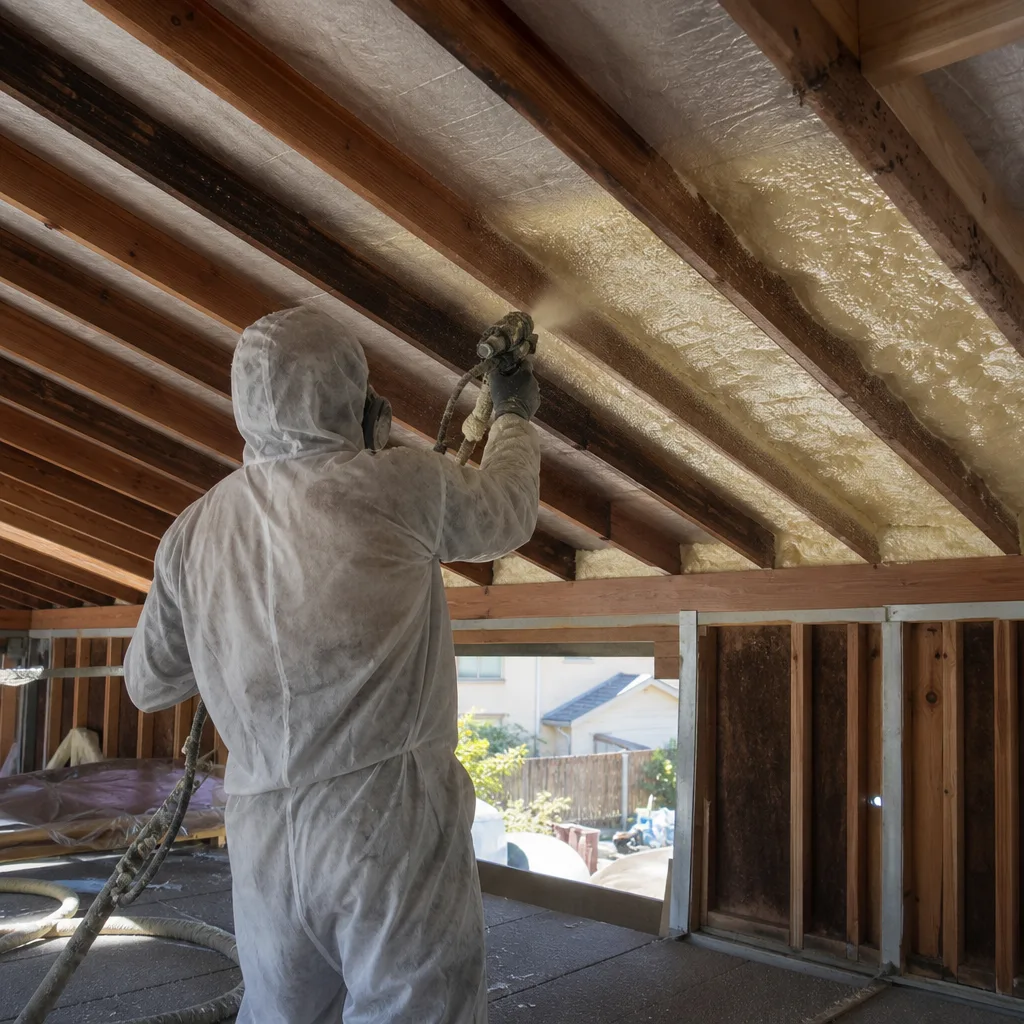
Spray foam insulation in Rancho Mirage addresses one specific problem above all: attics that bake under Coachella Valley sun. Most homes here were built between the late 1970s and early 2000s, and their shallow-pitch roofs leave attics too tight, too hot, and too crowded with ductwork for fiberglass to hold up. Creep attic temperatures past 140°F in July and standard batt insulation simply collapses. We install open-cell and closed-cell spray foam systems from Icynene and Demilec, matched to how your specific attic was built. If your upstairs rooms won’t hold temperature during a Rancho Mirage summer afternoon, call (855) 382-3451. We’ll assess what’s happening above your ceiling and tell you honestly whether spray foam is the right fix.
Why Thermal Insulation Co Is Rancho Mirage’s Preferred Spray Foam Insulation Company
Our Spray Foam Insulation team works steadily across Rancho Mirage, from the gated enclaves off Bob Hope Drive up through Mission Hills and Thunderbird Heights. Homeowners here don’t call us for a commodity insulation job. They call because a room won’t cool, a utility bill climbed, or a duct system baked brittle in an unconditioned attic. Ruben Castellano leads every assessment with the same starting point: we measure the attic before we quote anything. That’s how we know whether closed-cell Demilec foam against the roof deck will outperform open-cell, or whether the real problem is radiant heat through a shallow-pitch roof that spray foam alone can’t solve. Our advice is method-matched to the home, not to a product we need to move. Local work means we know the roof styles, the HOA constraints in communities like The Springs, and how Coachella Valley summers punish under-insulated attic assemblies.
Spray Foam Insulation Contractors in Rancho Mirage
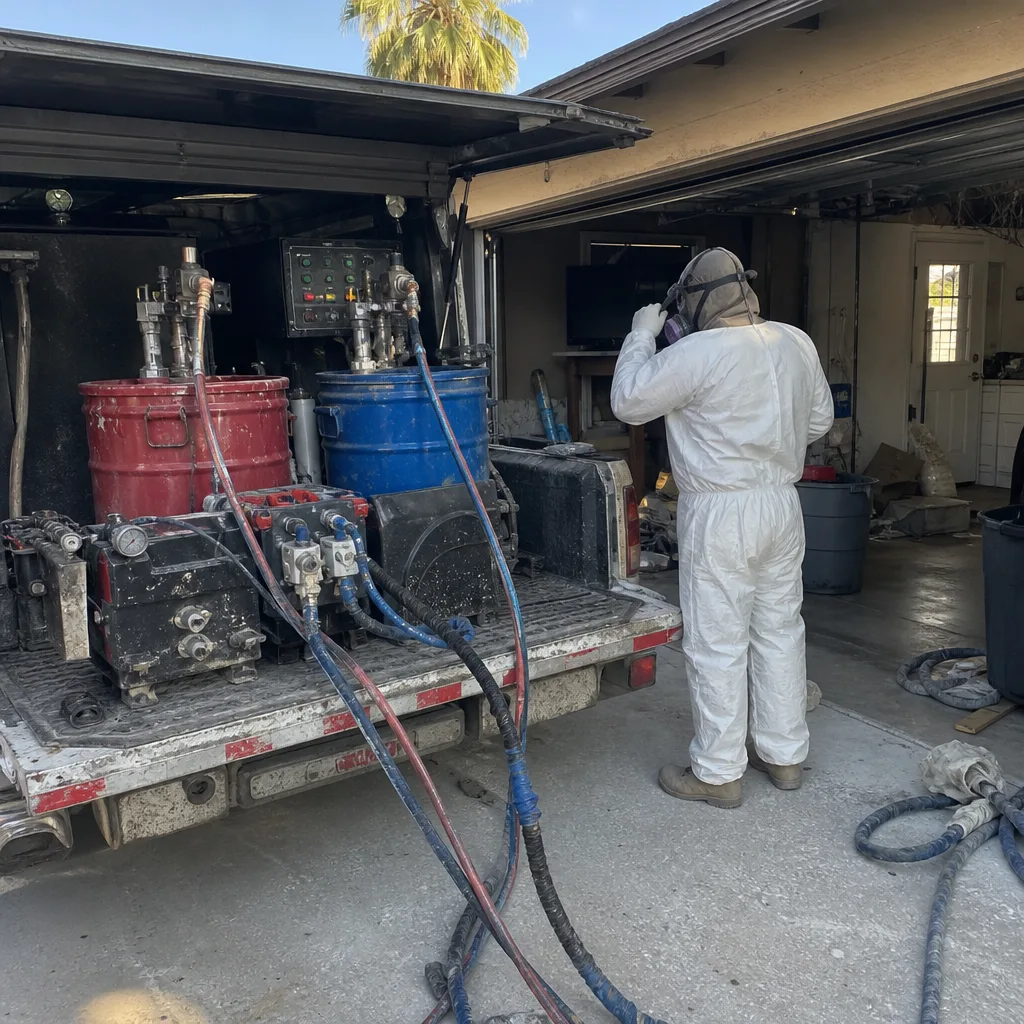
Spray foam insulation contractors in Rancho Mirage do a fundamentally different job than contractors working 15 miles west or north. The low-slope and flat roof profiles here create attic cavities that are three to four feet at the ridge, sometimes less, and packed with duct runs. A standard pitched-roof attic in Palm Desert lets a crew move freely. In Rancho Mirage, we’re often applying foam in controlled passes through access hatches or roof jacks, sealing around ductwork as we go because the flex duct is frequently original and degrading. That access constraint dictates both product choice and application sequence.
Open- and Closed-Cell Selection for Tight Attics
In a low-clearance attic above a 1980s Mediterranean home, open-cell Icynene often makes more sense for the first pass: it expands to fill irregular cavities and seals penetrations without the rigidity of closed-cell. But when we’re bonding directly to a roof deck that will spend six months absorbing direct sun, closed-cell Demilec adds a structural and vapor control factor open-cell cannot. We’ll explain which one fits your roof assembly before we spray anything.
Encapsulation Before Insulation
Rancho Mirage attics regularly contain flex duct that has baked to the consistency of a potato chip. Encapsulating that duct under closed-cell foam can trap heat and hide leaks. We inspect duct condition first. In many homes we recommend duct replacement or sealing before the foam goes in, because no insulation strategy recovers performance from failed air distribution.
Spray Foam Attic Insulation in Rancho Mirage
Spray foam attic insulation in Rancho Mirage typically runs $2.00 to $4.50 per square foot of applied area depending on foam type, attic access, and roof geometry. A 1,500 square foot shallow-pitch attic might land between $3,000 and $6,800 for closed-cell at the roof deck. This is not the insulation approach for a home that just needs a top-up over existing batts. It’s the approach for attics where heat gain through the roof drives cooling loads all summer and where ductwork sits in that superheated air. Rancho Mirage homes with flat or low-slope roofs have far less attic volume than homes in Cathedral City, so you’re not paying to condition dead space. You’re paying to seal the thermal boundary at the roof deck itself.
Duct-Aware Application in Low Attics
We won’t spray foam over failing duct insulation. The foam’s air-sealing power works against you if it traps 140°F attic air around a leaky duct boot. Our crews map duct runs first, seal or replace deteriorated sections, then apply foam in lifts. This sequence matters in Rancho Mirage, where original flex duct from the 1990s is often disintegrating well before the insulation loses its R-value.
Radiant Heat Control as Part of the Package
A shallow-pitch Rancho Mirage roof absorbs sun from 6 a.m. to nearly 7 p.m. in June. Closed-cell foam slows conductive heat transfer, but radiant heat gain through the roof deck still loads the attic space. Where roof geometry allows, we pair foam with a radiant barrier on the underside of the deck. Where it doesn’t, we’ll be straight with you about what foam can accomplish alone.
In the Mission Hills East community off Frank Sinatra Drive, we opened a low-clearance attic above a 1990s Mediterranean home to find original flex duct disintegrating and fiberglass batts collapsed under 140°F heat. After removing the failed ductwork, we sprayed two inches of Icynene closed-cell foam directly to the roof deck and sealed all penetrations, then re-insulated the new ducts with Owens Corning duct wrap. The homeowner reported the upstairs bonus room finally held 78°F during a 115°F afternoon.
Trusted Brands We Service in Rancho Mirage
We carry Icynene and Demilec spray foam systems because they cover different performance requirements, and because we’ve seen both perform across hundreds of Coachella Valley attics. For homes where spray foam is not the right call, we also work with Owens Corning, Johns Manville, and GreenFiber cellulose. Having those options under one roof means an honest recommendation isn’t constrained by our inventory. A 1980s Rancho Mirage home with a vented attic might be better served by blown-in GreenFiber plus air sealing. A flat-roof addition with no attic at all likely needs closed-cell Demilec. We’ll tell you which, and why. Rancho Mirage homeowners get the same access to every brand and method because the right answer depends on the roof above you, not on what a contractor happens to stock.
Common Spray Foam Insulation Problems We See in Rancho Mirage Homes
- Foam sprayed over brittle, disintegrating flex duct in tight flat-roof attics. This traps heat, hides duct leaks, and makes cooling performance worse. We see this in roughly a third of Rancho Mirage attics that already have spray foam from previous work.
- Improperly ventilated low-slope attics causing foam to off-gas and blister. When attic temperatures push past 140°F during July heat waves, moisture trapped in the foam layer expands. In shallow-pitch roofs, ventilation design has to be considered before application.
- Spray foam alone without any radiant heat control on shallow-pitch roofs. Closed-cell foam slows conductive gain, but doesn’t stop radiant gain through a roof deck that bakes in direct sun. We often find attics insulated with foam that still hit 120°F by noon because nothing addresses the radiant load.
- Foam applied in a single thick lift that cures unevenly in low-clearance attics. Tight spaces make hose control difficult. We apply in multiple thin passes. A one-pass job in a three-foot attic will cure with voids and weak adhesion points.
Pricing for Spray Foam Insulation in Rancho Mirage, CA
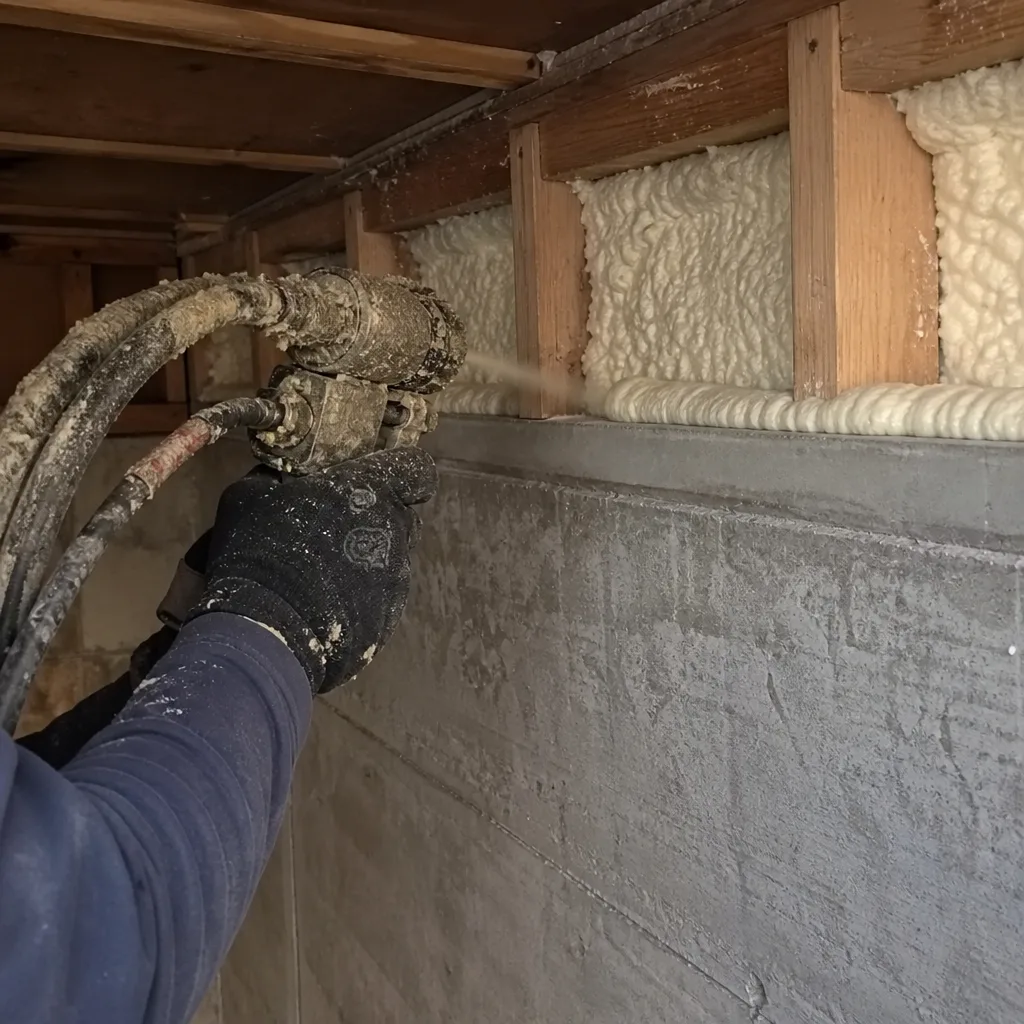
Real numbers for the Rancho Mirage market, as of this year: open-cell spray foam runs $1.50 to $2.50 per board foot installed, and closed-cell runs $2.50 to $4.50 per board foot. In a 1,800 square foot Rancho Mirage home with a sealed attic application, that translates to $4,500 to $11,000 total for a full roof deck encapsulation. Rim joist work in a crawlspace or garage lid runs $900 to $2,200 depending on linear footage. Access constraints in flat-roof attics can add 10 to 20 percent compared to a standard pitched attic. These ranges reflect what we quote across the 92270 ZIP code. Every job starts with a free attic inspection and a written estimate. Call (855) 382-3451 and we’ll give you a number grounded in your roof, not a range pulled from a national database.
We Also Serve Cities Near Rancho Mirage
Beyond Rancho Mirage, our spray foam crews cover the surrounding Coachella Valley communities including Cathedral City, Palm Desert, Thousand Palms, and Indian Wells. Homes in those cities tend to have more conventional pitched roofs, which changes access and material recommendations. If you’re in a neighboring city and comparing approaches, our Rancho Mirage service standard applies across the valley. If you live in Rancho Mirage, we focus here first.
Serving Rancho Mirage, CA — Our Local Coverage Area
We’re based in the Rancho Mirage area and know this community well. Use the map below to see our service coverage — if you’re nearby, we can almost certainly help.
FAQs About Spray Foam Insulation in Rancho Mirage
No, spray foam cannot fix failed ductwork by itself. Spray foam seals the attic and slows heat transfer, but if your flex duct is brittle, collapsed, or leaking, foam applied over it traps heat and hides the real problem. In Rancho Mirage specifically, we regularly see attics where foam was applied over disintegrating ducts and the upstairs rooms got warmer, not cooler. The correct sequence in flat-roof attics is to replace or seal ducts first, then apply foam. If you’re not sure what condition your ducts are in, call (855) 382-3451 and we’ll inspect before we quote.
Spray foam outperforms fiberglass in Rancho Mirage summers in two ways: air sealing and resistance to heat-driven settling. Fiberglass batts lose R-value when attic temperatures climb because air moves through them, and they collapse under their own weight over decades of heat exposure. Closed-cell spray foam creates an air barrier and holds its R-value in 140°F+ attic conditions. But the performance gap narrows if the attic is improperly ventilated or if radiant heat through a shallow-pitch roof is not addressed. In Rancho Mirage’s climate, spray foam is generally the stronger choice for sealed attics, while blown-in fiberglass can work in vented attics with enough depth.
For a 1980s Rancho Mirage home with a shallow-pitch roof, the right approach usually starts with a duct inspection and attic access assessment. If the attic is packed with original flex duct and has less than four feet of clearance, we typically recommend closed-cell foam at the roof deck with the ducts removed first and replaced. If roof geometry is too tight for deck application, we may recommend an unvented assembly using open-cell foam plus a radiant barrier. The 1980s construction era in Rancho Mirage is when many homes received their first AC systems and minimal attic insulation, so you’re often dealing with both duct condition and thermal boundary issues in the same cavity.
Yes, in most Rancho Mirage attics old insulation must be removed before spray foam is applied, especially if you’re converting to a sealed or unvented attic. Old fiberglass batts in flat-roof attics are often compressed, contaminated with rodent activity, or baked brittle after 30 years of desert heat. Leaving them in place under foam creates a moisture trap and prevents the foam from bonding to the roof deck. We remove old insulation, assess the deck and ducts, and then apply foam. This adds cost and time, but skipping it is the single biggest cause of failed spray foam jobs in Rancho Mirage.
Spray foam handles Rancho Mirage’s day-night temperature swings far better than fiberglass because the air barrier prevents hot daytime air from migrating into the house and cool nighttime air from escaping. The material’s thermal mass and continuous seal means the attic assembly responds more slowly to outside temperature changes, which keeps the home’s interior temperature more stable. In shallow-pitch roofs, this is especially noticeable at sunset when radiant gain from the roof deck finally stops but the attic has already absorbed heat. A properly sealed foam assembly releases that heat more slowly, and the air conditioning load stays lower through the evening. For an exact recommendation on your roof’s pitch and orientation, call (855) 382-3451.
Written by Ruben Castellano, Owner at Thermal Insulation Co, serving Rancho Mirage and the Coachella Valley with insulation expertise across attic, spray foam, and blown-in applications.