
Fast, Reliable Spray Foam Insulation Across March Air Force Base
Spray foam insulation in March Air Force Base typically costs $2.50 to $6.50 per square foot installed, with attic applications in the 92551 area running $3,800 to $9,200 depending on square footage and foam type. The semi-arid Inland Empire climate, with summer days regularly pushing past 95°F, makes closed-cell foam a strong fit for most homes here. We’re a dedicated insulation contractor based in Van Nuys, but we know the March Air Force Base housing stock well, from the 1950s-era military quarters to the 2000s stucco infill along the March corridor. Call (855) 382-3451 for an estimate specific to your square footage and insulation goals.
Why Thermal Insulation Co Is March Air Force Base’s Preferred Spray Foam Insulation Company
We don’t carry one brand of spray foam. We carry two: Icynene and Demilec, covering both open-cell and closed-cell applications. That matters in March Air Force Base because the right foam for a 1960s military-family quarter with minimal original insulation is often different from what a 2005 stucco tract home needs. We’re also one of the few insulation companies serving 92551 that can install fiberglass, mineral wool, blown-in, and spray foam under one roof, so the recommendation you get is driven by your home’s construction, not by what we happen to stock.
Ruben Castellano leads our team, and his approach is simple: we explain what each material actually does for your home before we quote it. That’s why homeowners near Graeber Street, Alessandro Boulevard, and the neighborhoods just outside the base gates call us when they’re tired of rooms that never cool down in July. We schedule DoD pass coordination for base housing work, and we’re familiar with the compressed attic insulation left behind by decades of base-mandated pest-control work. That local knowledge keeps our estimates accurate and our work on schedule.
We respond to March Air Force Base service calls on a timeline that respects the Inland Empire heat. When your attic hits 130°F in August, you don’t want to wait three weeks for an estimate. Call (855) 382-3451 and we’ll get you an appointment quickly.
Spray Foam Attic Insulation in March Air Force Base
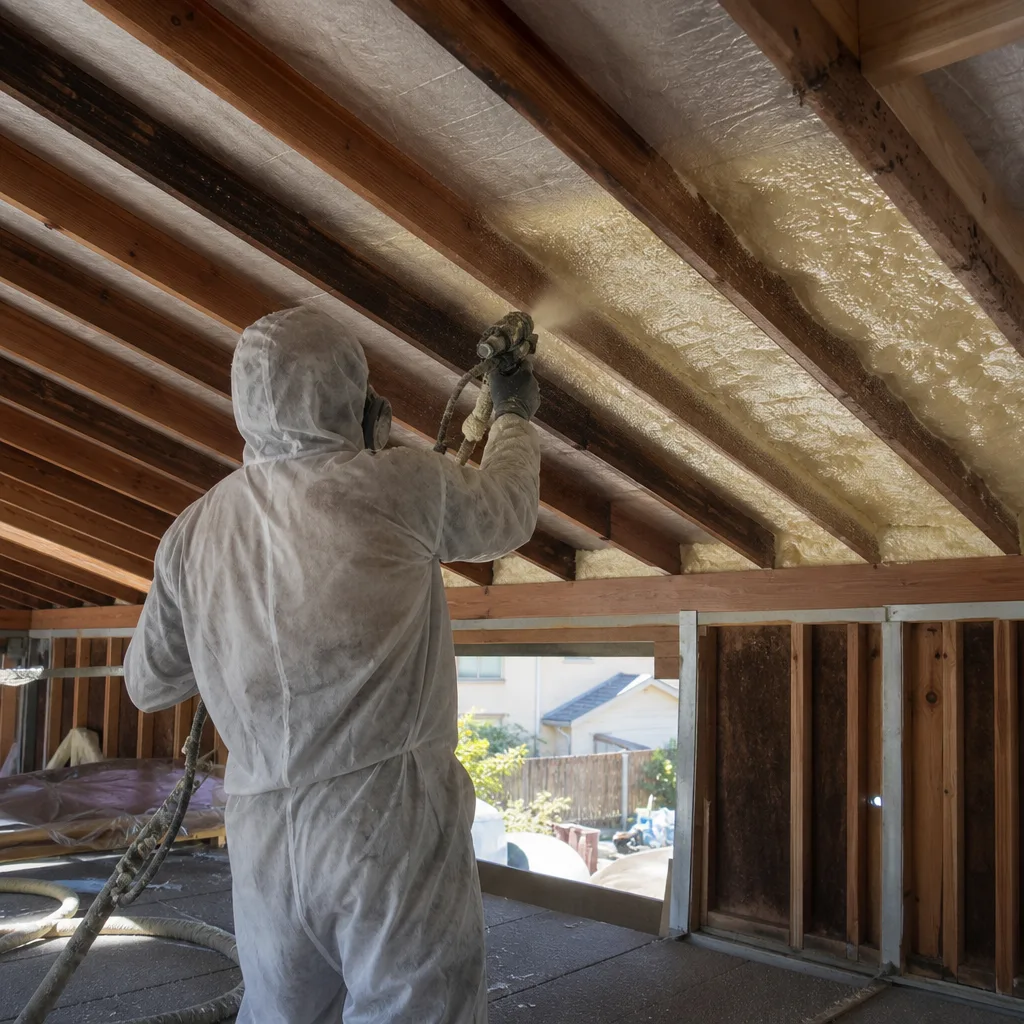
Spray Foam Attic Insulation in March Air Force Base is the single most effective upgrade for homes in the 92551 area because the attic is where cooling loss hits hardest during those long 95°F+ summer stretches. In most mid-century military housing and post-war tract homes here, the original fiberglass batts are thin, compressed, or disturbed, and heat pours through the attic floor into living space all afternoon. Closed-cell foam applied to the attic floor or roof deck stops that heat at the source. We see uniform tract-style construction across the older base housing, which means we can estimate your job accurately before we even walk the property.
Attic Floor Air-Sealing
For most March Air Force Base homes with a vented attic, we spray closed-cell foam directly on the attic floor after removing old, compressed insulation. This seals air leaks around electrical penetrations, recessed lights, and duct chases while adding R-value. In homes where HVAC retrofits have left the attic floor swiss-cheesed with gaps, this is the highest-impact fix we offer.
Unvented Roof Deck Applications
Some March Air Force Base homeowners use the attic for storage or have HVAC equipment and ducts in the attic. For these homes, spraying the roof deck with closed-cell foam keeps the entire attic within the conditioned envelope. That’s a big deal when your air handler sits in a 130°F attic, fighting its own supply air. The roof deck approach costs more upfront, but it removes the attic from the thermal equation entirely.
Expect to pay between $3,800 and $9,200 for a typical attic job in March Air Force Base, depending on whether we’re doing the floor, the roof deck, or both. The homes here don’t need the thicker vapor barriers common in coastal districts, but substrate prep is where a lot of mid-century military housing jobs go wrong, and that’s where our local experience pays off.
Spray Foam Wall Insulation in March Air Force Base
Spray Foam Wall Insulation in March Air Force Base addresses one of the most consistent problems in 1950s-1970s base housing: walls with minimal insulation, sometimes nothing more than a thin batt or empty cavities. When those walls face the afternoon Inland Empire sun, the inside surface heats up and rooms never really cool down, no matter how hard the AC runs. Spray foam fills the entire cavity, air-seals every gap, and adds structural rigidity to framing that’s been settling for 50 or 60 years. For the 2000s stucco tract homes in the March corridor with standard R-13 walls, closed-cell foam in exterior walls is a meaningful upgrade over the original fiberglass.
Existing Wall Cavity Injection
We can inject open-cell or closed-cell foam into existing walls without full drywall removal, which matters in March Air Force Base where many homeowners want the performance upgrade without a gut remodel. We drill small access points, inject the foam, and patch cleanly. The result is a wall that stops air movement and holds temperature far better than the original construction.
New Construction and Remodel Framing
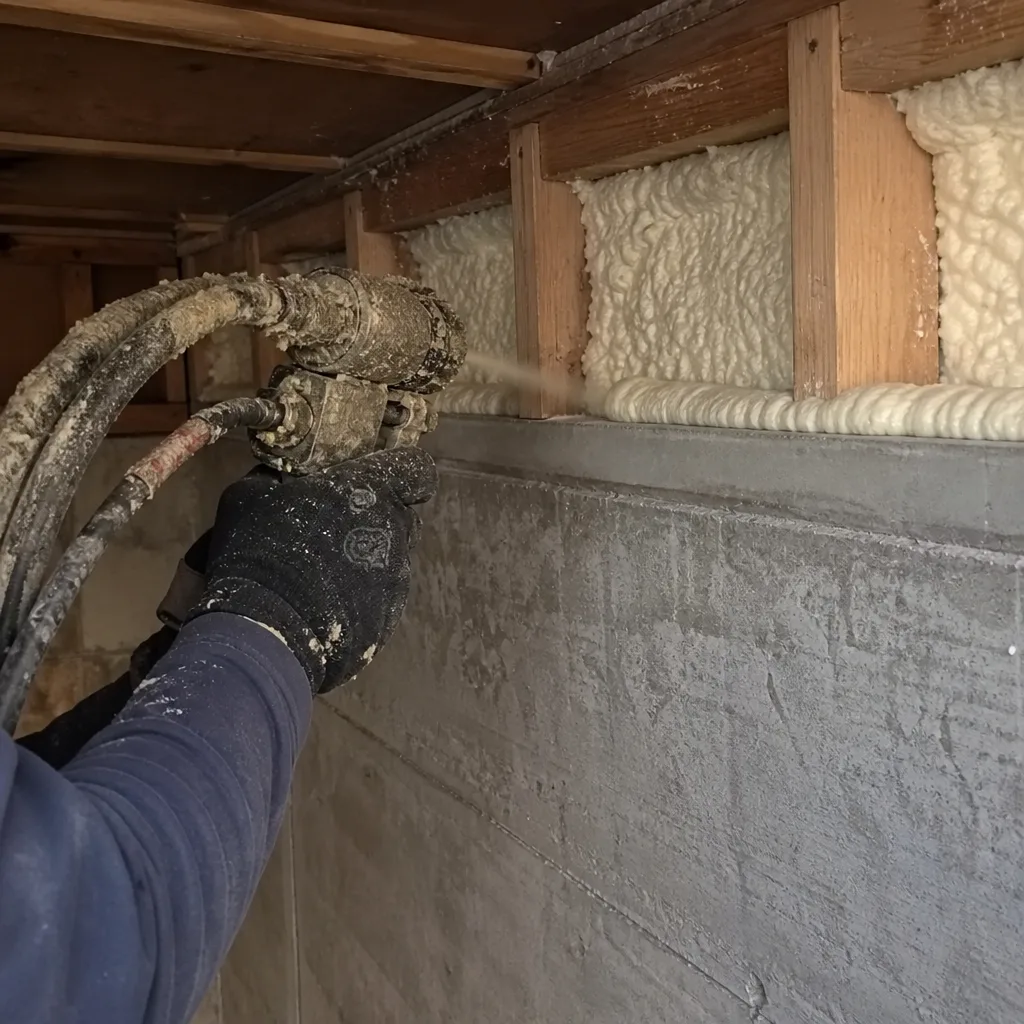
If you’re redeveloping one of the older military-family quarters or adding onto a post-war tract home, we spray foam directly onto exposed studs before drywall. This gives a continuous air barrier and fills every irregular cavity, which is something a batt simply cannot do in a 1960s framing layout that was never perfectly square. Closed-cell foam also adds shear strength, which matters when we’re working on older structures near the base.
Wall insulation in March Air Force Base runs $3 to $7 per square foot of wall area for existing cavity injection, and $2 to $4.50 per square foot for open-stud work in new construction or remodels. We’ll give you an exact number after a site visit.
Trusted Brands We Service in March Air Force Base
We install Icynene and Demilec spray foam because both have proven open-cell and closed-cell formulations that hold up to Inland Empire thermal cycling. That’s the starting point. We also stock Owens Corning and Johns Manville fiberglass for projects where spray foam isn’t the right call, and GreenFiber cellulose for homeowners who want a recycled-content blow-in option. Carrying multiple brands across multiple material categories means we don’t have to force a foam solution when a different material makes more sense. For March Air Force Base homeowners, that’s the difference between a contractor who sells one product and a contractor who actually solves insulation problems.
Common Spray Foam Insulation Problems We See in March Air Force Base Homes
- Foam delamination from attic sheathing: The semi-arid Inland Empire cycles between 95°F+ summer days and cool winter nights, which makes roof sheathing expand and contract significantly. Foam applied over dusty or improperly prepped sheathing, especially when old batts were left in place, can delaminate. We remove old insulation and clean the substrate before spraying, which prevents this failure mode that’s common in older March Air Force Base homes.
- Compressed insulation from decades of pest-control and HVAC work: Base housing and base-adjacent homes in 92551 have often had pest-control treatments and HVAC retrofits that tore up, compressed, or scattered the original fiberglass. That leaves uneven coverage and big thermal bypass paths. We’ve seen attic floors in 1960s military-family quarters where half the insulation was pushed into one corner.
- Adhesion failures over original fiberglass batts: We’ve seen foam applied over old batts in mid-century homes near the base, and it doesn’t bond properly. The foam skins over the fiberglass, then lifts and off-gasses. In the dry March AFB climate, vapor barrier concerns are less critical, but substrate prep is not optional. Removing old material first is the standard we hold to.
- Unsealed rim joists in post-war tract homes: Many of the older homes in the March corridor have unsealed rim joists that leak air into the crawlspace or basement. Spray foam rim joist sealing is a quick fix that pays for itself in the first summer. We recommend it on nearly every older home we assess in this area.
Pricing for Spray Foam Insulation in March Air Force Base, CA
Open-cell spray foam in March Air Force Base runs $2.50 to $4.50 per square foot installed. Closed-cell runs $4 to $6.50 per square foot because it uses more material and delivers a higher R-value per inch, plus a moisture barrier and added structural strength. A full attic floor in a 1,200 square foot mid-century military home typically lands between $4,000 and $7,500. Wall cavity injection for an average 1,500 square foot home falls in the $5,000 to $10,500 range. What moves the number is square footage, foam type, accessibility, and how much old insulation has to be removed first. Call (855) 382-3451 for a free on-site estimate and we’ll give you a written number, not a vague range.
We Also Serve Cities Near March Air Force Base
Our Spray Foam Insulation crew handles jobs throughout the March corridor and the surrounding Inland Empire. If you’re in Moreno Valley, Woodcrest, Perris, or Good Hope, the same team and the same eight-brand material range applies. See our Spray Foam Insulation in March Air Force Base page for details on base-specific scheduling, or call directly for an estimate in any of these neighboring communities.
Serving March Air Force Base, CA — Our Local Coverage Area
We’re based in the March Air Force Base area and know this community well. Use the map below to see our service coverage — if you’re nearby, we can almost certainly help.
FAQs About Spray Foam Insulation in March Air Force Base
Spray foam air-seals and insulates in one step, which stops hot attic air from leaking into your living space during the 95°F+ afternoons common at March Air Force Base. Closed-cell foam in the attic floor or roof deck cuts cooling load immediately, and it keeps conditioned air from escaping through the ceiling plane. Most homeowners here notice the difference in the first full summer after installation. Call (855) 382-3451 to talk through your home’s specific heat gain patterns.
Yes, spray foam work inside March Air Force Base housing requires DoD pass coordination for our crew and vehicles, and we handle that entire process for you. We schedule the required passes in advance so the job doesn’t stall. If you live off-base in the surrounding 92551 neighborhoods, no special access is needed at all.
Spray foam fills the irregular wall and attic cavities of mid-century military construction completely, and it air-seals every gap, which fiberglass batts cannot do. In these 1950s-1970s homes, the original batts were thin, inconsistently installed, and often disturbed by pest-control or HVAC work. Closed-cell foam also adds structural rigidity to older framing, which matters when the house has been settling for 50 or 60 years.
We install Icynene and Demilec spray foam, in both open-cell and closed-cell formulations. Icynene is our default for attic floor air-sealing and wall cavity injection; Demilec comes into play for roof deck applications and projects where a specific closed-cell density or R-value target is required. Both manufacturers have products that perform well in the Inland Empire’s temperature swings. We’ll recommend the right formulation for your job after a site assessment.
Yes, March Air Force Base’s semi-arid climate means vapor barriers are less critical than in coastal districts like Los Angeles or Orange County. Closed-cell foam still provides a moisture barrier by default, but we don’t have to over-engineer vapor management the way a beach-town contractor would. What we do have to get right is substrate prep and thermal cycling durability, and that’s where our local experience matters most. For an exact recommendation for your home, call (855) 382-3451, and estimates are always free.
Written by Ruben Castellano, Owner at Thermal Insulation Co, serving March Air Force Base and the Inland Empire with spray foam, blown-in, and attic insulation.