
Fast, Reliable Spray Foam Insulation Across Good Hope
If you live in Good Hope, you already know the drill: summer afternoons where the attic hits 140°F and the AC never quite catches up. Spray foam insulation fixes that at the source. Our crews work in Good Hope throughout the week, and we can typically schedule an estimate within 48 hours. We know the housing stock here, the heat load, and what these attics actually look like once you climb up. Call (855) 382-3451 and we’ll walk you through what your home needs – no guesswork, just straight answers.
Why Thermal Insulation Co Is Good Hope’s Preferred Spray Foam Insulation Company
Insulation is all we do. We’re not a general contractor who subcontracts spray foam to the lowest bidder – Spray Foam Insulation is one of the three methods we install ourselves, alongside attic batts and blown-in. That matters in Good Hope, where the correct method depends entirely on what’s already inside your walls and attic. Founded by Ruben Castellano, our company stocks eight material brands so the recommendation fits the home, not the warehouse. We carry Icynene and Demilec for spray foam, plus Owens Corning and Johns Manville for fiberglass work where foam isn’t the right answer.
Good Hope homeowners have called us for jobs ranging from garage ceilings to full roof-deck air sealing. The thing we hear most often: the last contractor quoted one product and never explained why. We explain why. If foam doesn’t make sense for a specific cavity, we’ll tell you that and suggest blown-in instead. That’s what a dedicated insulation contractor should do.
Garage Spray Foam Insulation in Good Hope
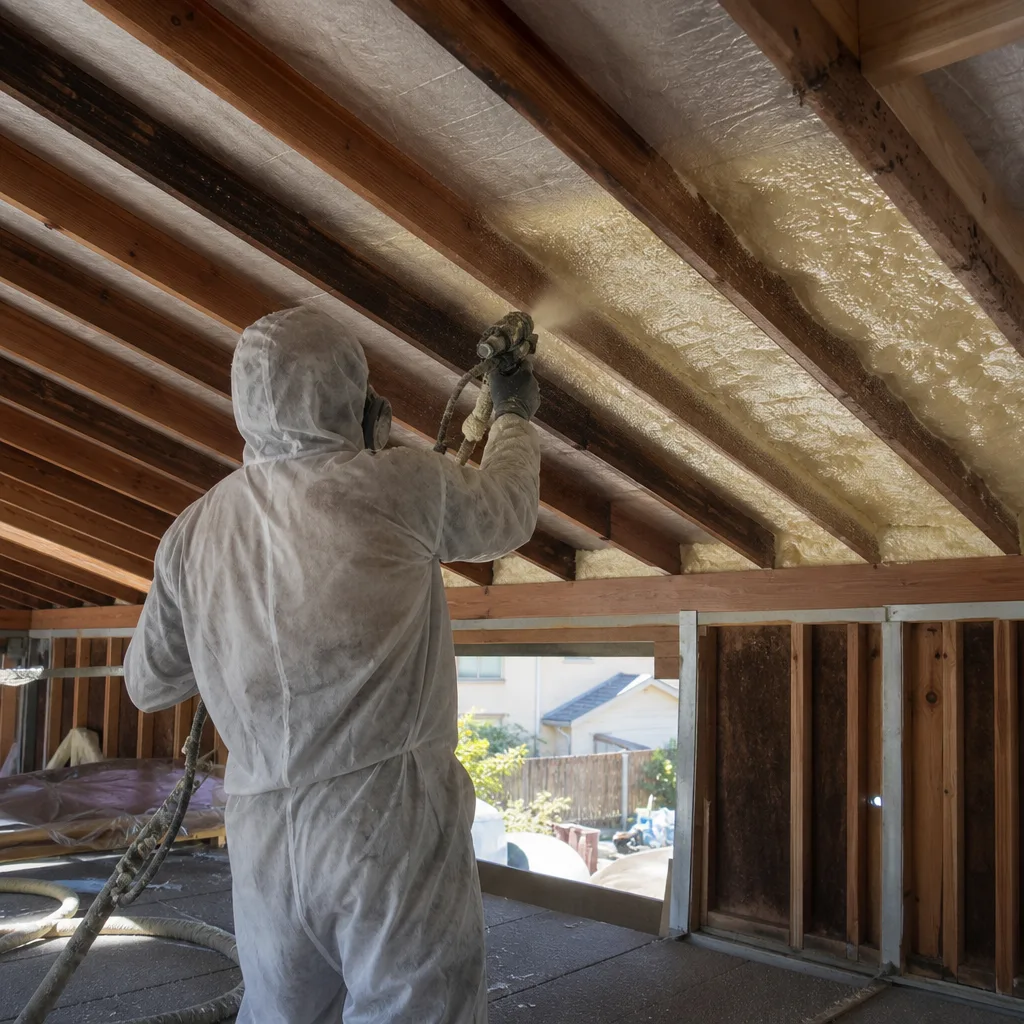
Garage Spray Foam Insulation in Good Hope is one of the most common upgrades we handle, especially for homes where the garage shares a wall with a bedroom or living space. The job involves spraying open- or closed-cell foam onto the garage ceiling and, in many cases, the shared wall cavity. Homeowners in Good Hope usually call us when the garage turns into a heat sink in summer and makes the adjacent room uncomfortable no matter how low the thermostat goes. A typical garage ceiling spray foam job in Good Hope runs $1,600 to $3,400 depending on square footage and foam type.
Shared-Wall Air Sealing
Older Good Hope homes often have zero insulation in the wall between garage and living space. Spray foam fills that cavity completely, sealing gaps that batts never touch. In manufactured homes, this shared-wall problem is even more pronounced because the original construction rarely included any thermal barrier.
Garage Ceiling Deck Applications
If there’s no room above the garage, we spray the underside of the roof deck directly. That creates an unvented, conditioned garage that stays noticeably cooler. In Good Hope’s dry climate, closed-cell foam also acts as a vapor barrier without needing an additional membrane.
Closed Cell Spray Foam Insulation in Good Hope
Closed Cell Spray Foam Insulation in Good Hope is our most-recommended option for roof decks and rim joists because it delivers roughly R-7 per inch and hardens into a rigid structure that strengthens the building frame. For Good Hope homes with single-pane windows and older construction, closed-cell foam on the roofline cuts radiant heat transfer dramatically. A closed-cell roof deck application in a typical 1,200 to 1,800 square foot Good Hope home runs $4,200 to $7,800, with rim joist work starting around $900.
Rim Joist and Band Board Sealing
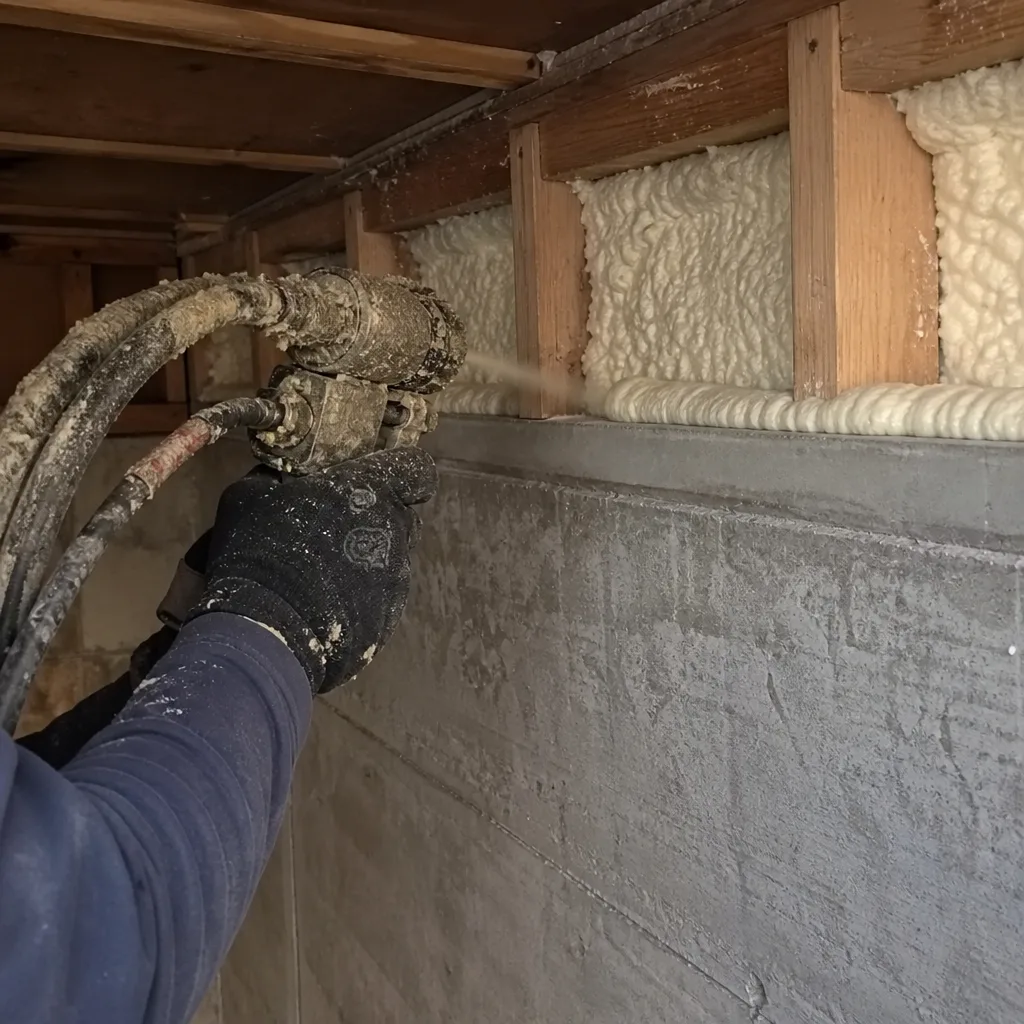
The rim joist is where the foundation meets the floor framing, and in Good Hope’s older stock it’s almost never sealed. Closed-cell foam stops air infiltration, keeps dust and pests out, and prevents the hot outside air from pulling into the crawlspace.
Roof Deck Air Barriers
On homes where the attic is vented but still blazing hot, moving the thermal boundary to the roof deck makes a measurable difference. We’ve done this on homes in the older sections of Good Hope near the 92572 corridor, where attics are shallow and adding R-60 blown-in simply isn’t possible. Closed-cell foam brings the R-value up inside a limited cavity.
Trusted Brands We Service in Good Hope
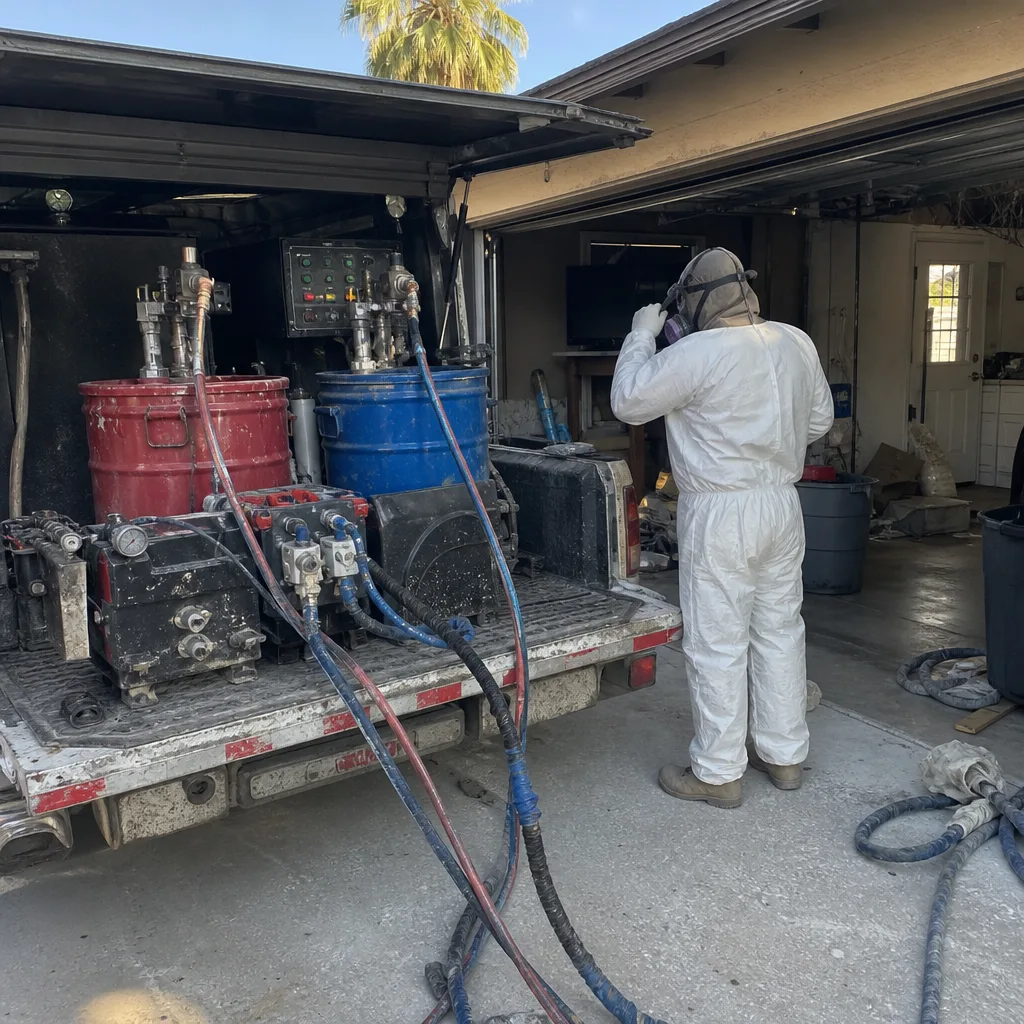
We install Icynene and Demilec spray foam systems, two of the most proven open- and closed-cell products on the market. We stock them because they cure reliably in Good Hope’s dry, hot conditions and they’re backed by long-term performance data. For jobs where spray foam isn’t ideal, we carry Owens Corning and Johns Manville fiberglass, plus GreenFiber cellulose for homeowners who want a recycled-content option. Our relationship with these manufacturers means we have local supply access, so Good Hope jobs don’t stall waiting on material. One truck can usually carry everything a single-family retrofit needs.
Common Spray Foam Insulation Problems We See in Good Hope Homes
- Sun-baked batt removal: Many Good Hope attics have original fiberglass batts that have turned brittle and dusty after years of 100°F+ summers. Spraying foam over them is a mistake – the foam won’t adhere and you’ll end up with hidden air gaps. We remove degraded material before applying anything.
- Thin, cracked old foam: In Good Hope’s dry heat, older spray foam that was applied too thin can shrink and crack. We see this on homes insulated more than a decade ago. The fix is usually a careful top-coat or full removal and reapplication, depending on adhesion.
- Manufactured home voids: Good Hope has a significant number of manufactured homes, and their wall cavities aren’t uniform. Foam injected too quickly bridges across irregular shapes and leaves voids. We inject slowly and in stages, checking for fill density as we go.
- Dusty attic surfaces: The semi-arid climate means attics accumulate a fine layer of dust on every surface. Two-component spray foam needs a clean, dry substrate to bond. We vacuum and wipe down surfaces before spraying – a prep step that generic guides skip and DIY kits completely ignore.
Pricing for Spray Foam Insulation in Good Hope, CA
Garage ceiling spray foam in Good Hope typically runs $1,600 to $3,400. Closed-cell roof deck work on a standard single-family home runs $4,200 to $7,800. Open-cell attic floor applications are more affordable, usually $1,800 to $3,600. Rim joist sealing starts at $900 for a typical crawlspace perimeter. What moves the number: total square footage, roof pitch, access (some Good Hope attics have tight hatch openings that slow us down), and whether old insulation needs to be removed first. That last item is the one most quotes miss. We include removal in our estimate when we can see it’s necessary. Call (855) 382-3451 for a free, written estimate on your home.
We Also Serve Cities Near Good Hope
Our crews cover Good Hope and the surrounding inland communities. If you’re in Perris, Romoland, Sun City, or Mead Valley, the same team serves you with the same three-method approach. Attic conditions across this part of Riverside County are similar enough that our Good Hope experience transfers directly.
Serving Good Hope, CA — Our Local Coverage Area
We’re based in the Good Hope area and know this community well. Use the map below to see our service coverage — if you’re nearby, we can almost certainly help.
FAQs About Spray Foam Insulation in Good Hope
The cost difference comes almost entirely from prep work. Many Good Hope homes built before 1990 have original fiberglass batts that have broken down in the dry heat. We have to remove that material, vacuum the attic, and sometimes repair or replace framing before foam goes in. Homes with clean, empty cavities don’t carry that extra step. Call (855) 382-3451 and we’ll inspect yours – the estimate will show exactly what’s required.
No, it should not be. Spray foam needs direct contact with the substrate – the wood sheathing, drywall, or framing – to bond properly. In Good Hope, where old batts are often sun-baked and dusty, the failure rate is high if foam is sprayed over them. We remove the old material first. Some contractors will spray over it to save time; we won’t, because the air gaps that result defeat the purpose of using foam in the first place.
Good Hope’s heat is the main reason spray foam makes sense here. Closed-cell foam’s R-value per inch holds up in high temperatures far better than settled fiberglass, and it stops the radiant heat load from turning your attic into an oven. The heat also ages poor installations faster – thin foam, weak adhesion, and uncured spots show up within a few summers. Properly installed foam in Good Hope should last the life of the home. Give us a call at (855) 382-3451 to talk about what your attic needs.
Yes, but it demands a different technique. Manufactured home wall cavities and roof spaces are often irregular, shallow, or blocked by framing. We inject foam at low pressure and in stages to avoid bridging and voids. Many Good Hope manufactured homes also have thin roof decks, so we typically spec closed-cell foam there because it adds structural rigidity as well as insulation.
We use Icynene and Demilec systems, both open- and closed-cell. Demilec’s closed-cell product performs particularly well on Good Hope roof decks and rim joists because of its adhesion strength in dry conditions. Icynene’s open-cell product is a good fit for interior wall cavities where moisture vapor needs to pass through. We carry both so the home gets what the application needs – call (855) 382-3451 for a free estimate on your Good Hope retrofit.
Written by Ruben Castellano, owner of Thermal Insulation Co, serving good hope and surrounding inland communities with spray foam, attic, and blown-in insulation.