
Fast, Reliable Spray Foam Insulation Across Costa Mesa
Spray foam insulation in Costa Mesa costs between $2,200 and $6,800 for a typical attic project, with open-cell foam running $1.40 to $2.25 per board foot and closed-cell at $2.50 to $4.00 per board foot installed. If you live west of the 405 in the older 92627 tracts, the job usually involves fixing what June Gloom condensation did to your original attic before we ever talk about R-value. Thermal Insulation Co serves Costa Mesa homeowners with same-week scheduling in most cases, and Ruben Castellano leads a team that understands how this city’s split housing stock actually behaves. Call (855) 382-3451 to get a straight answer about your house.
Most Costa Mesa homes were never insulated for thermal performance. That’s not a criticism of whoever built them in 1958. It’s just what the coastal climate allowed. But when the marine layer sits on this city for weeks in May and June, a vented attic with original kraft-faced batts does something ugly: it condenses moisture on the underside of the roof deck and grows mold. We fix that. Then we insulate it properly.
Why Thermal Insulation Co Is Costa Mesa’s Preferred Spray Foam Insulation Company
We’re a dedicated insulation contractor, not a generalist who picked up a foam rig last year. Insulation is the only trade we do, and Spray Foam Insulation is one of three installation methods we bring to Costa Mesa jobs. That matters because a home near South Coast Plaza has different failure modes than a 1955 bungalow off Baker Street, and we match the method to the house rather than forcing one product line onto every roof.
Homeowners across Costa Mesa keep calling us back for one reason: we diagnose before we quote. A musty hallway smell in 92627 might mean pulling wet batts and air-sealing top plates before any foam goes in. A 1970s ranch in 92626 that fails Title 24 comfort expectations needs a different conversation entirely about air barrier performance. Ruben Castellano and the crew treat each Costa Mesa house as its own problem to solve, not a square footage number to bill.
We’re authorized to install products from eight nationally recognized manufacturers, including Owens Corning, Johns Manville, Knauf, Rockwool, CertainTeed, Icynene, Demilec, and GreenFiber. Most single-trade competitors carry one or two lines. We carry the breadth because Costa Mesa’s housing stock demands it. A 1958 stucco tract house with moisture issues and a 1985 condo near the 405 need very different foam chemistries.
Spray Foam Insulation Contractors in Costa Mesa
Spray Foam Insulation Contractors in Costa Mesa need to understand that this city’s work splits along the 405, and most of us who do this trade here have learned it the hard way. West of the freeway in 92627, you’re dealing with 1950s and 60s single-story stucco tracts and small bungalows, many of which still have their original uninsulated walls and vented attics. East of the freeway in 92626, you’re looking at 1960s and 70s ranch homes, plus apartments and condos near South Coast Plaza that were built to old energy standards and now feel uncomfortable for reasons the original builder never anticipated. The job in Costa Mesa is rarely just “spray foam.” It’s diagnosing why the house fails first, then choosing the foam chemistry and application detail that actually solves it.
Open-Cell vs. Closed-Cell Decisions
Open-cell foam, which we install using Icynene and Demilec products, is the workhorse for Costa Mesa attic undersides and ceiling assemblies. It’s half the cost of closed-cell, expands aggressively into framing gaps, and lets the roof deck breathe enough to dry outward during Santa Ana weeks. Closed-cell foam makes sense when moisture resistance and structural rigidity matter: rim joists, garage ceilings under living space, and spray foam roof decks on flat or low-pitch Costa Mesa roofs where bulk water intrusion from winter storms or marine air is a real concern.
Rim Joist and Garage Ceiling Work
Rim joist spray foam shows up constantly in Costa Mesa homes because the same June Gloom moisture cycle that attacks attics also sneaks into the band joist area where floors meet foundation. Closed-cell foam here stops conditioned air from leaking and keeps damp outside air from condensing against rim framing. Garage ceiling spray foam is common for Costa Mesa homes with finished rooms above the garage, where the uninsulated garage ceiling acts as a giant thermal hole. We see it weekly in both the 92627 bungalows and the 92626 ranch houses.
Spray Foam Attic Insulation in Costa Mesa
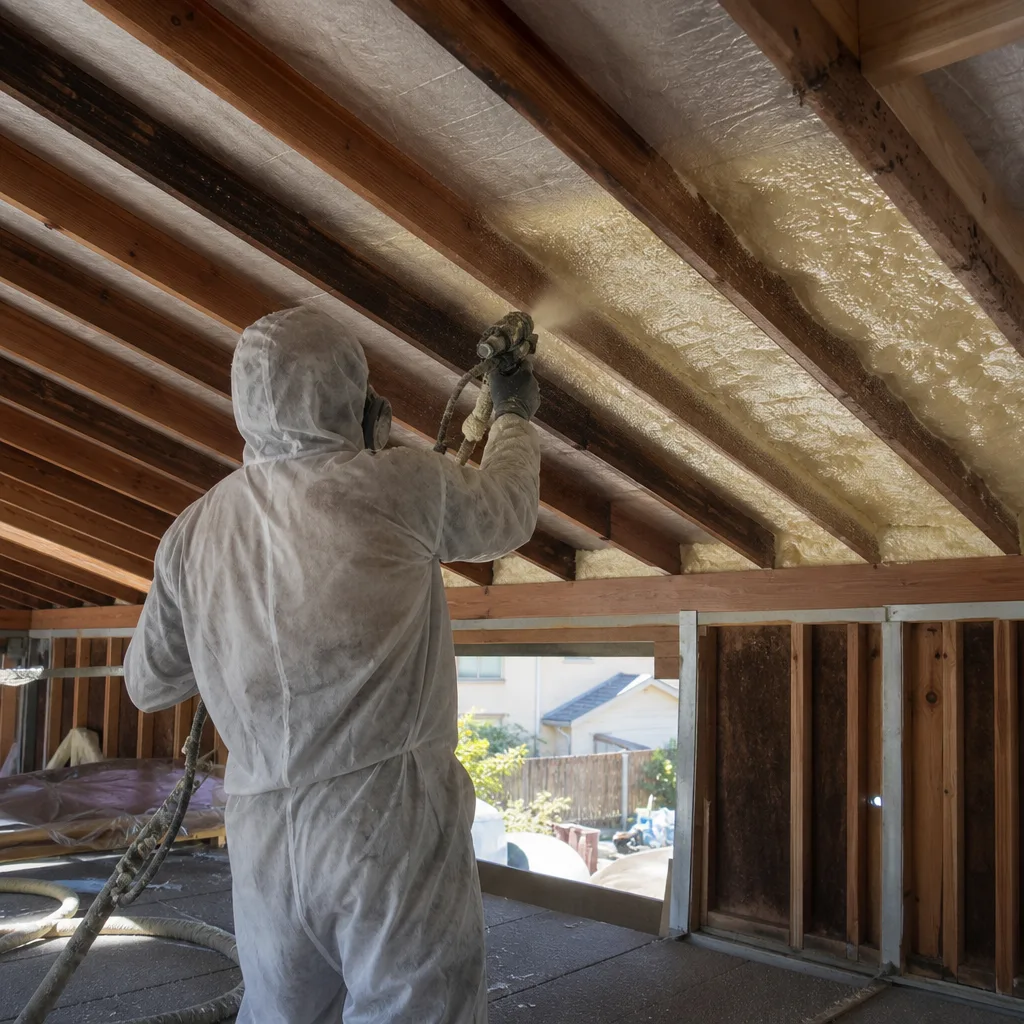
Spray Foam Attic Insulation in Costa Mesa has one recurring failure mode we see more than any other: the vented 1950s attic with original kraft-faced batts sagging against the roof deck, black mold blooming on the deck underside, and a homeowner who thinks they need more R-value. They don’t. They need the moisture path fixed first. In Costa Mesa’s 92627 west-side tracts, the June Gloom marine layer rolls in off Huntington Beach and sits for weeks, pushing humidity into vented attics. When that humid air meets a cold roof deck at night, it condenses. Foam applied without air-sealing and baffles can seal that moisture in and make the mold worse. So our first step on these older Costa Mesa attics is always the same: pull the wet batts, air-seal the top plates and knee walls, install rafter baffles to keep the vent path open, then apply closed-cell or open-cell foam depending on what the deck condition actually allows.
Air-Sealing Before Foam
Air-sealing is the foundation of spray foam attic work in Costa Mesa, and it’s the step most homeowners never hear about from other contractors. Before we spray, we seal top plates, electrical penetrations, plumbing vents, and any gap where attic air can reach living space. On the older west-side houses, the top plates are often leakier than the wall cavities themselves, because 1950s framing didn’t account for air movement the way modern building science requires. Sealing first means the foam actually does its job.
Knee Walls and Vaulted Sections
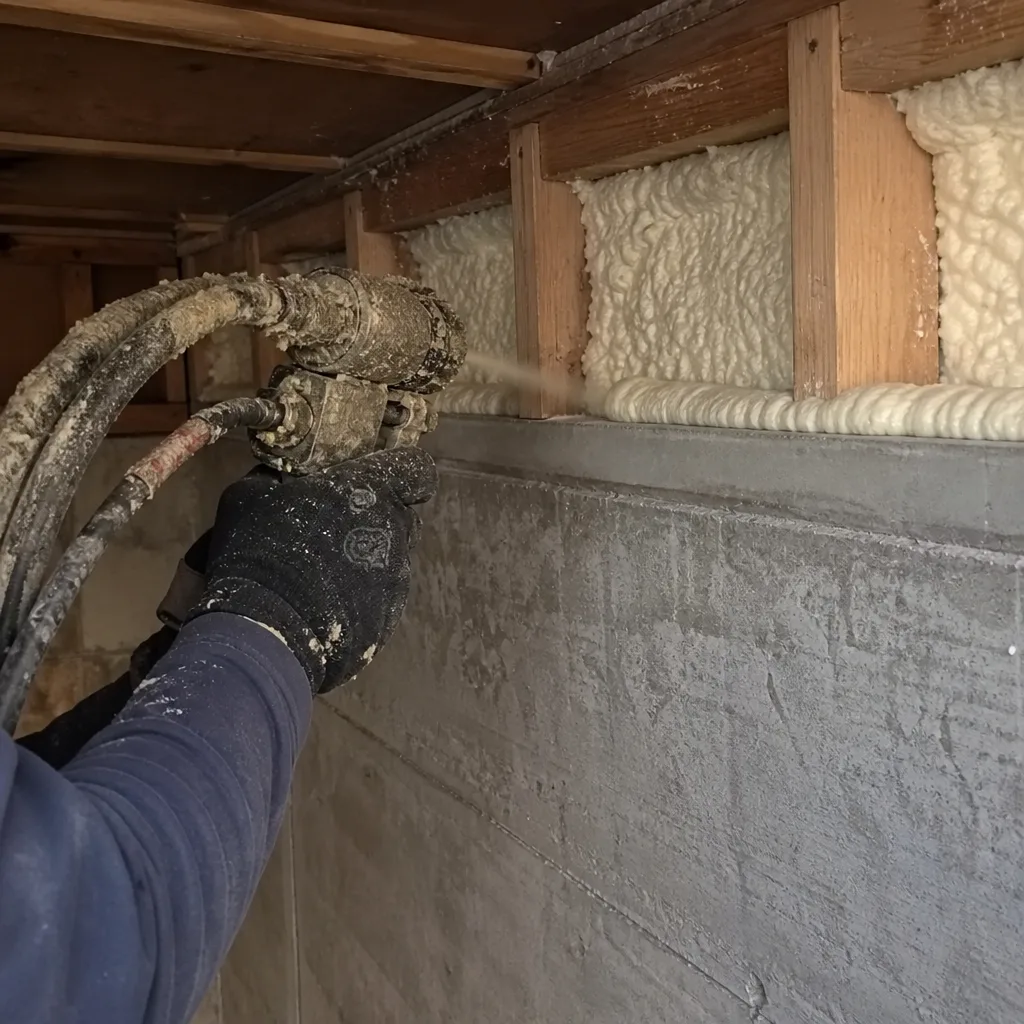
Many Costa Mesa ranch homes have attic knee walls or vaulted ceiling sections where fiberglass batts were stuffed in and forgotten. These areas short-circuit the building envelope. We spray the knee wall backside or the vaulted ceiling underside with open-cell foam to create a continuous air barrier that also insulates. On stucco-over-wood-frame construction, which dominates Costa Mesa, these transitions are where the house leaks most.
Trusted Brands We Service in Costa Mesa
We carry Icynene and Demilec for spray foam applications because both brands offer open-cell and closed-cell formulations that behave differently in Costa Mesa’s marine-layer humidity and Santa Ana heat cycles. Icynene’s open-cell product is a good fit for attics where the deck needs to dry outward, while Demilec’s closed-cell formulations hold up well in rim joist and garage ceiling applications where moisture resistance is the priority. We also stock Owens Corning, Johns Manville, and Knauf fiberglass for Costa Mesa customers who need a hybrid approach: spray foam for the air barrier, fiberglass or Costa Mesa blown-in for additional R-value in vented sections. Having all these materials available locally means faster turnaround when you call (855) 382-3451.
Common Spray Foam Insulation Problems We See in Costa Mesa Homes
- June Gloom deck condensation in 92627: Original kraft-faced batts left in place under new foam create a double vapor barrier that traps condensation against the deck during the May-June humidity weeks. We pull the old batts, air-seal, and add baffles before any foam goes in.
- Mold bloom on the underside of roof decks: This is the classic Costa Mesa signature of trapped marine-layer moisture, not heat loss. The fix is a full moisture path correction: remove wet material, seal top plates, install baffles, then foam the deck.
- Santa Ana wind stress on attic surfaces: Those hot dry gusts push attic temps far above the mild outdoor reading, and foam or radiant barrier surfaces installed without accounting for those cycles can degrade prematurely. We specify foam chemistry with the right temperature tolerance for Costa Mesa’s specific wind season.
- Title 24 comfort failures in 92626 ranch homes: 1970s construction near South Coast Plaza was never designed for modern comfort expectations, and the building envelope leaks air in ways that make rooms feel drafty and uneven. Spray foam air-sealing plus insulation fixes the comfort problem, not just the energy bill.
Pricing for Spray Foam Insulation in Costa Mesa, CA
Here’s what Costa Mesa homeowners can expect to pay. Open-cell spray foam typically runs $1.40 to $2.25 per board foot installed. Closed-cell runs $2.50 to $4.00 per board foot. A standard 1,200-square-foot attic with open-cell foam lands between $2,800 and $4,500. Rim joist work in a typical Costa Mesa crawlspace foundation runs $900 to $2,000 total. Garage ceiling spray foam for a two-car garage runs $1,800 to $3,500. What drives the final number in Costa Mesa is access, existing insulation removal, and whether we’re doing air-sealing and baffle work first. We give free estimates with a specific number attached, not a vague range. Call (855) 382-3451 and Ruben Castellano’s team will walk your attic with you.
We Also Serve Cities Near Costa Mesa
Thermal Insulation Co also runs spray foam crews into Newport Beach, Fountain Valley, Huntington Beach, and San Joaquin Hills. If you’re in one of those cities and dealing with the same marine-layer damp or old-house air leaks, the same diagnosis-first approach applies. We’re based in Van Nuys but Costa Mesa is a regular service area for us, and we keep material stocked for this part of Orange County specifically.
Serving Costa Mesa, CA — Our Local Coverage Area
We’re based in the Costa Mesa area and know this community well. Use the map below to see our service coverage — if you’re nearby, we can almost certainly help.
FAQs About Spray Foam Insulation in Costa Mesa
Because the June Gloom marine layer pushes weeks of high-humidity air into vented attics, and when that damp air hits a cold roof deck at night, it condenses. The original 1950s kraft-faced batts then hold that moisture against the wood, which is exactly what mold needs. The house never feels cold because Costa Mesa’s climate is mild. It just gets musty. Call (855) 382-3451 and we’ll diagnose the moisture path before recommending any foam.
No, you should never spray foam over the original kraft-faced batts in a 1950s Costa Mesa home. The kraft paper is a vapor barrier, and the new foam is another vapor barrier. Together they create a double vapor barrier that traps condensation against the roof deck during marine-layer weeks and makes mold worse. We remove the old batts, air-seal, and add baffles first. Then we foam. That’s the correct sequence, and it’s how we handle every legacy attic job in 92627.
Yes, but only if the air-sealing gets done with it. A 1970s ranch in 92626 leaks air through top plates, recessed lights, plumbing penetrations, and wall-to-ceiling transitions. Foam without sealing helps somewhat. Foam with sealing changes how the house feels within days. You’ll notice the difference first in the rooms that were always drafty or uneven. For an exact scope and price, call (855) 382-3451 and we’ll walk through it.
Santa Ana winds push attic temperatures far above the mild outdoor reading in Costa Mesa, and that heat can stress under-specified foam products or degrade surfaces that weren’t installed for that reality. We specify open-cell and closed-cell formulations with temperature tolerance suited to Southern California’s wind season, not a generic spec pulled from a national datasheet. It’s one of the reasons we use Icynene and Demilec lines that have documented performance in hot attic assemblies.
We use both Icynene and Demilec depending on the application, and open-cell is usually the right call for marine-layer attics because it lets the roof deck dry outward when humidity recedes. Closed-cell from either brand goes into rim joists, garage ceilings, and flat roof decks where moisture resistance and structural stiffness matter more. If you’re not sure which your Costa Mesa house needs, call (855) 382-3451 and we’ll tell you after looking, not guessing.
Ready to fix the attic that’s been musty since June? Call Thermal Insulation Co at (855) 382-3451 for a free spray foam estimate in Costa Mesa. Ruben Castellano and the crew will walk your attic, explain what’s actually happening up there, and give you a specific number. No pressure, no vague ranges, just the right insulation for your home.
Written by Ruben Castellano, Owner at Thermal Insulation Co, serving Costa Mesa homeowners with attic, blown-in, and spray foam insulation.