
Fast, Reliable Spray Foam Insulation Across San Joaquin Hills
Spray foam insulation in San Joaquin Hills typically costs $2,800 to $8,500 for a full attic application, with garage jobs running $1,200 to $2,900 and closed-cell running roughly 30 to 45 percent more than open-cell. We’ve worked on enough custom homes off Newport Coast Drive and Bonita Canyon to know that most jobs here are not simple re-insulations. They’re code-sensitive upgrades inside architecturally controlled houses where the attic often doubles as a mechanical platform. That changes how you choose foam, how it gets applied, and who you trust to do it. Call us at (855) 382-3451 for a straight answer on what your specific home needs.
Why Thermal Insulation Co Is San Joaquin Hills’s Preferred Spray Foam Insulation Company
San Joaquin Hills homeowners usually call us after another contractor has told them what they can’t do. The HOA won’t allow exterior vents to be added. The attic has no ventilation but it does have HVAC equipment taking up half the space. The foam needs to hit certain R-values without changing the roofline. We walk into those conversations already knowing the constraints, because we’ve foamed enough Mediterranean and Spanish-style homes in this community to understand the architectural review process and the WUI fire-code requirements that apply here.
Ruben Castellano runs every San Joaquin Hills estimate personally. That matters when the job involves clearances around ductwork, fire-rated assembly lines, and cathedralized ceilings that need closed-cell rather than open-cell. We’re not a general contractor guessing at insulation. We’re a dedicated insulation contractor carrying eight product lines, and we’ll tell you which one makes sense for the assembly you actually have.
Our team reaches most San Joaquin Hills homes same day for assessments and can schedule installations within a week of approval. We also know which local HOA sub-associations require pre-approval for attic work and which ones only care about visible exterior changes. That local knowledge keeps projects moving instead of stalling in review.
Garage Spray Foam Insulation in San Joaquin Hills
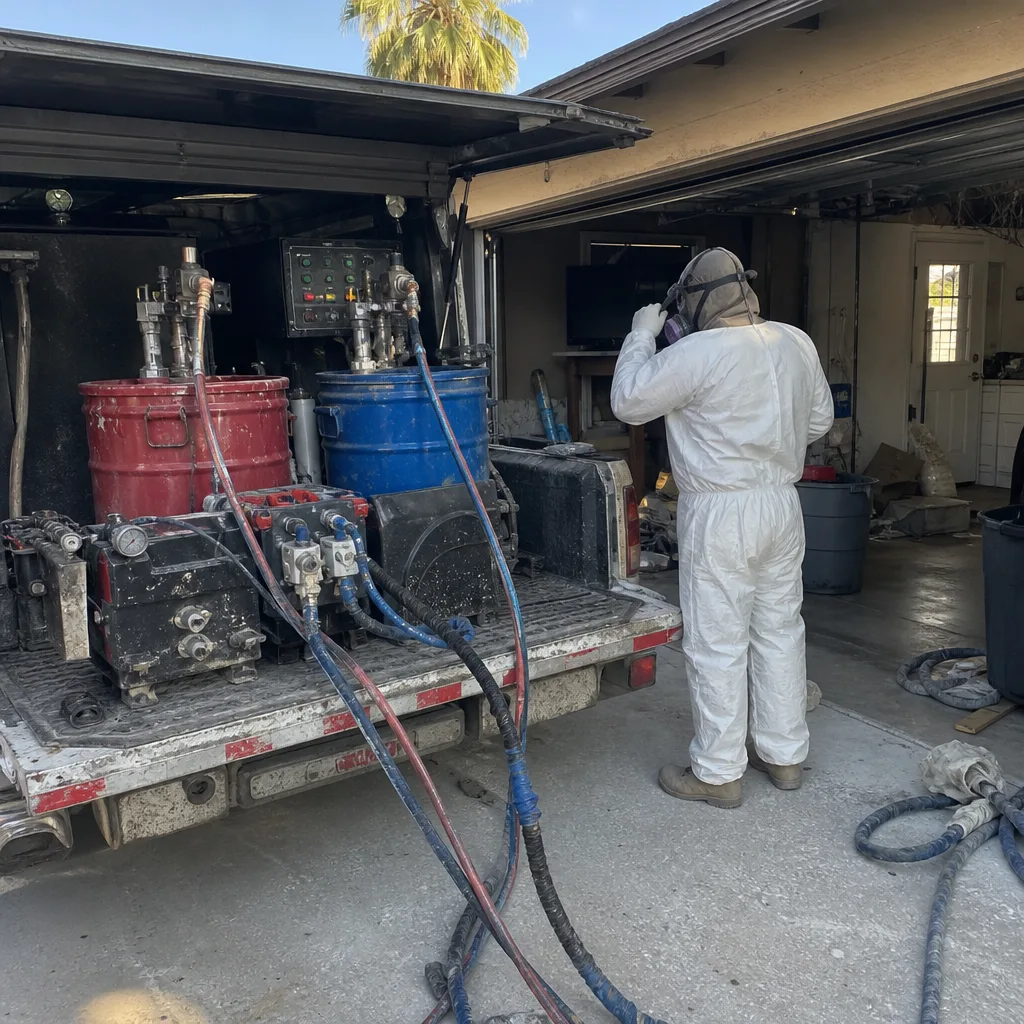
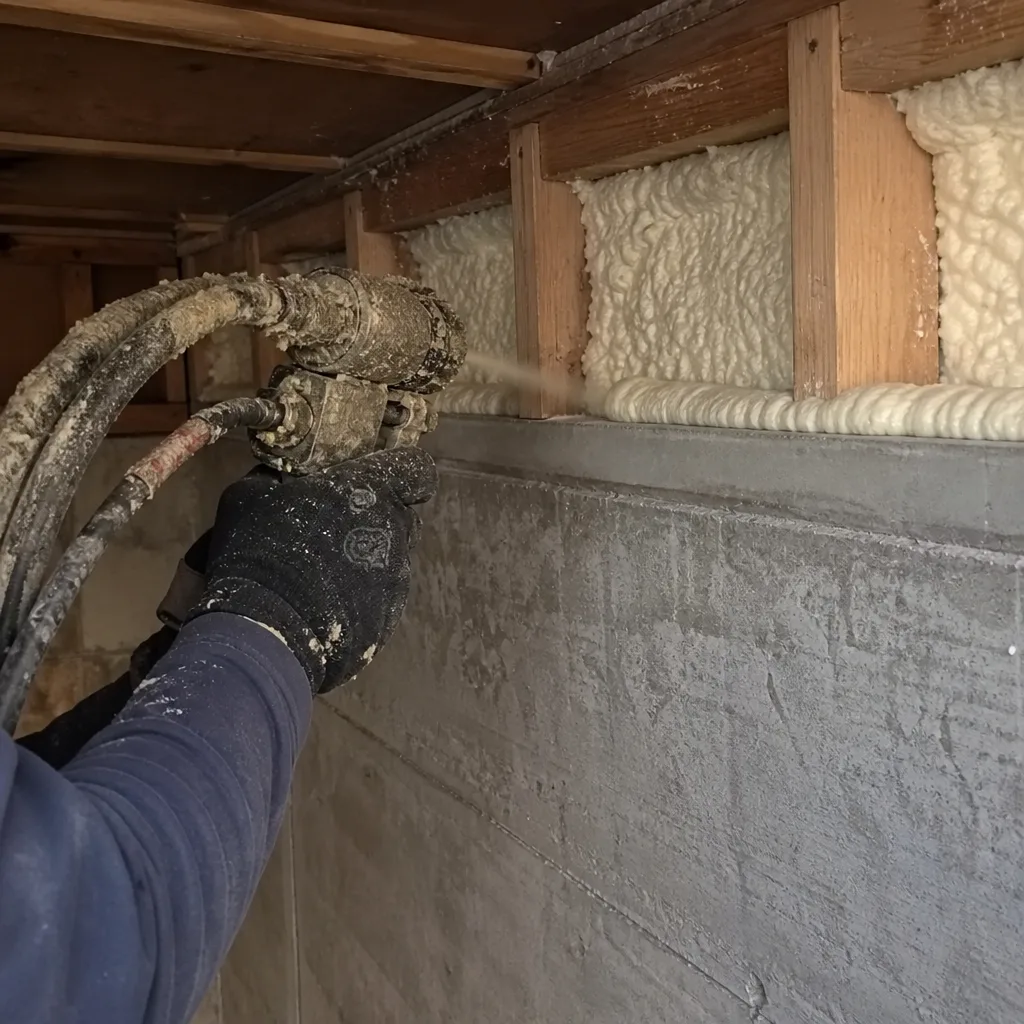
Garage spray foam insulation in San Joaquin Hills is one of the more straightforward upgrades we do here, but it still carries the community’s stamp of approval considerations. Most garages in this neighborhood sit under living space, which means hot afternoons bake the ceiling and radiate into bedrooms above. Foam on the garage ceiling and band joist area stops that transfer. The work involves spraying the ceiling cavity, rim joist, and any shared wall with the house, then trimming back to meet fire-code separation requirements between garage and living space.
Typical garages in San Joaquin Hills run $1,200 to $2,900 depending on ceiling area and whether shared walls are included. The job takes one day, and because everything stays inside the garage shell, HOA architectural review generally doesn’t apply unless your association has rules about contractor access or parking. We’ve done enough of these to know which streets have strict daytime work-hour limits.
Ceiling and Shared Wall Applications
Closed-cell foam on the ceiling stops the afternoon heat stack effect that turns a garage into a convection oven above your bedrooms. On shared walls, it also cuts noise transfer between the garage and adjacent living space. In San Joaquin Hills custom homes with bonus rooms over the garage, this single change often fixes rooms that never held temperature.
Code-Separation Compliance
Garage-to-house fire separation matters in every city, but it gets particular attention in WUI-mapped areas like the hills above Newport Beach. We apply and hand-trim the foam so the ignition barrier and separation sheetrock stay intact. You’ll pass inspection, and the HOA never sees a thing.
Closed Cell Spray Foam Insulation in San Joaquin Hills
Closed cell spray foam insulation in San Joaquin Hills is the workhorse for this community’s unvented attic and cathedralized ceiling assemblies. It’s what we reach for when homes have tile roofs with no ridge ventilation, when attics carry HVAC equipment on mechanical platforms, and when the marine layer sits in wall cavities every morning. Closed-cell foam acts as its own air and moisture barrier, which is precisely what these assemblies demand. Open-cell can’t do that in damp coastal conditions without trapping moisture against the framing.
Closed-cell applications in San Joaquin Hills typically run $3,400 to $8,500 for a complete attic or roof-deck application. The higher cost per board foot is offset by a higher R-value per inch, roughly R-6.5 to R-7 versus open-cell’s R-3.5 to R-3.8. That extra density matters when the HOA prohibits visible changes and you need maximum R-value inside the existing cavity depth.
Roof Deck and Cathedralized Ceiling Work
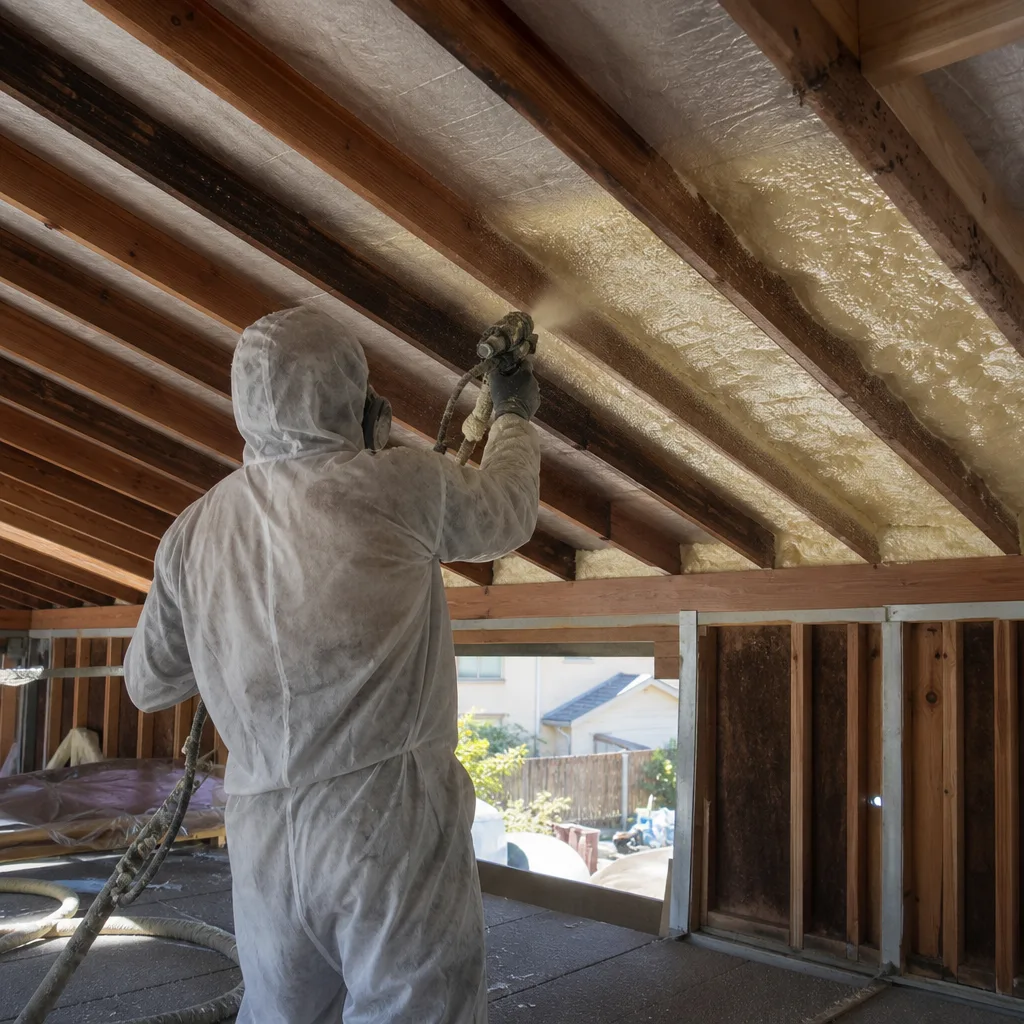
Homes off San Joaquin Hills Road frequently have second-story ceilings that follow the roofline with no attic above them. Closed-cell foam sprayed directly to the underside of the roof deck turns that sealed cavity into conditioned space. The tile roof never changes, the stucco never changes, and the home hits Title 24 energy targets.
Mechanical Platform Encapsulation
Many custom homes in the 92657 zip code tuck their air handler and duct runs into attic spaces with tight clearances. We foam the underside of the roof deck to the fire-rated assembly line while leaving service access around the equipment. The HVAC stays reachable, the assembly stays compliant, and the attic stops cooking the ducts.
Trusted Brands We Service in San Joaquin Hills
We install Icynene and Demilec spray foam systems because those two product lines cover the full range of what San Joaquin Hills assemblies require. Icynene’s closed-cell formulation handles damp unvented attics well. Demilec gives us an open-cell option for interior wall cavities where moisture risk is lower and sound control matters. When a job calls for something other than foam, we also stock Owens Corning and Johns Manville batt and blown-in products, plus GreenFiber cellulose for homeowners who want recycled content. Most single-trade shops carry one or two lines. We carry eight brands across three methods, and we’ll say plainly which one your house needs. That’s the difference between a product pitch and a recommendation.
Common Spray Foam Insulation Problems We See in San Joaquin Hills Homes
- Open-cell foam in damp wall cavities. The marine layer that rolls into this neighborhood every morning pushes moisture into exterior walls. Open-cell absorbs that moisture and holds it against framing. In unvented assemblies, closed-cell is the correct call, and we’ve corrected several open-cell jobs that were failing within a few years of installation.
- Foam sprayed tight to HVAC equipment on attic platforms. Crews that don’t know the WUI code will foam right up against the air handler and ductwork. That blocks required service clearance and can violate fire-rated assembly requirements. We mask and dam around equipment so you keep access and stay code-compliant.
- Exterior changes made to chase R-value. Adding roof vents or eave changes to an unvented attic will trigger HOA architectural review, and the board will almost always deny exterior modifications on Spanish-style custom homes. Closed-cell foam solves the R-value problem from the inside with zero visible change.
- Batt insulation rotting under tile roofs. We regularly find fiberglass batts sagging and mold-stained under San Joaquin Hills tile roofs where morning condensation drips down. The tile stays cold while the attic air warms, and moisture condenses on everything. Foam seals that cycle off.
Pricing for Spray Foam Insulation in San Joaquin Hills, CA
Here are honest numbers for this market. Open-cell spray foam in San Joaquin Hills runs $1.10 to $2.10 per board foot installed. Closed-cell runs $2.20 to $3.60 per board foot. A standard two-car garage ceiling and rim joist job lands between $1,200 and $2,900. A full attic roof deck in a 2,500 to 3,500 square foot custom home runs $3,400 to $8,500 depending on depth and assembly complexity. What moves the number: attic accessibility, mechanical equipment that needs masking and clearance, cathedralized ceiling square footage, and whether we’re remediating failed insulation first. Estimates are free and take about 45 minutes on site. Call (855) 382-3451 and we’ll give you a firm number, not a range stretched so wide it’s meaningless.
We Also Serve Cities Near San Joaquin Hills
Our spray foam crews work throughout the coastal hills and adjacent valleys. We serve Spray Foam Insulation in San Joaquin Hills, plus regular projects in Aliso Viejo, Newport Beach, Laguna Beach, and Irvine. If you’re on the edge of the 92657 boundary, we’ve probably already worked on your street.
Serving San Joaquin Hills, CA — Our Local Coverage Area
We’re based in the San Joaquin Hills area and know this community well. Use the map below to see our service coverage — if you’re nearby, we can almost certainly help.
FAQs About Spray Foam Insulation in San Joaquin Hills
No. Spray foam work is applied inside the existing wall, attic, and ceiling cavities. Your stucco exterior, tile roof, and visible vents stay exactly as they were. The HOA only reviews what it can see, and foam changes nothing visible. We have completed many San Joaquin Hills projects that required no architectural submission at all because the work was entirely interior. If your specific sub-association requires notification of any contractor work on the property, we’ll provide a work-scope letter for your file. Call (855) 382-3451 and we’ll tell you what your particular HOA typically asks for.
Yes, and we’ve done it many times in San Joaquin Hills homes where the attic is essentially a mechanical room. We mask and dam around the unit, foam the underside of the roof deck to the fire-rated assembly line, and leave the manufacturer-specified service clearance intact. You won’t have to move the equipment, and the WUI fire-code requirements stay satisfied. We recently foamed a Spanish-style home off Newport Coast Drive exactly this way, sealing the cathedralized ceilings while keeping the air handler fully accessible. The damp attic air stopped condensing on the old batts within days. Call for an inspection and we’ll map out clearances before we quote.
Yes, and in most San Joaquin Hills assemblies the answer is closed-cell. The morning marine layer puts damp air against the exterior side of your wall and roof assembly. Closed-cell foam is its own moisture barrier, so it prevents that dampness from condensing inside the cavity. Open-cell foam is vapor-permeable and can hold coastal moisture against the framing in unvented assemblies, which leads to rot and mold over time. Our Spray Foam Insulation team specifies closed-cell for roof decks, cathedralized ceilings, and any unvented attic in the coastal hills. Open-cell still has its place in interior partition walls where sound control matters more than moisture performance.
Only if it’s applied incorrectly. The fire-separation requirement between garage and living space means foam on shared walls and ceilings must be covered with an approved thermal or ignition barrier, and the separation sheetrock must stay intact. We hand-trim foam, keep the separation plane clean, and document the work for building inspection. HOA architectural standards don’t regulate interior garage finishes in most San Joaquin Hills associations, but they do care about work hours, parking, and debris. We know the local expectations and schedule accordingly.
By using closed-cell foam inside the existing cavity. Title 24 for climate zone 8, which covers San Joaquin Hills, requires R-38 to R-49 in vented attics and has specific U-factor targets for unvented assemblies. Closed-cell foam at R-6.5 to R-7 per inch reaches those numbers within the depth of your existing rafters, usually 2×10 or 2×12 framing in this housing stock. No exterior changes, no added bulk, no roofline modification. The HOA sees nothing, and your Title 24 compliance file gets a logged R-value with the installation date. That’s the cleanest path through both the energy code and the architectural review board.
Get a Free On-Site Estimate in San Joaquin Hills
If your home has an attic that bakes the HVAC equipment, a garage ceiling that heats your bonus room, or wall cavities that run damp from the morning marine layer, we’ll assess it and tell you exactly which foam solves it. Ruben Castellano handles every San Joaquin Hills estimate, and he’ll walk your attic before quoting. No pressure, no generic product pitch, just a straight recommendation for your specific assembly. Call Thermal Insulation Co today at (855) 382-3451 to schedule your free estimate. We’re licensed, insured, and we know the HOA and code landscape in this community as well as any contractor working here.
Written by Ruben Castellano, Owner at Thermal Insulation Co, serving San Joaquin Hills and the surrounding coastal hills.