
Last updated October 30, 2026
Insulation Warning Signs: A Van Nuys Homeowner’s Reference Guide
Here’s a pattern we see constantly in Van Nuys: a homeowner replaces their AC compressor in June, spends $6,000 to $9,000, and by August the upstairs is still 82 degrees at 6 PM. The equipment was never the problem. The house was. Failing insulation doesn’t trip a breaker or flash an error code. It degrades quietly, and the symptoms get blamed on undersized HVAC, old windows, or just “how summers are.” This guide will teach you to read the actual signals your home gives off when insulation stops doing its job, so you can fix the right problem the first time.
Quick Answer
The most reliable insulation warning signs in a Van Nuys home are a temperature difference of 4°F or more between floors on hot days, AC runtime that increases year over year without a corresponding change in thermostat settings, dust streaking on ceilings near light fixtures, and visible settling or compression in attic insulation. If you notice two or more of these, your building envelope is leaking conditioned air, and the attic is the first place to inspect.
Table of Contents
- The Second-Floor Temperature Differential Test
- Compression vs. Settling: They Require Different Fixes
- Dust Streaking on Ceilings: What Air Movement Leaves Behind
- The Pest Infestation Insulation Audit
- The 24-Month Utility Bill Trend Analysis
- AC Runtime Creep: When the Unit Tests Fine but the House Won’t Cool
- Moisture Signals in the Attic: What Condensation and Staining Reveal
- Common Mistakes to Avoid
- When to Call a Professional
- Frequently Asked Questions
The Second-Floor Temperature Differential Test
If your AC runs longer each summer but the unit tests fine, the problem is almost certainly the building envelope, and your attic insulation is the first place to look. Here’s the test we use on almost every Attic Insulation in Van Nuys inspection, and it takes about 30 seconds.
On a day when the outdoor temperature is above 90°F, set your thermostat to a steady 76°F and leave it there for at least four hours. Then walk upstairs with a basic thermometer. If the second floor reads 80°F or higher while the first floor holds at 76°F, that 4°F gap is a red flag.
Why does this gap occur? Heat rises. During a Van Nuys summer day, attic temperatures routinely hit 130°F to 150°F. Your attic insulation is the only barrier between that superheated air and the living space below. When insulation is adequate and properly installed, the ceiling plane stays within a degree or two of the rest of the house. When insulation has been compressed, settled, or displaced, the ceiling becomes a radiant heat panel, warming upstairs rooms from above even while the AC works normally.
We’ve measured temperature differentials of 8°F to 12°F in Van Nuys homes with attic insulation that was installed before the 1990s and never touched again. The homeowners almost always tell us the same thing: their AC “works fine downstairs but can’t keep up upstairs.” That’s not an AC problem. It’s a ceiling problem.
This test works in winter too, in reverse. On a cold night, a properly insulated upstairs should not feel noticeably colder than downstairs. If you can feel a chill radiating from the ceiling plane, heat is escaping through the attic.
The differential test matters because it isolates the building envelope from the HVAC system. If your AC unit is less than 10 years old, tests within spec on refrigerant pressure, and the temperature gap persists, the equipment is doing its job. The house is losing the battle.
Compression vs. Settling: They Require Different Fixes
Not all degraded attic insulation is the same. In our work across Van Nuys, we classify attic insulation failure into two distinct categories: compression and settling. They look different, they’re caused by different things, and they call for different corrections.
Compression From Foot Traffic
Fiberglass batt insulation is essentially spun glass fibers that trap air in tiny pockets. Those air pockets are what provide the insulating value. When someone walks on the batts, or stacks boxes on them, the air pockets collapse and the R-value drops dramatically. A 6-inch R-19 batt compressed to 2 inches can lose 40% to 50% of its thermal resistance.
In Van Nuys, the most common source of compression is the sequence of trades that access the attic: HVAC technicians running new ductwork, electricians adding circuits for that remodel, cable installers, pest control operators, even holiday decor storage. Each trip leaves a trail of flattened insulation.
You can identify compression from the attic access point. Look for pathways: flattened areas running between the access hatch and the air handler, or around the furnace platform, or anywhere a technician would have stepped or knelt. Compression is localized. The rest of the attic may still be performing fine.
Settling From Age
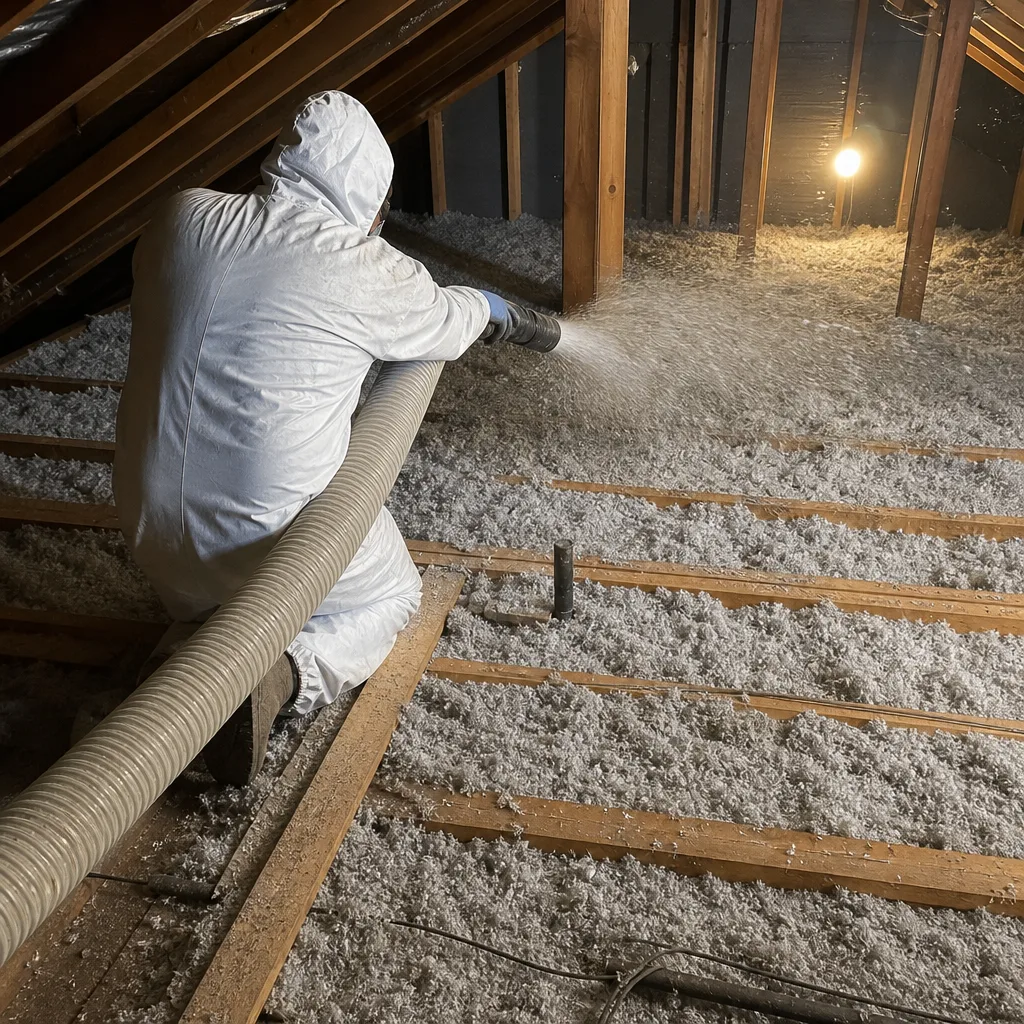
Blown-in fiberglass and cellulose settle over time. As the loose fibers shift and compact under their own weight, the insulation layer thins. A blown-in installation that was originally 12 inches deep may settle to 8 or 9 inches after 15 to 20 years. Every inch of lost depth is lost thermal resistance.
Settling is uniform. Unlike compression, which shows localized damage, settling affects the entire attic floor evenly. You identify it by measuring depth at multiple points. In a Van Nuys home built before 2000, we commonly measure original blown-in coverage at 6 to 8 inches of settled material where 12 to 14 inches would be required to meet current R-38 or R-49 recommendations for this climate zone.
The fix for compression may be as simple as fluffing the batts back up and correcting the pathway with a proper catwalk. The fix for settling is adding new blown-in material to restore the target depth. The point is: identifying which problem you have determines the right repair. We carry Blown In Insulation in Van Nuys options that let us restore depth efficiently when settling is the diagnosis.
Dust Streaking on Ceilings: What Air Movement Leaves Behind
Look up at your ceiling right now, specifically near light fixtures, ceiling fan mounts, and the corners where walls meet ceilings. Do you see gray or brown streaks? Those aren’t water stains. In most Van Nuys homes, they’re air infiltration marks.
Here’s how they form. The space between your ceiling drywall and the attic insulation is never perfectly sealed. There are gaps: around electrical boxes, recessed can lights, plumbing vents, flue pipes, and the joint between the wall top plate and the ceiling drywall. When air moves through these gaps, it carries fine dust particles from the attic. Over months and years, that dust deposits itself on the ceiling surface in a pattern that traces the air currents.
Dust streaking is a direct visual record of air movement through your insulation. Where you see streaks, conditioned air is escaping into the attic in summer (or being pulled down into the house in winter). And air movement through insulation destroys its performance. A batt of fiberglass works by trapping still air. When air flows through it, the trapped air is replaced constantly and the insulating value plunges.
This is also why recessed lighting and can lights are particularly problematic in Van Nuys attics. Older can lights are not air-sealed. They cut a hole in the ceiling, the fixture itself generates heat, and the gap around it becomes a chimney for stack effect air movement. We often find a ring of dust radiating outward from each can light, with the insulation beneath it darkened and degraded from years of particulate filtering.
The fix is twofold: air-seal the gaps, then ensure insulation coverage is full depth. Our approach to this comes up constantly when we discuss Spray Foam Insulation in Van Nuys because closed-cell foam is the most effective material for simultaneously air-sealing and insulating irregular penetrations.
The Pest Infestation Insulation Audit
When a Van Nuys homeowner discovers rats or squirrels in the attic, the conversation usually centers on trapping and exclusion. Those are necessary steps. But a pest intrusion is also an insulation audit you didn’t plan for.
Rodents don’t just visit attics. They live there. They burrow through loose-fill insulation to create nesting chambers. They shred kraft-facing on batts for nesting material. They urinate and defecate throughout the insulation layer. A rodent colony can turn a 1400 square foot attic from a functioning thermal barrier into a compromised, contaminated, compacted mess in a single breeding season.
Here’s what to look for after pest control has done their work. Walk the perimeter of the attic with a flashlight. Are there tunnels through the blown-in material? Rodents create runways along the eaves where they travel between entry points and nest sites. Each tunnel is a direct thermal short circuit from the attic air to the ceiling drywall.
Check the batts too. Rodents strip the paper facing from fiberglass batts, which destroys the vapor barrier function and exposes the fibers to degradation. If you see bare, unfaced fiberglass where there was once kraft paper, that insulation has been compromised.
Urine staining is harder to see but important to identify. It appears as yellow-brown mottling on the top surface of insulation, often concentrated in the nest area. Contaminated insulation should be removed and replaced, not covered over. Adding new insulation on top of a contaminated layer traps the contamination, and the odor persists through every warm season.
In our experience serving Van Nuys, the eave vents and the gaps around roof penetrations are the most common rodent entry points. After exclusion work is complete, we recommend a full assessment of what the pests displaced. If the insulation has been tunneled, compacted, or contaminated, the attic needs new material. The silver lining: you can upgrade to a better-performing product at the same time.
The 24-Month Utility Bill Trend Analysis
Your utility bills contain more information than you’re using. Southern California Edison makes 24 months of billing history available online, and that data set can isolate whether your insulation is failing and when it’s costing you the most.
Here’s the step-by-step method:
- Log into your SCE account and download 24 months of billing data as a spreadsheet.
- Add a column for average daily temperature in Van Nuys for each billing period. Weather Underground has historical data for the Van Nuys Airport station going back decades.
- Normalize your usage for temperature. The simplest method: divide monthly kWh by the number of cooling degree days in that billing period. This gives you kilowatt-hours per degree of cooling demand.
- Compare the same month across years. Your August usage this year versus August usage two years ago: if you’re using 15% to 20% more electricity for the same outdoor temperature, your home is losing cooling capacity somewhere.
- Compare the rate of change between seasons. In a properly insulated home, the winter-to-summer usage swing should be relatively modest. In a home with failing attic insulation, summer usage spikes disproportionately because the attic is conducting heat into the house all day.
What you’re looking for is a trend, not a single month. One hot August could be weather. Three consecutive summers with climbing kWh per cooling degree day is a building envelope problem.
We’ve helped Van Nuys homeowners analyze their bills and found that homes with failing attic insulation routinely use 20% to 30% more electricity in July and August than comparable homes with intact insulation. That translates directly to dollars in the most expensive billing months of the year.
The key insight: your AC unit doesn’t suddenly get less efficient at 30%. If the equipment tests fine but consumption keeps climbing, the leak is in the house. The attic is where most of that heat enters, and Attic Insulation in Van Nuys is where we start every energy audit.
AC Runtime Creep: When the Unit Tests Fine but the House Won’t Cool
Pay attention to how long your AC runs on a hot afternoon. Not how often it cycles on and off, but how long each cycle lasts. A properly sized, functioning AC in a well-insulated Van Nuys home should cycle roughly 15 to 20 minutes on, then 15 to 20 minutes off, during peak afternoon heat.
When your system starts running 45, 60, 90 minutes without shutting off, on a day when it’s 95°F outside and you’re asking for 76°F inside, that’s runtime creep. The unit is working constantly because the heat gain into the house is constantly replenishing the conditioned air it just cooled.
We see three possible explanations for runtime creep:
- Refrigerant is low or the compressor is wearing out. Have an HVAC tech check pressures and capacitor specs. If these check out, move to #2.
- Duct leakage in the attic. If your ducts run through unconditioned attic space and they’re leaking, you’re cooling the attic instead of the house. This is common in Van Nuys homes with flex duct installed in the 1980s and 90s.
- Insufficient attic insulation. If the ceiling is conducting heat downward faster than the AC is cooling the room, the thermostat never gets satisfied in the afternoon. The unit runs and runs.
When #1 is ruled out, the answer is usually a combination of #2 and #3. That’s where a dedicated insulation contractor adds value. A general HVAC tech will fix the duct leak and leave. We assess the whole building envelope, including whether the attic insulation is adequate to reduce the conductive heat gain that’s driving the runtime in the first place.
Here’s a simple observational test. On a hot afternoon when the AC has been running for over an hour, go upstairs and place your hand flat against the ceiling. In a well-insulated home, the ceiling should feel neutral or very slightly warm. If it feels noticeably warm to the touch, the attic insulation is not keeping pace with the heat load. The AC is fighting a losing battle against a hot ceiling.
Moisture Signals in the Attic: What Condensation and Staining Reveal
Insulation failures in Van Nuys aren’t only about heat. Moisture problems in the attic can indicate insulation issues, and they’re worth understanding even though our climate is dry most of the year.
Morning Condensation on the Attic Underside
We get marine layer mornings in Van Nuys, especially in May and June. High humidity can condense on the underside of the roof sheathing when warm attic air meets a cool roof deck. If you see water droplets on the underside of the roof in the morning, your attic ventilation may be inadequate, and your insulation may be getting damp. Wet insulation loses thermal resistance, and fiberglass that stays damp supports mold growth.
Staining on the Ceiling Below the Attic
Brown water stains on ceilings usually mean a roof leak, but not always. If you see a water stain that appears and fades with the seasons, with no active drip, the cause may be condensation forming on the ceiling drywall itself. This happens when insulation is compressed or missing over that area, allowing the drywall to reach the dew point on humid mornings. The water condenses on the ceiling surface, soaks in, and leaves a stain.
Corrosion on Metal Fasteners in the Attic
Nail points that penetrate the roof sheathing and stick into the attic air can accumulate frost or condensation. If you see rust on the underside of roofing nails, the attic is holding more moisture than it should. This is a ventilation issue, but it affects insulation performance too. Damp insulation loses loft, and loft is what makes it work.
For Van Nuys homes with flat or low-slope roofs, which are common in mid-century construction throughout the Valley, moisture issues can be more persistent because attic ventilation is harder to achieve. Our team at Thermal Insulation Co home has worked on many of these and uses closed-cell spray foam from brands like Demilec and Icynene for applications where moisture resistance matters as much as thermal performance.
Common Mistakes to Avoid
- Assuming the AC is the problem. In Van Nuys, our summers push AC systems hard, but the majority of cooling complaints we investigate trace back to the building envelope, not the mechanical equipment. Repair the envelope first, then evaluate the system.
- Adding insulation on top of compacted insulation. Piling loose-fill over a compressed layer doesn’t restore the lost R-value of the bottom layer. The compressed material stays compressed. Address the compression first, then top up.
- Ignoring air sealing before adding insulation. Insulation works by trapping air. If air moves through it, it underperforms. Air-seal gaps and penetrations before adding new material, or you’re paying for R-value you never receive.
- Treating pest removal as the end of the project. After rodents are excluded, the displaced insulation remains. Skipping the insulation assessment means living with compromised thermal performance indefinitely.
- Using the wrong material for the application. Batt insulation is fine for open, regularly spaced joist bays. Blown-in works better for irregular spaces and deep coverage. Spray foam is the answer for air-sealing and odd geometries. The right method matters as much as the right material.
- DIY work without understanding attic safety. Attics in Van Nuys reach 140°F in summer. The work involves navigating around electrical wires, plumbing, and HVAC equipment. We don’t recommend DIY insulation work in hot weather, and we recommend professional assessment regardless.
- Waiting until July to address an April problem. Insulation work is most comfortable and most efficient in spring and fall. Summer demand spikes mean longer scheduling windows. If you suspect an insulation problem, address it before peak cooling season.
When to Call a Professional
Some warning signs call for a professional assessment, not a DIY investigation. If your second-floor temperature differential exceeds 4°F and you’ve ruled out HVAC problems, schedule an attic inspection. If you see dust streaking that re-appears within a month of cleaning, air movement through the insulation is active and ongoing. If you’ve had pest intrusion, the insulation needs evaluation for displacement and contamination. If your normalized energy usage shows three consecutive summers of increasing kWh per cooling degree day, the building envelope is deteriorating. Spray Foam Insulation in Van Nuys is often part of the solution when air sealing is the primary goal.
Thermal Insulation Co offers free estimates in Van Nuys. Call (855) 382-3451 and we’ll assess your attic insulation, identify the specific problem, and recommend the right material and method for your home. Not just whatever we happen to stock. We carry products from eight manufacturers, including CertainTeed, Icynene, Demilec, and GreenFiber, so the recommendation fits your home’s needs rather than our inventory.
Frequently Asked Questions
How do I know if my attic insulation needs to be replaced or just topped up?
If the existing insulation is dry, uncontaminated, and simply settled, topping up with additional blown-in material is typically sufficient. If the insulation is compressed from foot traffic, contaminated by pests, water-damaged, or moldy, it should be removed and replaced. We assess this on a case-by-case basis for every Van Nuys attic we inspect.
What is the recommended insulation level for a Van Nuys attic?
The Department of Energy places Van Nuys in Climate Zone 3, which recommends R-30 to R-60 for attic insulation, with R-38 being the practical target for most homes. Many older Van Nuys homes we inspect have R-13 to R-19 in the attic, well below current recommendations.
Why is my upstairs always hotter than downstairs even though the AC is running?
Heat rises and collects against the ceiling plane. If your attic insulation is inadequate, the ceiling conducts that heat into the upstairs rooms faster than the AC can remove it. The fix is improving the attic insulation and air sealing, not necessarily replacing the AC. Call (855) 382-3451 for a free attic assessment in Van Nuys.
Can pest damage in the attic really affect my home’s insulation performance?
Yes. Rodents tunnel through loose-fill insulation, create runways that short-circuit the thermal barrier, and strip facing from batts. Their nesting habits compact material and their waste contaminates it. After pest exclusion, the displaced insulation should be evaluated and typically replaced.
How much does attic insulation replacement cost in Van Nuys?
Cost depends on attic size, the material selected, and whether air sealing or removal of old insulation is needed. We provide free estimates, so an exact price for your specific home is a phone call away. Call (855) 382-3451 for Van Nuys pricing.
Is spray foam insulation worth the higher cost compared to fiberglass?
In many Van Nuys applications, yes. Spray foam’s air-sealing capability makes it effective at addressing the dust streaking and temperature differential problems described above. Closed-cell foam also adds structural rigidity and moisture resistance. We install both open-cell and closed-cell foam from Icynene and Demilec, and we’ll tell you honestly when fiberglass or cellulose from GreenFiber is the more cost-appropriate choice.
The Bottom Line
Insulation failure in Van Nuys homes rarely announces itself. It shows up as a second floor that won’t cool, an AC that runs longer every summer, dust patterns on ceilings, and utility bills that climb without explanation. These are all signals, and they all point to the same underlying issue: the building envelope is losing the fight against heat transfer. The good news is that the fix is well understood and accessible. Assess the attic. Identify whether you’re dealing with compression, settling, air movement, contamination, or simply inadequate depth. Then choose the right material and method for the problem. The payoff is a house that holds its temperature, an AC that cycles normally, and utility bills that stop climbing. Thermal Insulation Co is at Thermal Insulation Co home for everything insulation-related in Van Nuys. Call (855) 382-3451 for a free estimate.
Written by the team at Thermal Insulation Co, serving Van Nuys since 2012.