
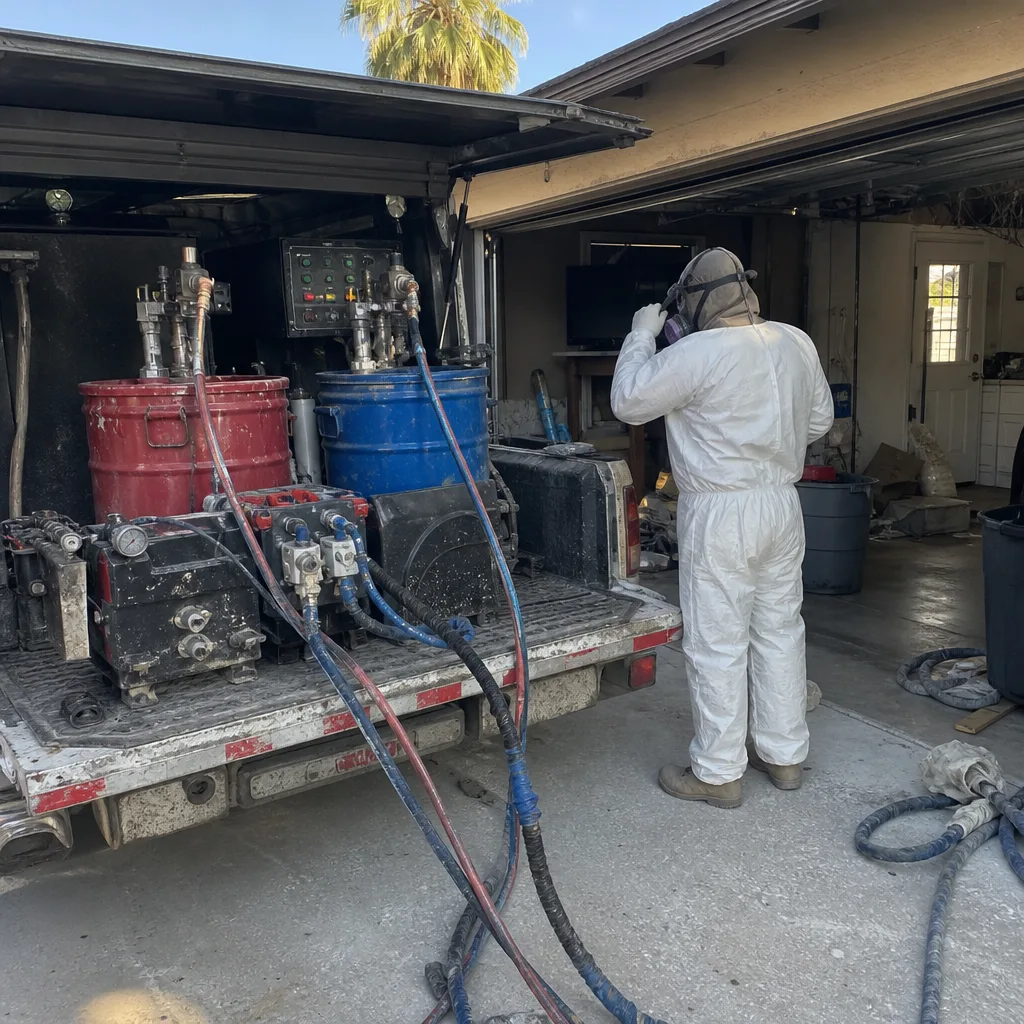
Fast, Reliable Spray Foam Insulation Across Sunland
Spray foam insulation in Sunland typically costs $2.50 to $6.50 per board foot for open-cell and $3.75 to $9.00 per board foot for closed-cell, with most whole-attic projects landing between $4,800 and $14,000. We run crews into Sunland multiple times a week, and most jobs are scheduled within five to seven business days from your call. If you’re dealing with a Sunland home where Santa Ana winds have shredded your attic insulation or your attached garage bakes all afternoon, call (855) 382-3451. We’ll walk the space, explain what’s actually happening, and quote the right fix. Not the generic one.
Sunland isn’t Burbank or Glendale. The canyon geography does things to insulation that most LA contractors never see. We’ve worked enough homes off Foothill Boulevard, Hillhaven Drive, and the streets climbing toward the Verdugo foothills to know exactly what fails here and why. That local pattern recognition is the difference between a fix that lasts and one that comes loose in the first strong wind event. Our Spray Foam Insulation team treats Sunland as its own job site, not an extension of the Valley.
Why Thermal Insulation Co Is Sunland’s Preferred Spray Foam Insulation Company
We’re a dedicated insulation contractor. That’s the whole trade. We’re not a general remodeler who picked up a foam rig to fill slow weeks, and we’re not tied to one manufacturer’s product line. Ruben Castellano runs our crews and has built the company around fit-to-application work: the material and method match the home’s actual condition, not our inventory. Sunland homeowners call us because someone in the neighborhood already had us out, and the work held up through a full season of wind and heat.
Our response to Sunland is measured in days, not weeks. We cover both 91040 and 91041 with the same scheduling priority as our own Van Nuys base. For canyon-edge properties near the Verdugo foothills, we’re familiar with the access quirks: narrow driveways, detached garages with questionable framing, low-slope roof decks that collect heat all afternoon. That familiarity means we arrive knowing what to look for and spend less of your time diagnosing on the day of the job. Quotes are free, and we don’t push a sale when the honest answer is a smaller repair.
Garage Spray Foam Insulation in Sunland
Garage Spray Foam Insulation is the most requested sub-service we handle in Sunland, because the attached garages on homes built between the 1940s and 1970s here are uninsulated heat boxes bolted to the side of the living space. In July, that garage ceiling radiates into whatever room sits above it all night. In a Santa Ana event, the garage becomes a wind tunnel that pressurizes the rest of the house. Spray foam on the garage ceiling and rim joist areas fixes both problems at once: the foam seals against air movement and adds real thermal resistance where there was none.
A typical attached garage ceiling in Sunland runs $1,800 to $4,200 depending on square footage, joist depth, and how much old debris we need to remove first. Rim joist sealing in the same structure adds $55 to $90 per linear foot. We use open-cell foam here most of the time. It’s the right tool for garage ceilings where airtightness matters more than maximum R-value per inch.
Legacy Framing and Dust Prep
Sunland garages from the 1950s and 1960s have decades of exhaust residue, sawdust, and oil film on the framing. Spray foam does not stick to that. If you skip the prep, it delaminates. We vacuum, scrape, and in some cases wipe the joists before application. That step is the difference between foam that’s still there in ten years and foam that’s peeling off the ceiling next spring.
Rim Joist Sealing in Sunland’s Tract Homes
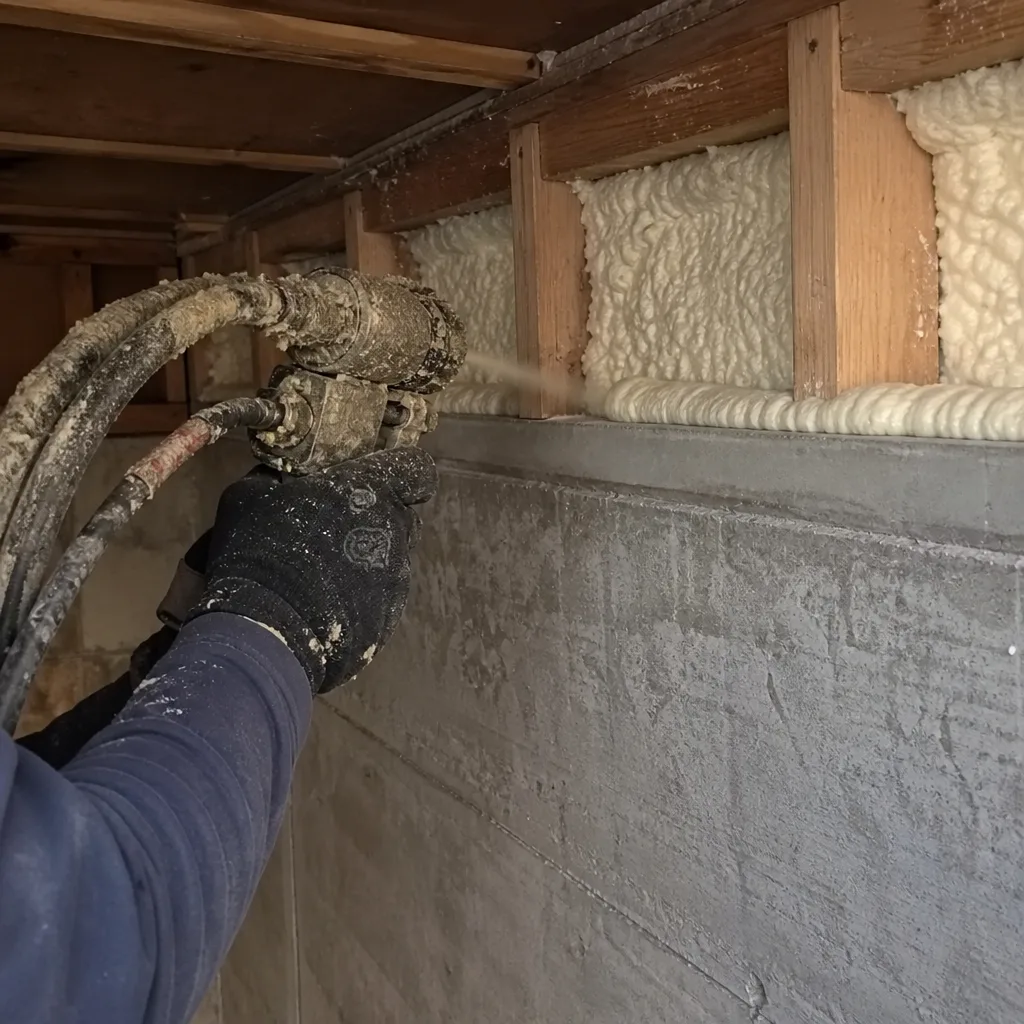
The rim joist is where the floor framing meets the foundation wall, and in Sunland’s postwar tracts it’s almost always unsealed. Santa Ana gusts push straight through those gaps and into the house. Closed-cell foam on the rim joist stops that air movement and adds structural rigidity to older framing. This is a half-day job in most garages and one of the highest-return fixes we do in Sunland.
Closed Cell Spray Foam Insulation in Sunland
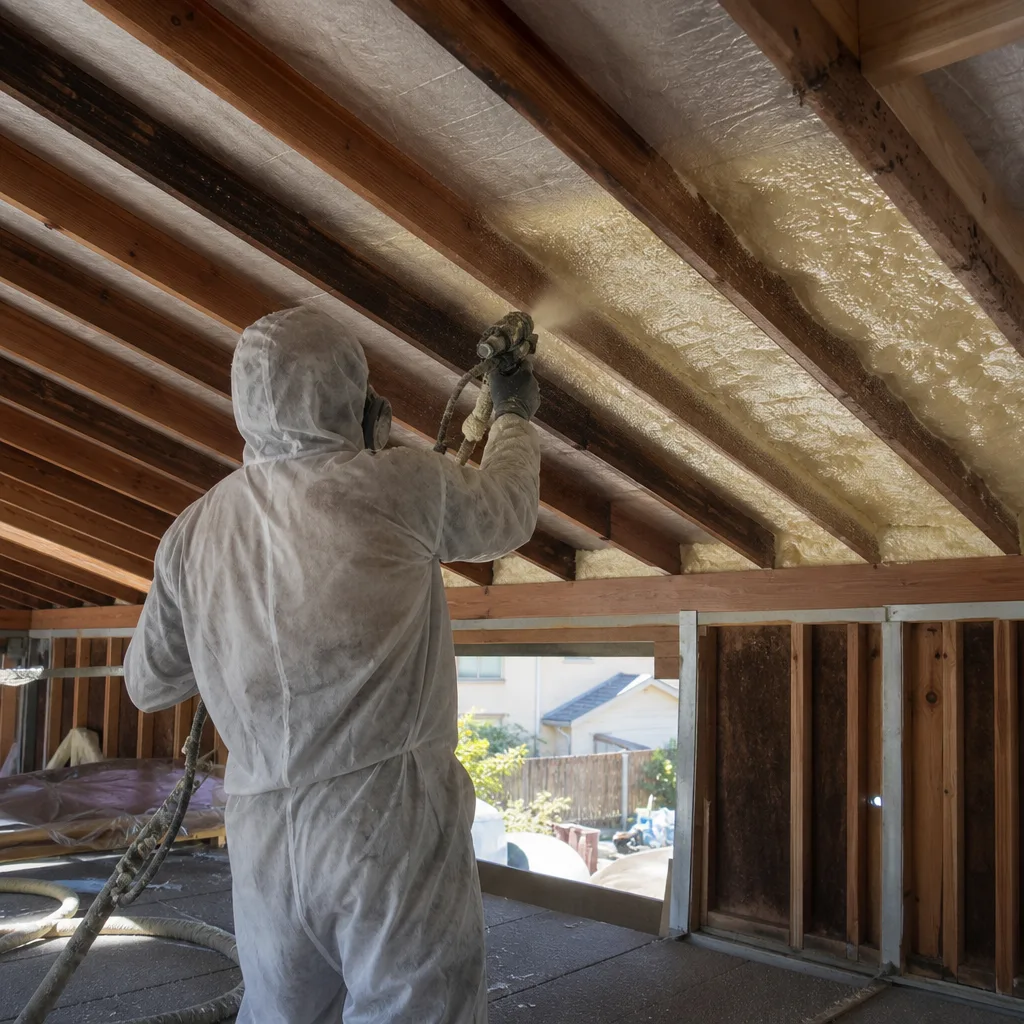
Closed Cell Spray Foam Insulation is the heavier option we recommend for Sunland homes where wind load, moisture control, or structural stiffening are the primary concerns. At 2 to 2.2 pounds per cubic foot and roughly R-6.5 to R-7 per inch, it’s denser, stiffer, and fully vapor-impermeable. We use it on roof decks in canyon-edge homes where Santa Ana winds have repeatedly displaced batt insulation, and on flat and low-pitch roofs where the Sunland sun turns an uninsulated attic into a convection oven.
Closed-cell work in Sunland runs $3.75 to $9.00 per board foot, with a typical 1,000-square-foot roof deck landing between $6,500 and $11,000. It costs more than open-cell. It also does things open-cell cannot: it structurally bonds the framing, sheds bulk water, and stops wind-driven air infiltration cold. Ruben is direct about this on estimates: if your roof deck doesn’t need closed-cell, he’ll tell you. We don’t upsell density for its own sake.
Wind-Resistant Adhesion for Canyon Homes
Sunland homes up against the Verdugo foothills get hit with sustained gusts that would barely register in Shadow Hills or Tujunga. Closed-cell foam applied directly to the roof deck stays in place because it bonds to the substrate and to the framing. There’s nothing to blow around. We pair it with proper vent baffling at the eaves so the roof assembly still breathes the way it was designed to.
Flat-Roof Heat Gain and Foam Depth
Most of Sunland’s low-pitch and flat roofs have minimal attic space, which means the roof deck radiates heat straight into the living area. Closed-cell foam at 2 to 3 inches on the underside of the deck puts a true thermal break between the sun and the ceiling. In homes we’ve worked on near Stonehurst Park, this single change shut off the afternoon heat transfer enough that the owners noticed it on the first hot day. We also inspect for vapor-drive issues when we quote flat-roof work, because closed-cell changes how a roof assembly dries.
Trusted Brands We Service in Sunland
We install spray foam from Icynene and Demilec, and we carry those lines because they’ve held up in high-heat, high-wind applications like the Verdugo Mountain corridor. For Sunland clients who are comparing traditional insulation alternatives, we also work with Johns Manville and Owens Corning fiberglass, plus Rockwool for fire-resistant mineral wool applications. We stock common foam depths and sealants so Sunland jobs don’t stall waiting on a parts order out of Los Angeles. When we quote a job, the brand choice is tied to what the home needs: open-cell for cost-effective airtightness, closed-cell for wind and moisture, and fiberglass or mineral wool where batts genuinely make more sense. We’ll explain which one and why.
Common Spray Foam Insulation Problems We See in Sunland Homes
- Wind-scoured attic insulation. Santa Ana gusts funnel through attic vents and physically push fiberglass batts away from the eaves, leaving bare spots and shredded material piled against gable vents. We see this constantly in Sunland and almost nowhere else in the LA basin. The fix is foam that adheres to the substrate and doesn’t move.
- Heat gain through uninsulated flat and low-pitch roofs. Sunland runs several degrees hotter than Burbank or Glendale on summer afternoons, and a dark roof deck over a shallow attic turns any living space below it into an oven. Spray foam on the underside of the deck breaks that heat path.
- Delaminated foam on old garage ceilings. Foam applied by another contractor to a 1950s garage ceiling without proper dust and oil prep will peel off within a season. The foam isn’t failing; the prep failed. We fix those properly, which means removing the old material and redoing it correctly.
- Air leaks through unsealed rim joists and top plates. Pre-1980s Sunland tract homes were framed fast and insulated little. The gaps left behind at the top plates, around plumbing penetrations, and along rim joists let wind-driven air move through the house. During a Santa Ana event, rooms get drafty and dusty. Closed-cell foam is the only material that permanently seals those leaks.
Pricing for Spray Foam Insulation in Sunland, CA
Here are honest numbers for Sunland work. Open-cell spray foam runs $2.50 to $6.50 per board foot; closed-cell runs $3.75 to $9.00 per board foot. A full attic roof deck in a 1,200-square-foot ranch off Foothill Boulevard typically lands between $5,500 and $9,500 for open-cell and $7,500 to $13,000 for closed-cell. Garage ceilings run $1,800 to $4,200, rim joist sealing $55 to $90 per linear foot. What shifts the number: roof geometry, attic accessibility, how much old insulation we’re removing, and whether framing needs cleaning before application. We give a written, line-item quote before any work starts. Call (855) 382-3451 for a free estimate. We’ll tell you what you need, what you don’t, and what it costs.
We Also Serve Cities Near Sunland
Our service area for Sunland extends into the surrounding foothill communities. We run crews regularly into Shadow Hills, Tujunga, and La Crescenta-Montrose, and we handle jobs in Burbank as well. If you’re just over the canyon line, call the same number and ask for scheduling.
Serving Sunland, CA — Our Local Coverage Area
We’re based in the Sunland area and know this community well. Use the map below to see our service coverage — if you’re nearby, we can almost certainly help.
FAQs About Spray Foam Insulation in Sunland
Fiberglass batts sit loose in the framing cavity and get pushed around by any sustained air movement, and Sunland’s Santa Ana winds create exactly that. Spray foam adheres directly to the substrate and the framing, so there’s nothing to scour or displace. It also air-seals as it insulates, which batts cannot do. For canyon-edge Sunland homes, that wind resistance is the primary reason we recommend foam over batts in attics and roof decks. Call (855) 382-3451 and we’ll come assess your attic’s wind exposure.
Yes, and we do it regularly. The 1950s garage ceilings in Sunland are usually open-framed, which makes them ideal for spray foam. The critical step is prepping the old framing: vacuuming dust, cleaning oil and exhaust residue, and confirming the wood isn’t so brittle it needs repair first. Once the foam is in, the garage stops radiating heat into the house and stops acting as a wind pressure chamber during Santa Ana events.
Flat and low-pitch roofs in Sunland absorb heat all afternoon, and the shallow attic space below converts that into a radiant ceiling over the living area. Spray foam applied to the underside of the roof deck puts a thermal barrier between the sun-heated decking and the interior. In practice, this means the ceiling stops feeling warm to the touch by late afternoon, and interior temperatures stay noticeably more stable. This is the single most effective intervention for Sunland’s flat-roof heat gain problem.
If the failure is localized, such as wind-scoured batts in one corner of the attic, a targeted repair may make sense: remove the damaged material, air-seal the gaps, and re-insulate that section. If the failure is systemic, meaning the batts are shredded throughout, the vents are unsealed, and the roof deck bakes the house every summer, a full spray foam retrofit is usually the better call. We’ll give you both numbers and let you decide. Call (855) 382-3451 for a free on-site assessment.
We use both, and we select between them based on the specific application. Icynene’s open-cell products are our default for garage ceilings and attic floors where airtightness is the goal and cost per board foot matters. Demilec’s closed-cell products get the call for roof decks, canyon-edge homes, and any application where wind resistance, moisture control, or structural bonding are required. Both have held up well in the Verdugo Mountain corridor’s heat and wind conditions. We’ll show you samples and explain which one fits your house.
Written by Ruben Castellano, Owner at Thermal Insulation Co, serving Sunland and the Verdugo foothill communities.