
Fast, Reliable Spray Foam Insulation Across Spring Valley Lake
Spray foam insulation in Spring Valley Lake typically runs $2.50 – $7.00 per board foot depending on whether you need open-cell or closed-cell, and most homes here see the highest return when we seal west- and south-facing assemblies first. That is the direct answer. If you live in Spring Valley Lake, you already know your energy profile: scorching afternoon sun off the lake and golf course, then freezing desert nights that pull heat straight out of your attic. We respond to Spring Valley Lake calls within 24 – 48 hours and our crews work the 92395 corridor every week. Call (855) 382-3451 for a free estimate, and we will tell you honestly whether spray foam is the right material for your specific walls, or whether blown-in attic insulation would serve you better.
Why Thermal Insulation Co Is Spring Valley Lake’s Preferred Spray Foam Insulation Company
We are a dedicated insulation contractor. That means we do not also pour concrete, replace windows, or run electrical. Insulation is the whole trade here, and in Spring Valley Lake that focus matters because the wall assemblies around this lake are not forgiving. Early-1970s ranch and Spanish-style homes with vaulted ceilings, original attic insulation, and sun-exposed rear walls facing the water need a contractor who can look at a rim joist or a top plate and know exactly what is happening to it across a 40-degree daily temperature swing.
Ruben Castellano leads our team, and his approach is methodical: we identify where conditioned air is actually escaping before we ever recommend a material. That sequencing is rare. Many companies will sell you the same foam package they sold the last house. We will not. Spring Valley Lake homes on the lake side need different work than homes tucked back near the golf course or along the southern edge of the community, and we plan accordingly.
Because we stock Spray Foam Insulation systems from Icynene and Demilec alongside fiberglass, mineral wool, and cellulose, our recommendation is driven by your home’s exposure and construction, not by what is sitting in our warehouse. That brand-agnostic approach is the reason Spring Valley Lake homeowners call us for second opinions after getting a one-material pitch from someone else.
Garage Spray Foam Insulation in Spring Valley Lake
Garage Spray Foam Insulation in Spring Valley Lake is one of the fastest ways to fix a room that swings from 110°F in July to near-freezing in January. Most garages here are attached to the home but were built with bare stud walls and zero insulation above the ceiling. That means the garage acts as a heat sink during the day and a cold box at night, pulling conditioned air from the rest of the house through the shared wall. Sealing the garage ceiling and the rim joists where the garage meets the house is the first step. A typical garage ceiling spray foam job in Spring Valley Lake runs $1,800 – $4,200 depending on square footage and whether we are doing open-cell or closed-cell. Call (855) 382-3451 and we will measure it.
Water-Facing Garage Walls
If your garage door or the long wall of your garage faces the lake or the golf course, you are getting direct afternoon solar gain on an uninsulated assembly. Closed-cell foam on those walls blocks radiant heat transfer and adds structural rigidity. We see this on nearly every lakeside property we inspect.
Rim Joist Sealing in the Garage
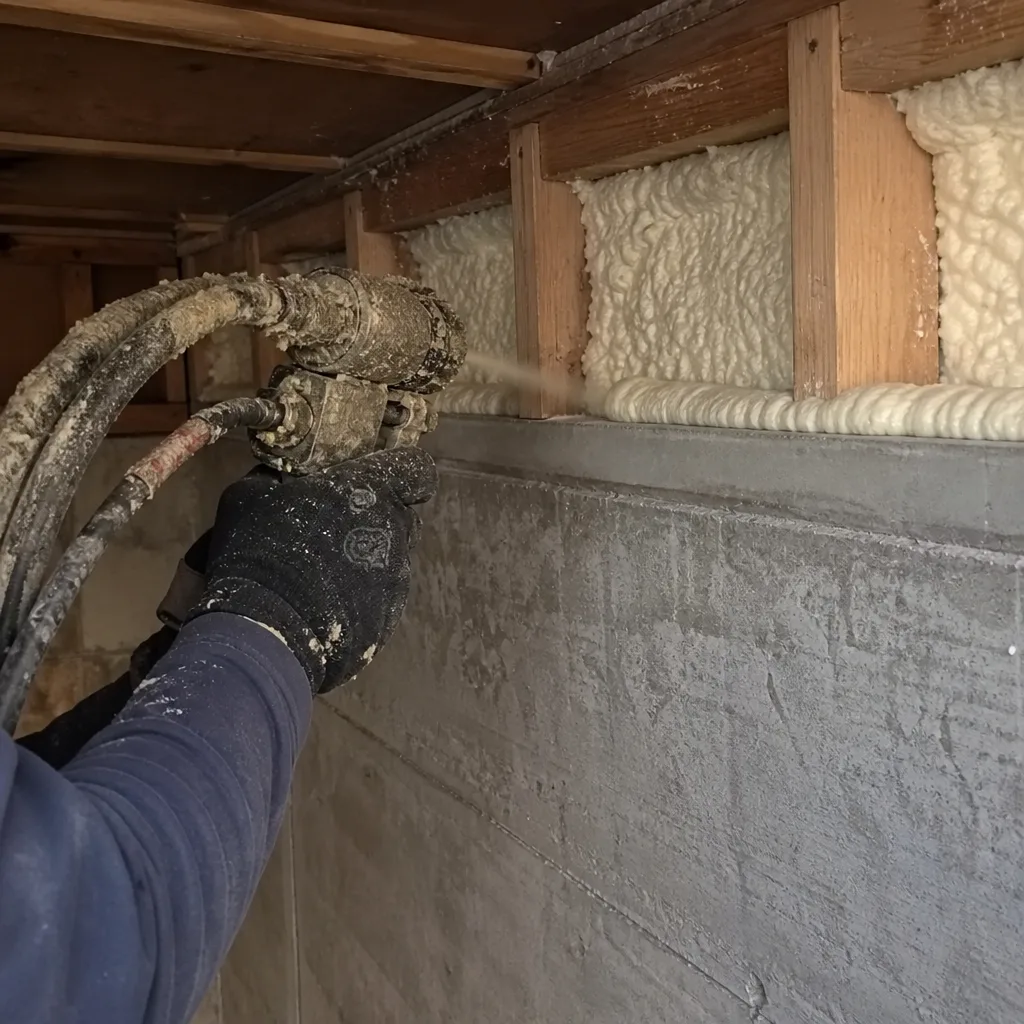
In Spring Valley Lake’s older homes, the rim joists above the garage foundation are often completely unsealed. That gap lets hot desert air pour in during summer and lets frost form on the joist cavities in winter. Closed-cell foam applied to the rim joist band stops both conditions at once.
Closed Cell Spray Foam Insulation in Spring Valley Lake
Closed Cell Spray Foam Insulation in Spring Valley Lake is the material we recommend most often on west- and south-facing walls and rim joists, because this community’s lakefront and golf-course exposure creates an unusual dual load. At 3,000 feet in the high Mojave, those walls take 100°F+ radiant gain off the water and turf every afternoon, then face below-freezing nights where any trapped moisture can condense and degrade open-cell foam. Closed-cell foam has a higher R-value per inch, acts as a vapor retarder, and adds shear strength to older framing. A closed-cell rim joist package on a typical 1970s Spring Valley Lake home runs $2,200 – $5,800 depending on linear footage and access.
Why Closed-Cell Handles the Frost Cycle Better
The diurnal swing here is severe. A 40-degree temperature shift in 12 hours is normal. Open-cell foam is vapor-permeable, which works in some climates but can absorb moisture during winter condensation cycles on a cold rim joist. Closed-cell does not. That is not a minor detail; it is often the difference between a foam job that lasts 15 years and one that starts sagging in five.
The West Wall Problem
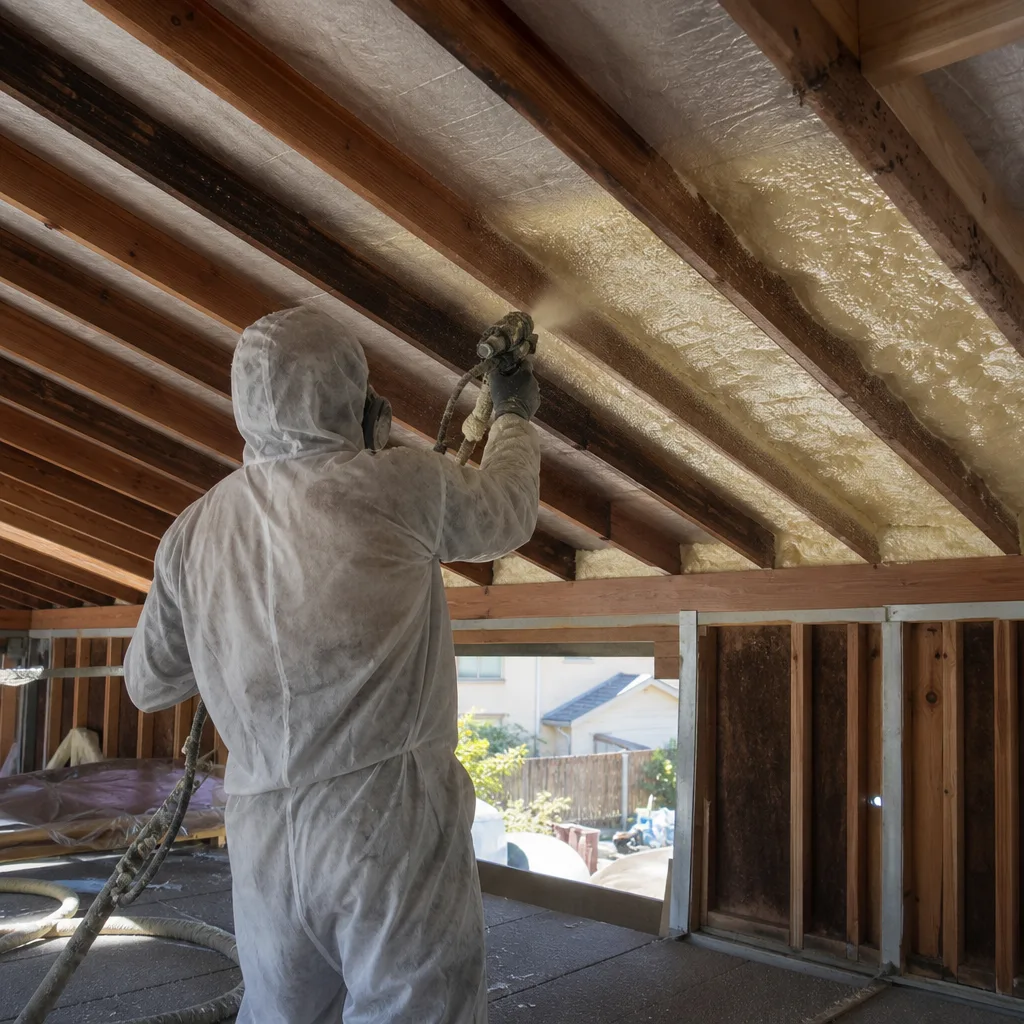
On a 1974 ranch-style home on the lake side of Spring Valley Lake, our crew opened a vaulted-ceiling attic and found original thin attic insulation and unsealed top plates feeding a west-facing room that baked every afternoon off the water. We applied closed-cell spray foam to the rim joists and top plates and sealed the duct runs, which stopped the convective heat gain into that room and the winter draft along the same wall. If your west wall feels like a radiator by 3 p.m., that is the condition.
Trusted Brands We Service in Spring Valley Lake
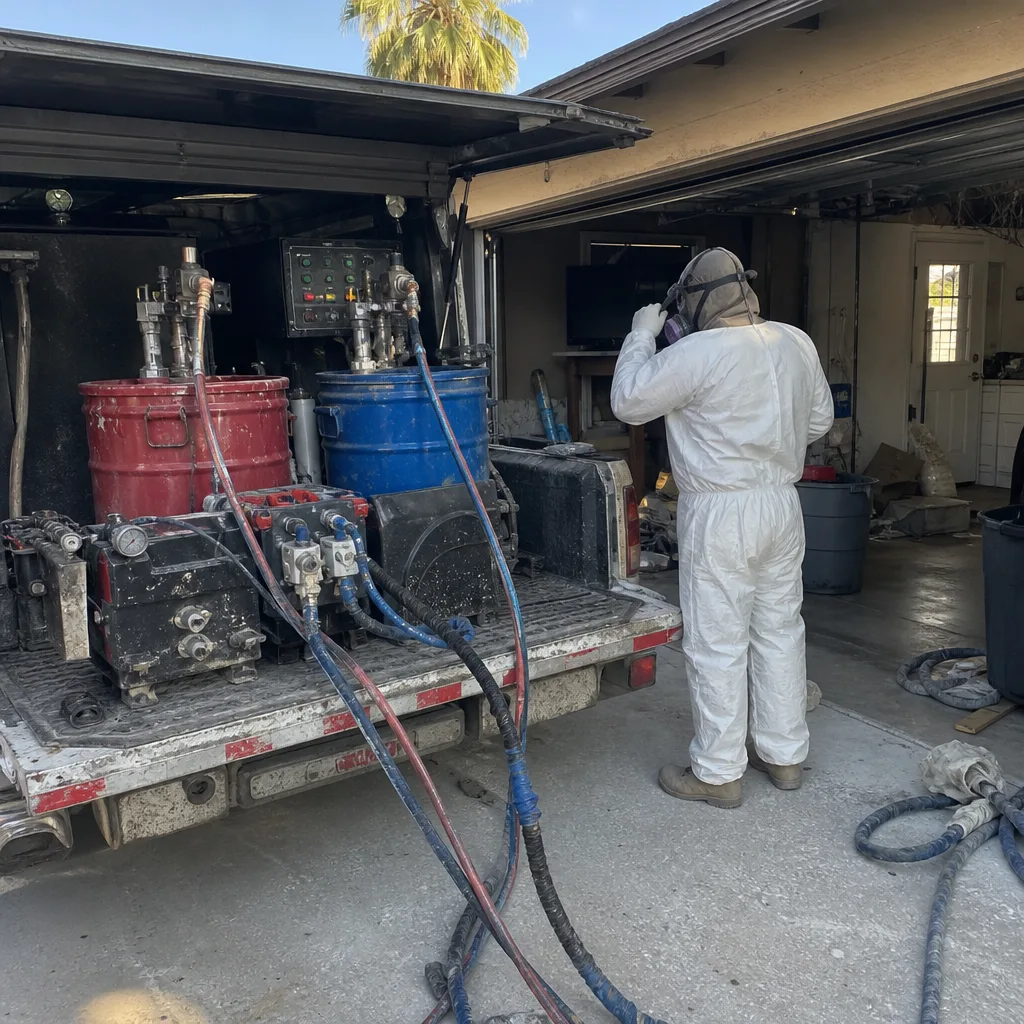
We carry Icynene and Demilec spray foam systems because those two product lines give us the open-cell and closed-cell range we need for the varying wall assemblies in Spring Valley Lake. We also install Owens Corning and Johns Manville fiberglass, Rockwool mineral wool, and GreenFiber cellulose, which means when we tell you foam is the right call on a specific wall, it is not because that is the only material we sell. We keep foam and sealant stock staged for Spring Valley Lake jobs, so we are not running back to a supply house mid-install. That keeps the work moving and your home sealed faster.
Common Spray Foam Insulation Problems We See in Spring Valley Lake Homes
- Unsealed top plates on 1970s vaulted ceilings. Original construction in this community often left the top plate gaps wide open, so afternoon lake glare pours heat directly into the upper wall cavity. We find this on nearly every vaulted ceiling we open in Spring Valley Lake.
- Deteriorated open-cell foam on sun-exposed rear walls. Older open-cell foam that was sprayed years ago on a west-facing wall can absorb moisture during winter frost cycles, sag, and lose its R-value. Closed-cell replacement on those specific walls is the fix.
- Unsealed rim joists and duct runs in legacy construction. The homes around the lake and golf course were built before air sealing was standard practice. Foam alone on the attic floor will underperform if the rim joists and duct boots are still leaking conditioned air into the attic space.
- Garage ceiling heat transfer into living space. Attached garages with uninsulated ceilings act as thermal batteries. In August the garage hits 110°F and that heat bleeds through the shared wall into the house, making your AC run longer than it should.
Pricing for Spray Foam Insulation in Spring Valley Lake, CA
Open-cell spray foam in Spring Valley Lake runs $2.50 – $4.50 per board foot installed, while closed-cell runs $4.50 – $7.00 per board foot. A typical rim joist package for a 1,800-square-foot home lands around $2,800 – $4,800. A full garage ceiling and wall job runs $2,500 – $6,000. What moves the number is access: vaulted ceilings, tight attic hatches, and lake-facing walls that require ladder work on sloped terrain all add labor. We give free estimates with exact pricing before you commit, and we will tell you if a less expensive blown-in or batt option would actually perform better for a specific area. Call (855) 382-3451 to schedule a walk-through.
We Also Serve Cities Near Spring Valley Lake
Our crews work the entire high-desert corridor around Spring Valley Lake. We serve Mountain View Acres, Victorville, Apple Valley, and Hesperia, and we are often in the area multiple times per week. If you are in a neighboring community and need Spray Foam Insulation in Spring Valley Lake’s style of older housing stock, we can schedule you on the same route. Call (855) 382-3451 and mention your city when you book.
Serving Spring Valley Lake, CA — Our Local Coverage Area
We’re based in the Spring Valley Lake area and know this community well. Use the map below to see our service coverage — if you’re nearby, we can almost certainly help.
FAQs About Spray Foam Insulation in Spring Valley Lake
West-facing walls in Spring Valley Lake take direct afternoon solar gain off the lake and golf course, which can push surface temperatures past 120°F in summer, and closed-cell foam blocks that radiant heat transfer while acting as a vapor retarder during winter frost cycles that hit the same wall. You need both properties on one assembly, and open-cell foam does not deliver the vapor control. We typically recommend closed-cell specifically on those west and south exposures, while other walls may do fine with open-cell at a lower cost.
Yes. Spray foam is the most effective way to seal duct boots, top plates, and rim joists in older Spring Valley Lake construction because it conforms to the irregular gaps left by 50-year-old framing. But the ducts themselves need to be sealed at the registers and connections too. We foam the envelope penetrations and then inspect the duct runs, because foam alone on the attic floor will not fix air leaking from a disconnected duct joint. Call (855) 382-3451 for a free attic inspection.
Most likely yes, at least on the ceiling and the wall facing the exposure. Garages on lake-facing or golf-course-facing lots in Spring Valley Lake absorb reflected solar gain off the water and turf all afternoon, and the uninsulated ceiling transfers that heat into the rooms above or beside the garage. Sealing the garage ceiling and rim joists with closed-cell foam is usually the highest-impact fix we can make on those properties.
Open-cell foam is lighter, less expensive, and allows moisture to pass through, which can work in a vaulted ceiling as long as the roof assembly has proper ventilation. Closed-cell foam is denser, costs more, and creates a full air and vapor barrier, which we recommend on vaulted ceilings over lake-facing rooms where condensation risk and radiant heat are both present. For a vaulted ceiling over a west-facing living room in Spring Valley Lake, closed-cell is almost always the right call.
Spray foam can be applied in Spring Valley Lake year-round, but the season changes how we prep. In summer the substrate temperature on an unshaded attic deck can exceed 140°F, so we schedule those jobs in the early morning. In winter we verify the surface is above the manufacturer’s minimum application temperature, usually by tenting or staging heat. The diurnal swing does not prevent application; it just means we plan around it instead of spraying at 2 p.m. in August.
If you own a home in Spring Valley Lake and your west-facing rooms heat up every afternoon, or your garage feels like an oven, call Thermal Insulation Co at (855) 382-3451. We will inspect the actual wall and attic assemblies, tell you which material and method fits best, and give you a written estimate that same day. Free estimates, no obligation.
Written by Ruben Castellano, Owner at Thermal Insulation Co, serving Spring Valley Lake and the high-desert communities of the 92395 corridor.