
Fast, Reliable Spray Foam Insulation Across Hesperia
Spray foam insulation in Hesperia typically runs $2.50 to $6.50 per board foot installed, with most full attic retrofits landing between $3,800 and $9,200 depending on the roof deck area and whether we’re doing open-cell or closed-cell. Our crews work in Hesperia every week, from the 92345 tract subdivisions off Main Street to the larger horse-property parcels out toward the 92344 side. We know these attics: shallow, hot, and carrying ductwork that cooks all summer. If you’re done with rooms that never hold temperature and a cooling bill that climbs every June, call us at (855) 382-3451 and we’ll walk you through what your attic actually needs.
Why Thermal Insulation Co Is Hesperia’s Preferred Spray Foam Insulation Company
We’re an insulation contractor, full stop. We don’t do roofs, we don’t do plumbing, and we don’t send a generalist out to figure out your attic. Spray foam is one of three methods we install, alongside blown-in and batt insulation, which means when Ruben Castellano’s crew looks at a Hesperia attic, the recommendation comes from seeing what each material actually does in that space – not from pushing the one product we happen to stock. That matters here because Hesperia’s housing stock is specific: 1980s and 1990s tracts with shallow roof pitches, manufactured homes on larger lots, and detached garages that were insulated informally or never touched. We see the same failure patterns block after block in 92345. Settled fiberglass, exposed top plates, duct jackets baking past 130 degrees. The fix isn’t always spray foam, and we’ll tell you when it isn’t. That’s why homeowners call us back for their second property, and why the referrals from the Spring Valley Lake area keep coming.
Spray Foam Attic Insulation in Hesperia
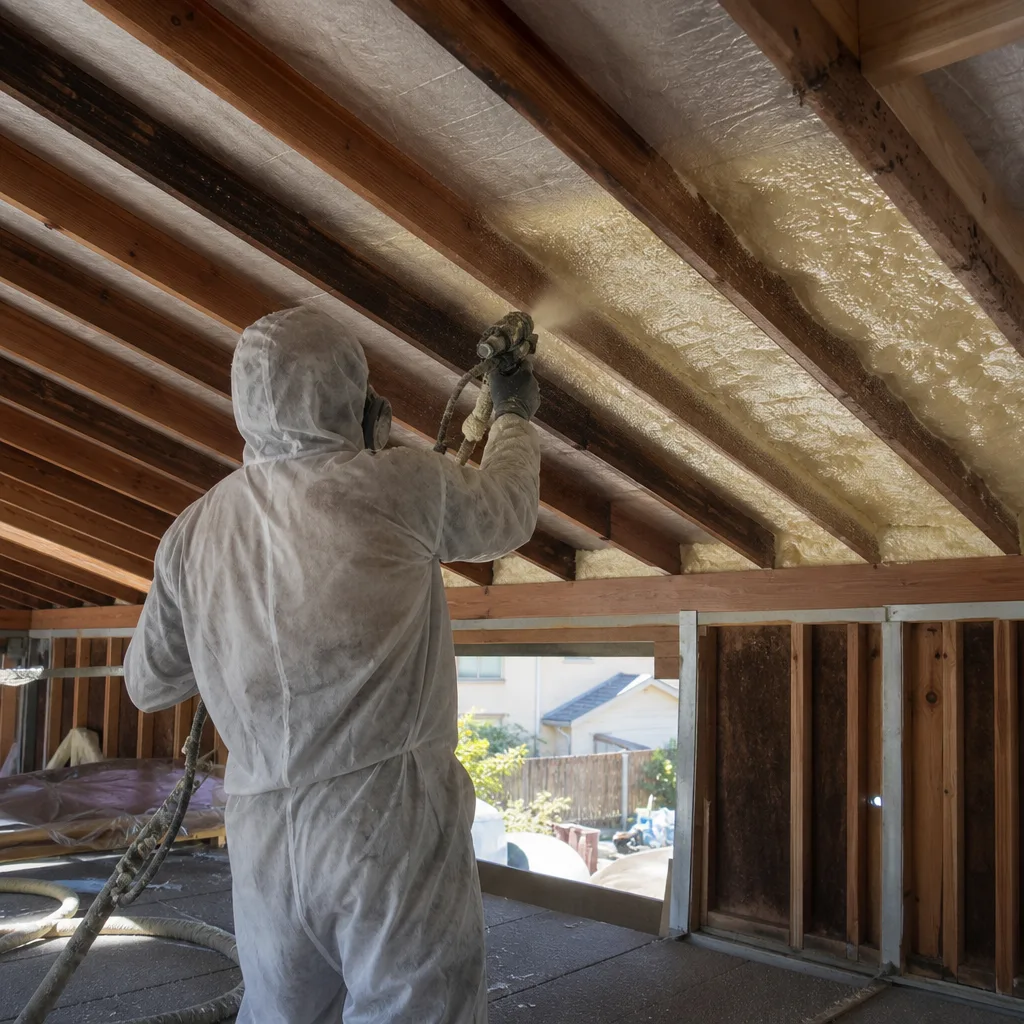
Spray Foam Attic Insulation in Hesperia is a different job than what you’d spec in a coastal city, because the attic here isn’t just hot – it’s carrying your furnace ductwork through a 140°F oven and asking it to deliver cool air. When we foam the roofline, we’re pulling the attic into the conditioned envelope, which means the ducts stop fighting the heat and the top plate air leaks get sealed as part of the same application. A typical open-cell attic retrofit in Hesperia’s 92345 tract homes runs $4,200 to $7,800. Closed-cell, which we recommend when the roof deck is low-slope or the attic has been a dust trap, runs $6,500 to $11,000 because the material cost per board foot is roughly double. The payoff here isn’t just R-value. It’s that the ducts and the living space finally share one thermal boundary.
Duct Protection as a Design Priority
In most Hesperia attic retrofits, the ductwork is the deciding factor. We’ve measured roof deck surfaces past 140°F in August, and when that heat bakes a duct jacket for fifteen years, the jacket cracks and the joints loosen. Foam at the roofline means the ducts sit in conditioned space, which extends their service life and stops the heat gain that makes your AC run longer. If the ducts are already degraded, we’ll flag that before we foam – sealing foam over failing ducts just locks the problem in.
Air Sealing Before the Foam Goes On
High-desert wind and dry air mean Hesperia attics are dust-heavy, which stresses adhesion if the decking isn’t prepped. Our standard process on older 92345 and 92340 homes includes top plate sealing, penetration sealing around vents and wires, and surface cleaning before the first pass of foam. Skipping that prep is how you get delamination and air leaks under the foam – and we’ve seen enough of that from other contractors’ work to know the prep is the job.
Spray Foam Wall Insulation in Hesperia
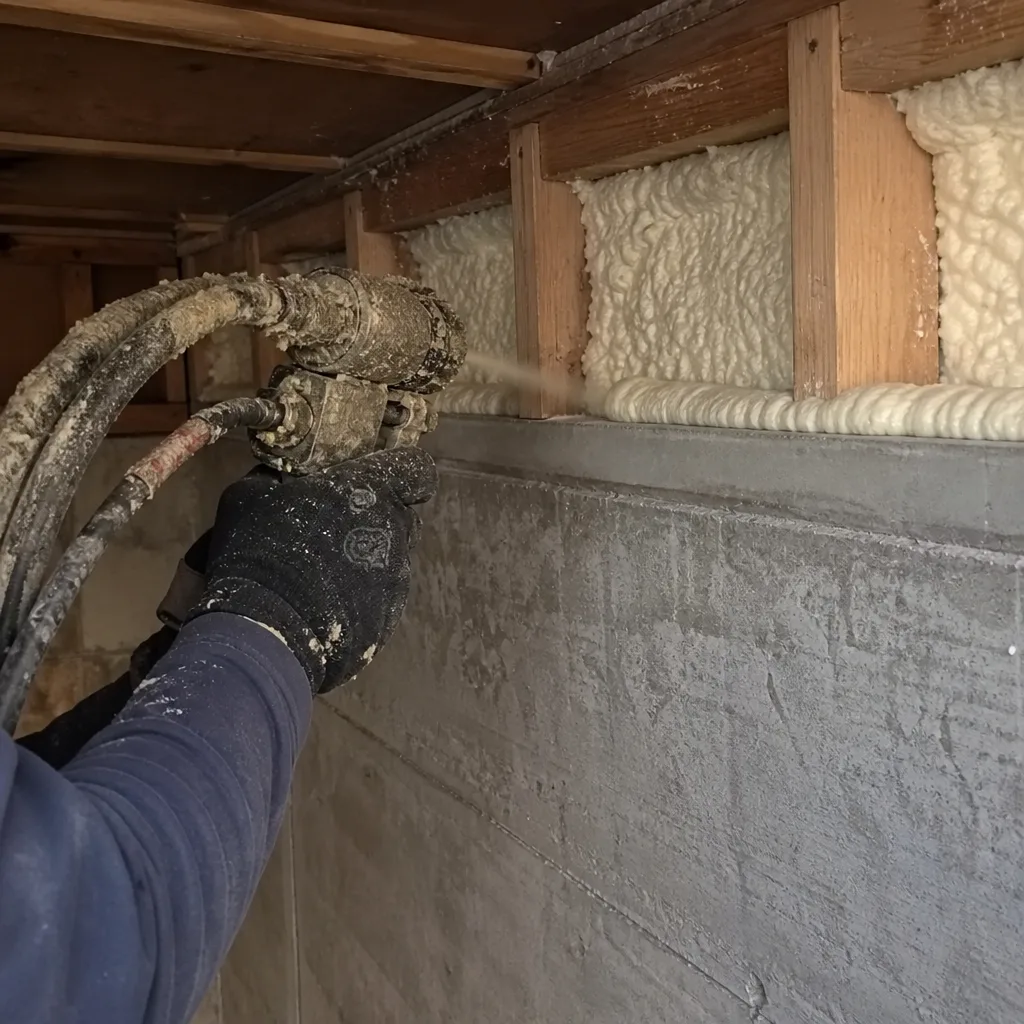
Spray Foam Wall Insulation in Hesperia shows up most in two places: the rim joist cavities of older tract homes and the exterior walls of detached garages, workshops, and additions on larger lots in 92344. The rim joist is where a home’s framed wall meets the foundation, and in 1980s construction it was rarely sealed, so it lets cold air in on winter nights that drop below freezing and lets that same air carry dust in during the windy months. Foaming the rim joist in a typical Hesperia home runs $1,400 to $2,900 depending on perimeter length and access. For wall cavities in garages or additions, closed-cell foam at two inches gives you insulation plus an air barrier plus a vapor retarder in one pass, which matters when the building wasn’t sheathed or wrapped properly the first time. Expect $3,200 to $6,500 for a typical two-car detached garage.
Rim Joist Sealing for Winter Comfort
The diurnal swing in Hesperia means the same wall assembly that bakes in the afternoon sheds heat fast after sundown. Rim joist cavities are the biggest single source of that heat loss in older tract homes, because they sit at the floor line right where cold air pools. Closed-cell spray foam seals the cavity and insulates it in one application. It’s the highest-impact wall upgrade most Hesperia homes have never had done.
Garage and Workshop Retrofits on Larger Lots
Hesperia’s residential and horse-property parcels in 92344 often have detached structures that were built without insulation or with someone’s best guess at it. When a garage becomes a workshop or a home office, we foam the walls and ceiling as a single assembly so the space holds temperature without overwhelming the home’s HVAC. The brand-agnostic approach matters here: sometimes closed-cell Icynene is right for a metal building, and sometimes an open-cell Demilec product makes more sense in a stick-framed garage. We’ll tell you which, and why.
Trusted Brands We Service in Hesperia
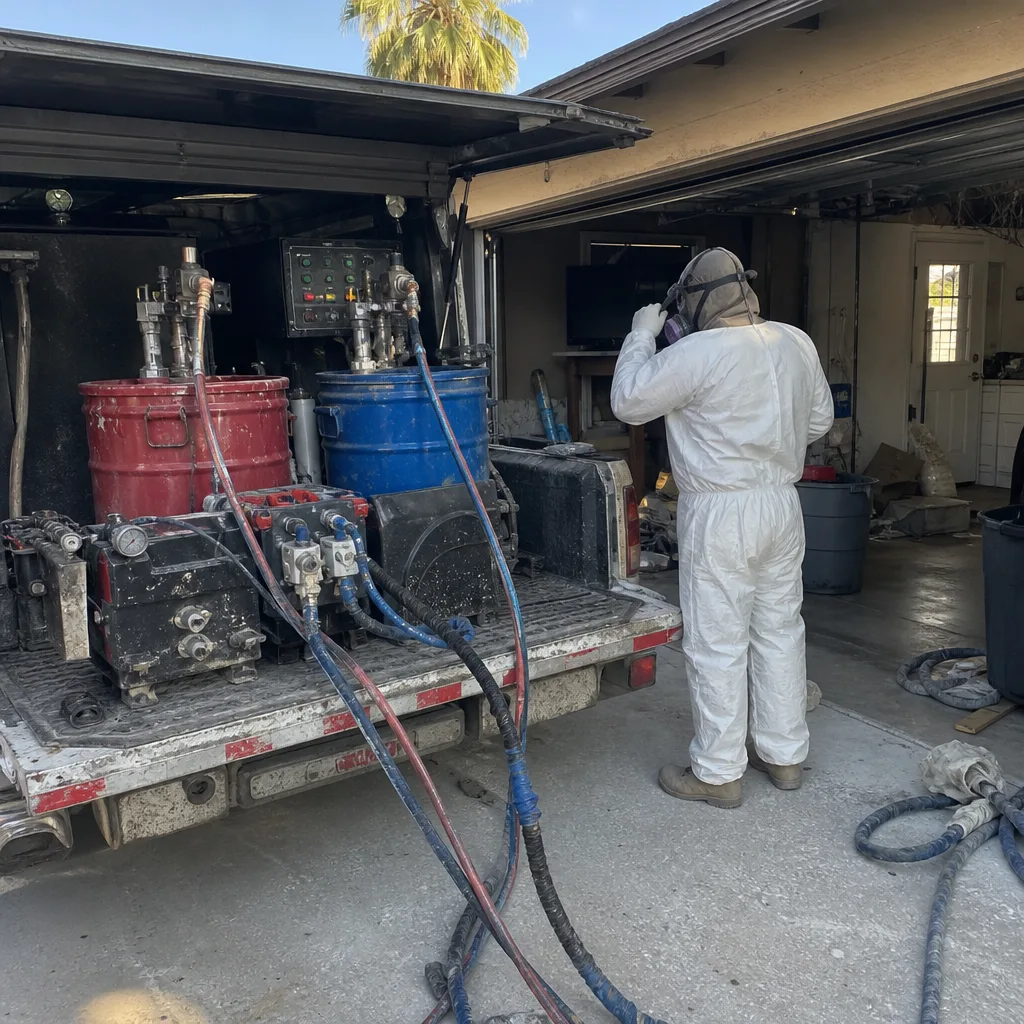
We install Spray Foam Insulation systems from Icynene and Demilec, and we carry them because they’re the two foam brands that have held up best across the High Desert’s temperature swings and dust conditions in our experience. Beyond foam, our full lineup includes Owens Corning and Johns Manville fiberglass, Rockwool mineral wool for fire- and moisture-sensitive applications, and GreenFiber cellulose for homeowners who want a recycled-content option. Hesperia homeowners get the same eight-brand access as anywhere else we work, which means the material gets matched to the attic, not the other way around.
Common Spray Foam Insulation Problems We See in Hesperia Homes
- Settled fiberglass under fresh foam. It’s tempting to spray over old blown-in insulation, but in Hesperia’s 1980s tracts that fiberglass has often settled below the top plate, which means the air leaks remain. Foam over a compromised substrate inherits the leaks it was meant to seal. We pull or stabilize the old material first.
- Baked ductwork in shallow attics. In the 92345 subdivisions, furnace ducts routinely sit in attics that pass 140°F in summer, and fifteen years of that cracks the jackets. Foam installed without addressing the ducts just traps heat against them. Duct condition evaluation is part of every attic quote we do in Hesperia.
- Foam losing adhesion on dusty decking. Wind-driven Mojave dust settles on roof decking and makes spray foam lift. We see this on informal additions and older garages in 92344 where attics were never sealed. Proper surface prep is not optional out here.
- Vapor and air-sealing failures in dry, windy conditions. The desert air is dry, but the temperature swing still creates condensation risk at the foam-to-deck interface. Closed-cell foam’s built-in vapor retarder handles this properly. Open-cell installed without considering the assembly can create moisture problems, which is why method selection is not a trivial detail in Hesperia.
Pricing for Spray Foam Insulation in Hesperia, CA
Open-cell spray foam in Hesperia runs $2.50 to $3.50 per board foot installed. Closed-cell runs $4.50 to $6.50 per board foot. Those are the real market numbers for this area, and they hold across 92340, 92344, and 92345. What moves your total is ceiling area and roof pitch: a 1,200-square-foot shallow-pitch tract attic might land around $4,500 for open-cell, while the same square footage on a custom home with vaulted ceilings could hit $8,000 and up. Wall jobs are priced by cavity area, not floor area. Every estimate we write for Hesperia includes a line item for prep work, because the dust and the settled insulation are consistent enough that we factor them in from the start. Call (855) 382-3451 for a free estimate, and we’ll give you numbers for both open-cell and closed-cell so you can decide on the actual trade-off, not a sales pitch.
We Also Serve Cities Near Hesperia
Our crews cover the High Desert consistently. In addition to Spray Foam Insulation in Hesperia, we work in Oak Hills, Mountain View Acres, Spring Valley Lake, and Victorville. If you’re on the edge of one of those communities, the same crew and the same eight brands show up. Response time is typically within a day or two for estimates anywhere in the Victor Valley.
Serving Hesperia, CA — Our Local Coverage Area
We’re based in the Hesperia area and know this community well. Use the map below to see our service coverage — if you’re nearby, we can almost certainly help.
FAQs About Spray Foam Insulation in Hesperia
Yes, and shallow attics are actually where spray foam earns its place, because it doesn’t need the depth that blown-in fiberglass needs to hit code. In a Hesperia 1980s tract home with a low-slope roof, we can apply open-cell foam directly to the roofline and hit the performance target without adding height. The bigger question is whether the ductwork and the top plates get addressed in the same pass, because those are the parts that have been leaking and baking since the house was built. Call (855) 382-3451 and we’ll tell you what your specific attic can take.
It does, especially for the underside and the rim area, where manufactured homes in Hesperia lose the most heat on freezing nights. The roof assembly on a manufactured home is often too tight for a full roofline foam job, so we typically foam the belly, the marriage line, and the rim joists instead – which tackles the air leaks first. Closed-cell is usually the right choice for manufactured home undersides because of its vapor control and structural stiffness. Call us and we’ll spec it based on your home’s actual construction, not a generic mobile home template.
Repairing means adding more of what was already there. Retrofitting means changing how the attic works. In Hesperia’s older tract homes, the existing fiberglass has often settled below the top plate and the attic is vented, so adding more fiberglass on top doesn’t fix the air leaks or the radiant heat gain. Retrofitting with spray foam seals the attic, pulls the ducts into the conditioned space, and stops the heat at the roofline. It costs more up front, but you’re fixing the problem instead of repeating the same fix every decade.
No. Spray foam on the roofline already stops the radiant heat transfer, because the foam itself is the barrier. Radiant barriers work in vented attics with air gaps; once you foam the roofline, you’ve eliminated the vented space and the radiant barrier becomes redundant. If you want to keep a vented attic and just reduce radiant gain, that’s a different conversation, and we can quote you the blown-in and radiant barrier option side by side with the foam option so you can make an informed call.
We install Icynene open-cell and Demilec closed-cell systems. We carry both because they serve different performance needs: Icynene’s open-cell for roofline applications where breathability and air sealing matter most, and Demilec’s closed-cell for rim joists, wall cavities, and any application where moisture control and structural strength matter in a desert assembly. We can quote both on the same attic and explain the real-world difference in a Hesperia summer. Call (855) 382-3451 for a free estimate on either system.
Written by Ruben Castellano, Owner at Thermal Insulation Co, serving Hesperia, CA. We work in attics and walls all over the High Desert, and we’re still learning from every house we open up.