
Fast, Reliable Spray Foam Insulation Across Rancho Cucamonga
Spray foam insulation in Rancho Cucamonga means solving two problems at once: the 100°F+ attic heat that cooks tract homes every summer, and the Santa Ana winds that peel old batts apart every fall. We work the foothill tracts off the 210 corridor routinely, so we know what happens to builder-grade fiberglass after twenty years of desert gusts. If your attic is under-insulated or your cooling bills keep climbing, call (855) 382-3451 for a free estimate. We’ll tell you whether spray foam actually makes sense for your home before you spend a dime.
Why Thermal Insulation Co Is Rancho Cucamonga’s Preferred Spray Foam Insulation Company
Insulation is our only trade. That matters in Rancho Cucamonga, where a generalist contractor who sprays foam occasionally won’t know that surfaces on foothill homes need extra prep before application or that vent sealing has to happen before R-value conversations. We do.
Ruben Castellano leads our insulation team, and his standard on every Rancho Cucamonga job is that the foam adheres correctly the first time. Wind does not forgive shortcuts. When we spray a roof deck on a home backing the foothills, we’re thinking about what October winds will do to it, not just how it looks next week.
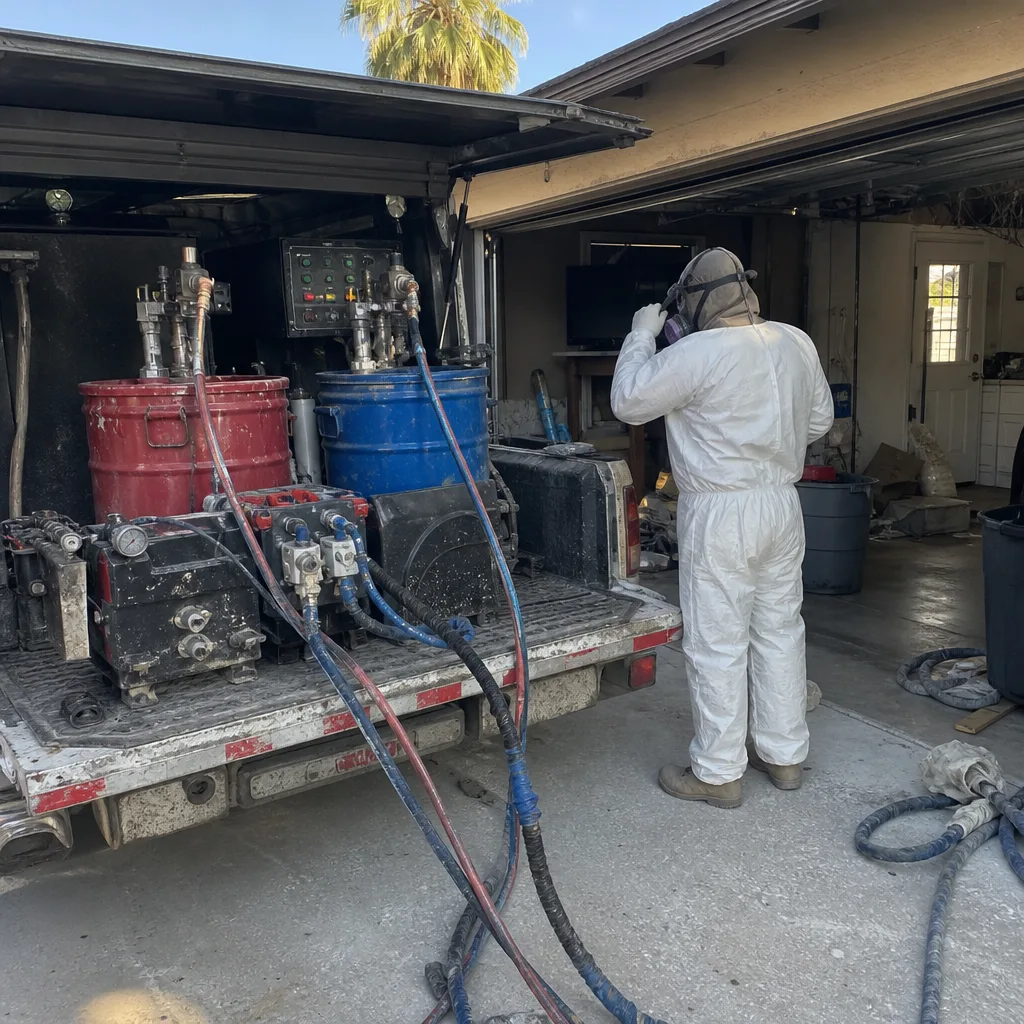
We carry Spray Foam Insulation products from Icynene and Demilec, which gives us both open-cell and closed-cell options depending on what the house needs. Rancho Cucamonga attics often need open-cell for the roof deck and closed-cell for rim joists, and having both under one roof means we match the material to the application instead of forcing one product everywhere.
Response time to the 91737, 91739, 91701, and 91729 zip codes is typically same-week, often faster. Most estimates are free, and we’ll give you an honest read on whether spray foam, blown-in, or batt is the right move for your attic.
Spray Foam Attic Insulation in Rancho Cucamonga
Spray Foam Attic Insulation in Rancho Cucamonga typically runs $2,800 to $7,500 depending on square footage, foam type, and whether the roofline needs vent sealing first. Most 1980s and 1990s tract homes in 91737 and 91739 still have original builder-grade batts that have compressed to maybe R-19 when the attic should be closer to R-38 or R-44. In the 91701 older ranch-era pockets, attics can be even worse.
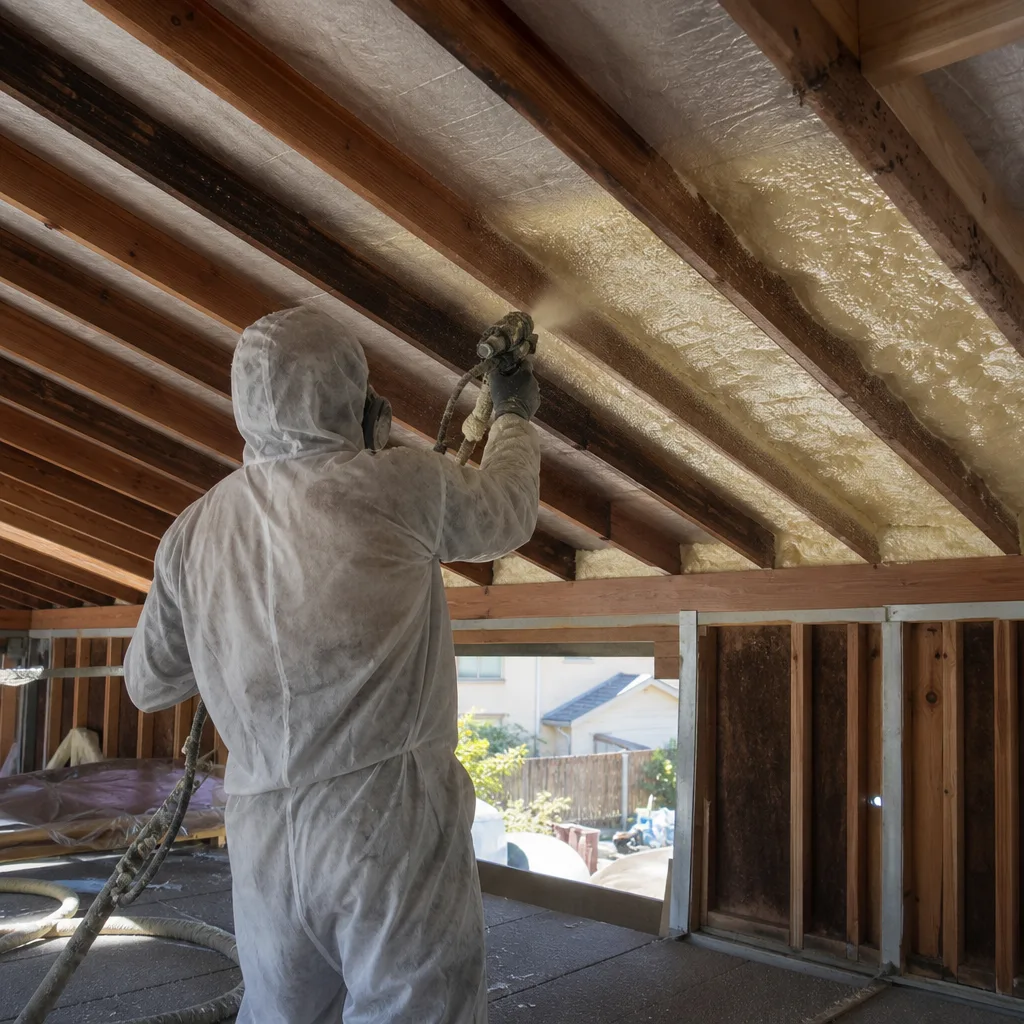
We recently sprayed open-cell foam in an attic on a home backing the Cucamonga foothills where the original Owens Corning batts had been peeled back by wind-driven debris. After sealing the soffit and gable vents with fire-rated foam, we applied Icynene directly to the roof deck. The homeowner reported immediate relief from the summer heat load and far fewer embers working into the attic during fall wind events.
Roof Deck Applications
Spraying the underside of the roof deck turns the attic into conditioned space. For Rancho Cucamonga homes with HVAC equipment and ducts running through the attic, this is often the single biggest improvement you can make. The foam stops heat before it enters the attic cavity, so your air handler isn’t fighting 140°F ambient air.
Vent Sealing Before Foam
Foothill homes need soffit and gable vents sealed before spray foam goes on. Embers and wind-driven debris enter through those openings during Santa Ana events. Sealing them with fire-rated foam is not optional up here.
Spray Foam Wall Insulation in Rancho Cucamonga
Spray Foam Wall Insulation in Rancho Cucamonga costs between $1,800 and $6,200 for most wall cavity applications, with closed-cell running higher due to material cost and R-value per inch. The biggest payoff is in exterior wall retrofits and rim joists, where air leakage accounts for a surprising share of heat gain.
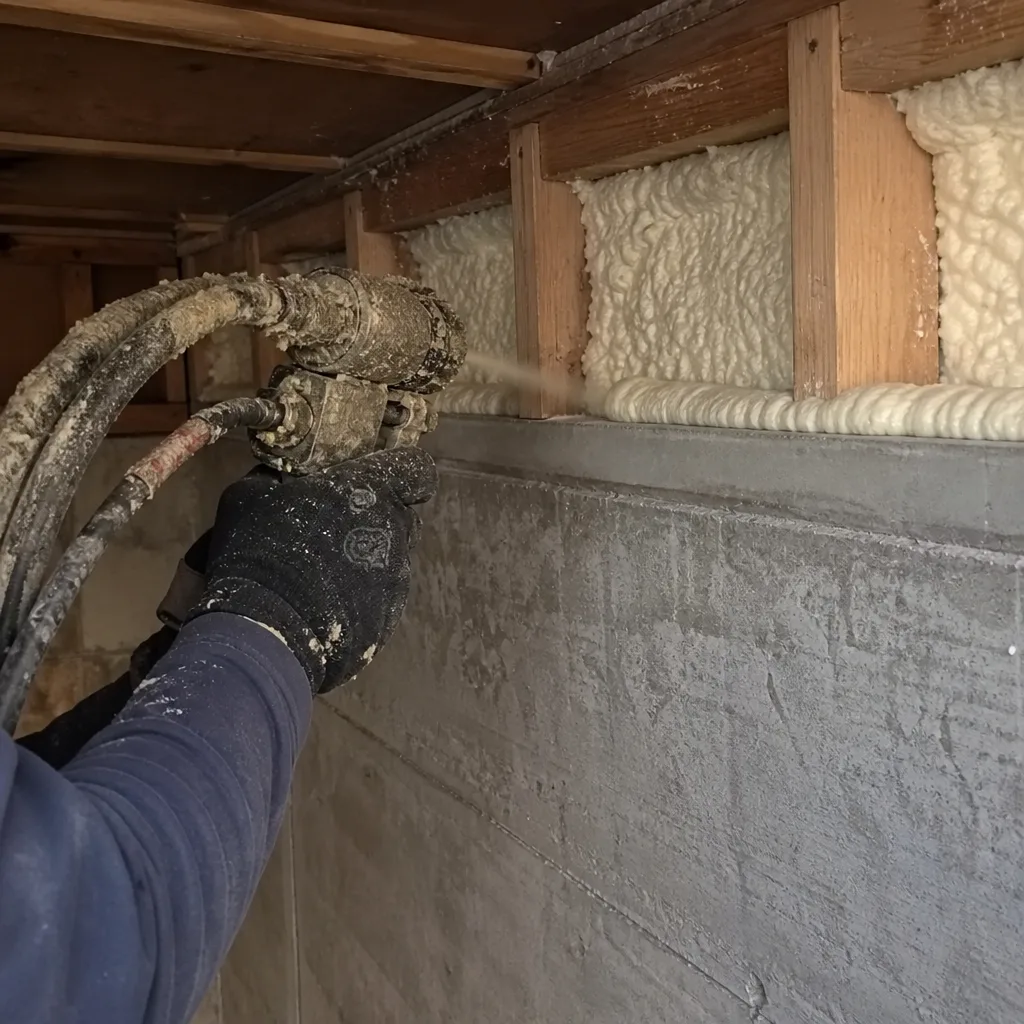
Closed-cell foam adds structural rigidity to wood-frame walls, which matters when Santa Ana winds hit 50+ mph against the north-end foothill tracts. It also acts as an air barrier, something fiberglass batts never do on their own. For 1980s to 2000s tract homes that were built fast and sealed only adequately, closed-cell in the rim joist band can close the biggest air leak in the house.
Rim Joist Sealing
Rim joists sit between floor levels and are notoriously leaky. Closed-cell Demilec foam in the rim joist band cuts air infiltration and gives the wall assembly a thermal break. We recommend this on nearly every older Rancho Cucamonga home we inspect.
Garage Ceiling Applications
Garages in Rancho Cucamonga tract housing are almost never insulated, which means the room above the garage is always hotter than the rest of the house. Spray foam on the garage ceiling evens out that temperature difference and keeps fumes from the garage from migrating into living space through the ceiling cavity.
Trusted Brands We Service in Rancho Cucamonga
We’re authorized to install Icynene and Demilec spray foam, and we stock the supporting products needed to do the job right for Rancho Cucamonga homes. We also work with Owens Corning and Johns Manville for batt applications where spray foam isn’t the right call, and Knauf for specific fire-resistance assemblies. If you need Reflectix repair in Rancho Cucamonga, we can handle that as well. Because we carry competing lines, our recommendation is driven by the home’s conditions: R-value target, moisture profile, wind exposure, and fire risk. Not inventory surplus.
Common Spray Foam Insulation Problems We See in Rancho Cucamonga Homes
- Santa Ana winds peeling poorly adhered foam. Surfaces in foothill attics collect fine dust and debris that prevent foam from bonding. If the deck isn’t cleaned and primed properly, the first strong wind event will separate the foam from the substrate. We prep every surface before spraying.
- Embers entering unsealed soffit and gable vents. Homes backing the Cucamonga foothills see wind-driven embers push through vents during red flag warnings. Unsealed vents leave foam and framing exposed. Fire-rated sealing is standard on our north-end jobs.
- Wind-blown and compressed fiberglass batts. Original builder batts in 1980s to 2000s tract attics lose R-value as they compress and shift. By the time we’re called, attics are often at R-15 to R-19 when the climate demands R-38 or better. Spray foam fills those gaps and holds.
- Uneven attic temperatures in ranch-era homes. The older 91701 corridor homes have different framing and often shallow ceiling cavities. We address these with a mix of open-cell foam and targeted air sealing rather than a blanket one-size approach.
Pricing for Spray Foam Insulation in Rancho Cucamonga, CA
A typical open-cell attic spray foam job in Rancho Cucamonga runs $2,800 to $5,400. Closed-cell roof deck applications range from $4,500 to $7,500 depending on square footage and prep requirements. Wall cavity spray foam falls between $1,800 and $6,200. Rim joist sealing is typically $900 to $2,200. Vent sealing before foam adds $400 to $1,100 depending on how many vents need treatment. These are honest ranges for this market, not teaser pricing. Call (855) 382-3451 and we’ll give you an exact quote after seeing the attic.
We Also Serve Cities Near Rancho Cucamonga
Our crews cover Spray Foam Insulation in Rancho Cucamonga plus the surrounding foothill and valley communities. You’ll find us working in San Antonio Heights, Upland, Ontario, and Fontana throughout the week. Same scheduling applies: free estimates, straight answers, and a crew that shows up ready to handle wind-exposed attics.
Serving Rancho Cucamonga, CA — Our Local Coverage Area
We’re based in the Rancho Cucamonga area and know this community well. Use the map below to see our service coverage — if you’re nearby, we can almost certainly help.
FAQs About Spray Foam Insulation in Rancho Cucamonga
Spray foam handles Santa Ana winds well when the surface is properly prepared and the foam is applied at the correct thickness. The wind problem in Rancho Cucamonga is not the foam itself; it’s what the wind carries: dust that prevents adhesion and embers that enter through unsealed vents. We clean and prime roof decks before spraying and seal soffit and gable vents with fire-rated foam as part of the job. That combination is what holds up through wind events.
Spray foam is better for Rancho Cucamonga attics because it air-seals while it insulates. Fiberglass batts only slow conductive heat transfer; they don’t stop air movement. In a climate where summer attic temps hit 140°F and Santa Ana winds push air through every gap, an air barrier matters as much as R-value. Open-cell foam on the roof deck keeps heat out of the attic cavity entirely, which batts cannot do. Call (855) 382-3451 to talk through your attic’s specific numbers.
Yes, in most foothill homes you need to seal soffit and gable vents before spraying foam. Those vents are how wind-driven debris and embers get into the attic. If you spray foam without sealing them, you’ve added insulation but left an unprotected opening. We seal vents with fire-rated foam as standard practice on north-end Rancho Cucamonga jobs, then apply the insulation to the roof deck.
Spray foam can contribute to fire resistance when it’s part of a properly detailed assembly. Closed-cell foam has a Class 1 fire rating, and combined with fire-rated vent sealing it reduces ember intrusion into attic spaces. It does not make a home fireproof, and it should not be treated as a substitute for defensible space or fire-rated building materials. But in foothill neighborhoods where embers are the primary ignition vector, sealing vents and using fire-rated foam products is a meaningful upgrade.
For most 1980s to 2000s tract homes in Rancho Cucamonga, open-cell foam on the roof deck is the best first move for attic performance, with closed-cell reserved for rim joists and areas needing structural or moisture resistance. Open-cell is more affordable per board foot and does an excellent job stopping heat transfer through the roof. Closed-cell adds R-value per inch and air barrier strength, but costs more. We’ll tell you which makes sense after looking at your attic, not before. Estimates are free at (855) 382-3451.
Written by Ruben Castellano, Owner at Thermal Insulation Co, serving Rancho Cucamonga insulation needs with expertise in wind-exposed foothill homes.