
Fast, Reliable Spray Foam Insulation Across Montclair
Spray foam insulation in Montclair costs between $2.50 and $6.75 per square foot for a typical retrofit job, with most whole-attic projects landing in the $4,800 to $9,600 range. We’re in and out of Montclair regularly, and most jobs go from first call to finished in under a week. Our crews know the post-war stucco tracts, the 91763 ZIP, and the way Inland Empire heat punishes under-insulated homes. If your upstairs rooms bake by mid-afternoon or your AC runs nonstop from June through September, spray foam is likely the fix. Call (855) 382-3451 for a free estimate and we’ll tell you honestly whether foam is the right material for your house or whether blown-in would serve you better.
Thermal Insulation Co is an insulation specialist. That’s the whole trade. We don’t do roofing on the side or plumbing between foam jobs. What that means for Montclair homeowners is simple: when we look at your 1960s tract home, we’re thinking about thermal boundaries, air sealing, and moisture management, not trying to sell you whatever’s left on the truck. Spray foam is one of three methods we install, and we carry both open-cell and closed-cell systems from Icynene and Demilec. We’ll spec the right one for your walls, your attic, or your garage ceiling and explain why in plain English.
Why Thermal Insulation Co Is Montclair’s Choice for Spray Foam
Montclair sits in a strange spot, climatically speaking. The summer heat is pure Inland Empire: weeks of 100°F-plus days, intense UV, and attics that hit 140°F by noon. But Montclair also sits close enough to the coastal side of the San Gabriel Valley that marine air sneaks in on summer evenings, bringing salt and moisture with it. That combination is rough on houses and harder on hardware. We see it constantly in the neighborhoods around Central Avenue and along the Warren Avenue corridor. Homes that were built in the 1950s and 60s simply weren’t designed for this. Wall cavities were left empty, attics got an inch or two of batt, and garage doors were fitted with whatever springs the builder could buy cheap. Fifty years on, Montclair homeowners are paying for it in energy bills and corroded garage door parts.
Ruben Castellano, who leads our insulation team, has spent years working homes across the Inland Empire. He knows what a 1960s Montclair stucco tract house looks like behind the drywall and what happens when foam is applied wrong, shrinks, or traps moisture. That’s the difference between hiring a dedicated insulation contractor and a generalist who sprays foam on weekends. We’re not guessing. We know which cavities in these older homes communicate with the garage, which vented attics can safely be sealed, and which stucco walls need remediation before foam touches them.
Spray Foam Attic Insulation in Montclair
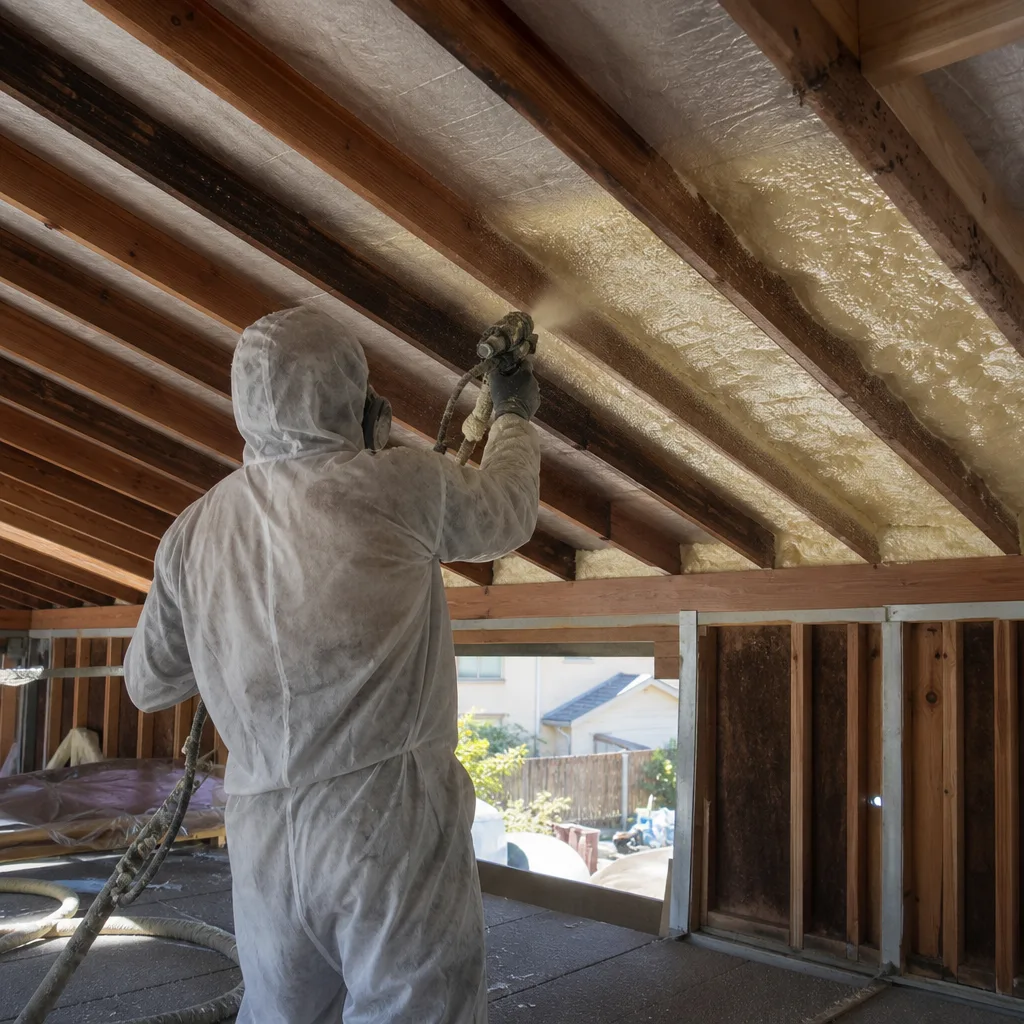
Spray foam attic insulation in Montclair is one of the highest-value improvements a homeowner in the 91763 ZIP can make this year. The attics in the post-WWII tracts around Howard Avenue and San Jose Street were originally insulated with maybe R-11 of fiberglass, much of which has compacted, settled, or been pushed aside by decades of storage. In the Inland Empire’s sustained triple-digit heat, that means radiant heat from the roof deck pours straight into the living space, and the AC compressor runs all afternoon just to keep the thermostat at 80. We install both open-cell and closed-cell foam at the roof deck, creating what’s called an unvented, conditioned attic. That single change lowers the temperature inside the attic by as much as 30 to 40 degrees during a Montclair summer, which takes enormous pressure off the cooling system and makes second-story rooms actually comfortable.
A full attic spray foam job in Montclair typically runs $4,800 to $9,600 depending on square footage and whether we’re doing open-cell or closed-cell. Open-cell is the common choice for attic roof decks because it’s half the price of closed-cell, expands aggressively, and does a great job air-sealing. Closed-cell costs more but adds structural rigidity and acts as a vapor barrier, which matters if you have any moisture concerns in the attic space. We’ll walk you through both options after looking at your specific roof deck, ventilation, and duct layout, and we’ll tell you if spray foam is actually the right call or if attic batts with air sealing would get you 85% of the result for less money.
Air Sealing Before the Foam Goes In
Spray foam is an air barrier as well as an insulator, and that’s often more valuable in Montclair than the R-value itself. Before we spray an attic, we walk the perimeter looking for gaps: plumbing chases, electrical penetrations, top plates where interior walls meet the ceiling. Those little leaks are how hot, dusty air from the attic gets pulled into the house every time the AC kicks on. Sealing them with foam stops that. It’s why some Montclair homeowners see a bigger comfort improvement from air sealing than from the insulation itself.
Hot Roof Repair and Re-insulation
If you’ve got older fiberglass batts that are blackened with dust, compressed, or chewed up by rodents, the first step is removal. We pull the old material, inspect the deck for moisture damage or wiring issues, and then foam. A clean roof deck lets the foam adhere properly. On the older Montclair homes with tongue-and-groove roof decking, we take extra care to check for gaps between boards where foam could leak through or where expansion could push boards apart. That’s a detail most generalist crews miss, and it’s one of the ways a dedicated insulation contractor earns their keep.
Spray Foam Wall Insulation in Montclair
Spray foam wall insulation in Montclair is the retrofit that addresses the biggest energy leak in the city’s older housing stock. Those post-WWII through early-1970s stucco tract homes were built with uninsulated wall cavities. That’s not a guess, it’s the standard construction practice of the era. Walk through the neighborhoods off Ramona Avenue or around Monte Vista Elementary, and the majority of those houses have nothing but air between the exterior stucco and the interior drywall. In summer, the walls become solar collectors. In winter, they leak heat all night. We insulate those cavities with injection-style open-cell foam or dense-packed cellulose, but when a homeowner specifically wants spray foam, we use a slow-rise open-cell product that expands gently and fills the cavity completely without bowing the drywall.
Wall cavity foam in a typical Montclair ranch home runs $3.50 to $6.75 per square foot of wall area, so a full exterior wall retrofit often lands between $6,500 and $14,000 depending on the size of the house and how much access we have. Some Montclair homes have a crawlspace access to the wall cavities, which makes injection easier and faster. Others require drilling small access holes from the outside or inside, which we patch and finish afterward. The result is dramatic: wall cavities that held 120-degree summer air now hold 75-degree conditioned air, and the house simply doesn’t cycle heat the way it used to. We’ll give you a written estimate after measuring the wall surface and checking the framing. No charge for the assessment.
The Garage Wall Connection
Montclair is one of the few Inland Empire cities where this next part matters: your garage wall shares framing with your house. When we spray foam the wall cavities of a 1960s stucco tract home, we also seal the wall that separates the garage from the living space. That matters because hot, dry Inland Empire air isn’t the only thing moving through those empty cavities. On summer evenings, the marine layer pushes inland from the coast, carrying salt-laden air through the San Gabriel Valley. That salty air finds its way into open wall cavities, and when it does, it ends up in the garage. Garage-door springs, hinges, tracks, and opener chains are sitting right there, and they corrode years faster in Montclair than they would in a city farther inland. Sealing that wall with spray foam stops the air pathway. We’ve seen it directly extend the life of door hardware.
Rim Joist and Band Joist Sealing
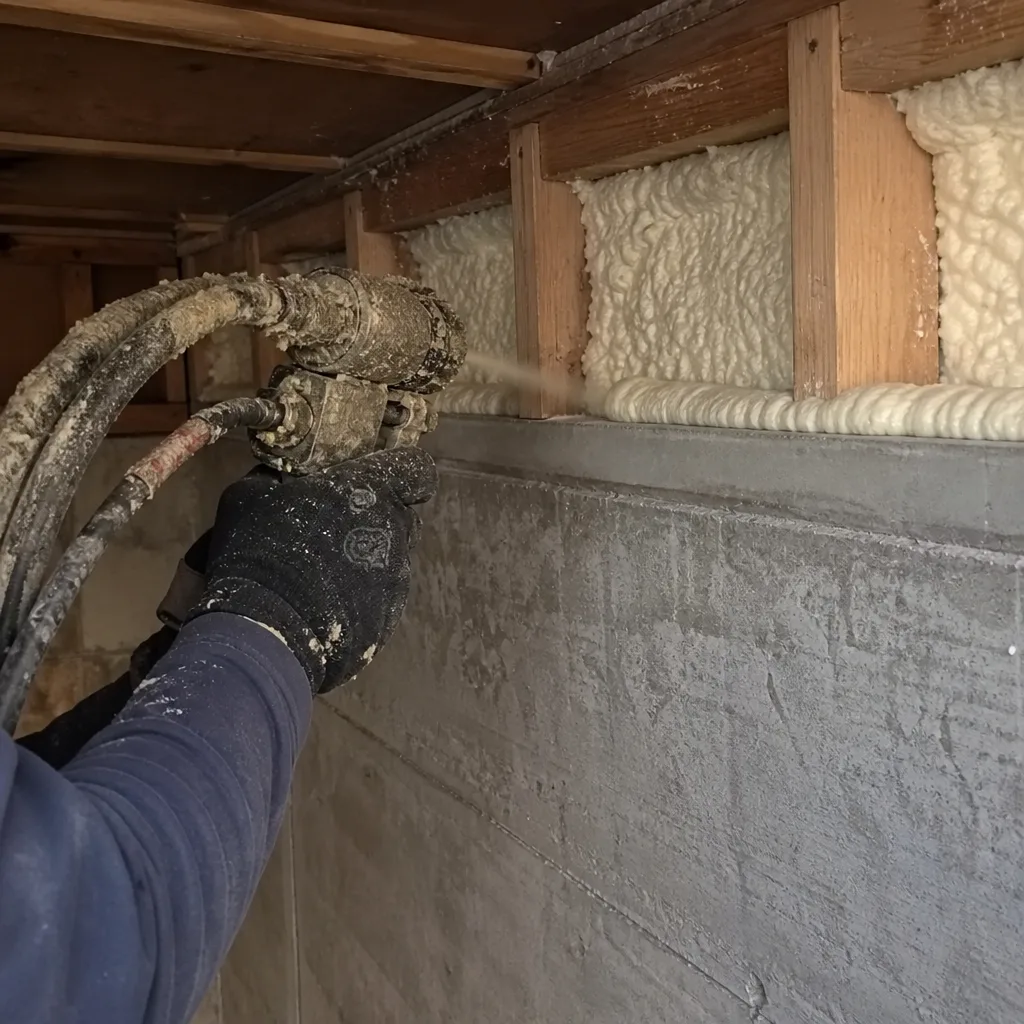
On the Montclair homes with raised foundations, the rim joist is the exposed wood band where the floor framing meets the foundation wall. It’s almost never insulated in houses from this era. Air moves freely through it, bringing dust, heat, and that same coastal-adjacent humidity into the crawlspace. Closed-cell spray foam is the standard fix: two inches applied to the rim joist area seals the air path and insulates the boundary. It’s a smaller job than a full wall retrofit, usually $1,800 to $3,400 for an average Montclair ranch, and it pays back fast in both full comfort and reduced dust in the house.
Trusted Brands We Service in Montclair
We stock open-cell and closed-cell foam from Icynene and Demilec, two of the most established names in spray foam. We carry Icynene because its open-cell formulation expands gently and performs exceptionally well in retrofit wall cavities where you’re working with old framing and fragile drywall. We carry Demilec closed-cell because its higher R-value per inch and vapor-barrier properties make it the right choice for Montclair rim joists, crawlspace walls, and any application where moisture intrusion is a concern. And when spray foam isn’t the right call for a Montclair home, we can pivot to Owens Corning, Johns Manville, Knauf, Rockwool, or GreenFiber from the same truck. We’re not brand-loyal. We’re outcome-loyal. The house tells us what it needs.
Common Spray Foam Insulation Problems We See in Montclair Homes
- Foam shrinkage at garage wall cavities. Montclair’s daily temperature swings are violent, sometimes 40 degrees between afternoon and pre-dawn. Two-component foam that was mixed off-ratio or applied to a hot, dusty stud bay will shrink as it cures. That shrinkage opens hairline gaps, and those gaps are exactly where the salty evening air gets through to your garage door hardware. We’ve corrected more than a few botched foam jobs where shrinkage left the wall only half-sealed.
- Moisture trapped behind spray foam on stucco walls. Montclair stucco is old, and old stucco develops hairline cracks and paint failure. When closed-cell foam is applied directly to the back of a stucco wall that’s letting moisture in from the outside, that moisture has nowhere to go. It gets trapped against the embedded fasteners and wire lath, and rust accelerates. On these older homes, we assess the exterior condition before recommending closed-cell; if the stucco needs patching or sealing, that comes first.
- Adhesion failure on dusty, unsealed garage framing. The garage framing in 1960s Montclair tract homes has had six decades to collect dust, oil residue, and sometimes decades of bug activity. Spray foam won’t bond to a dirty substrate. A generalist contractor who shows up and starts spraying is going to get delamination within a season or two, and then the foam is doing nothing but taking up space. We clean, prep, and sometimes prime the framing before applying foam, which is the difference between a 25-year insulation job and a 3-year failure.
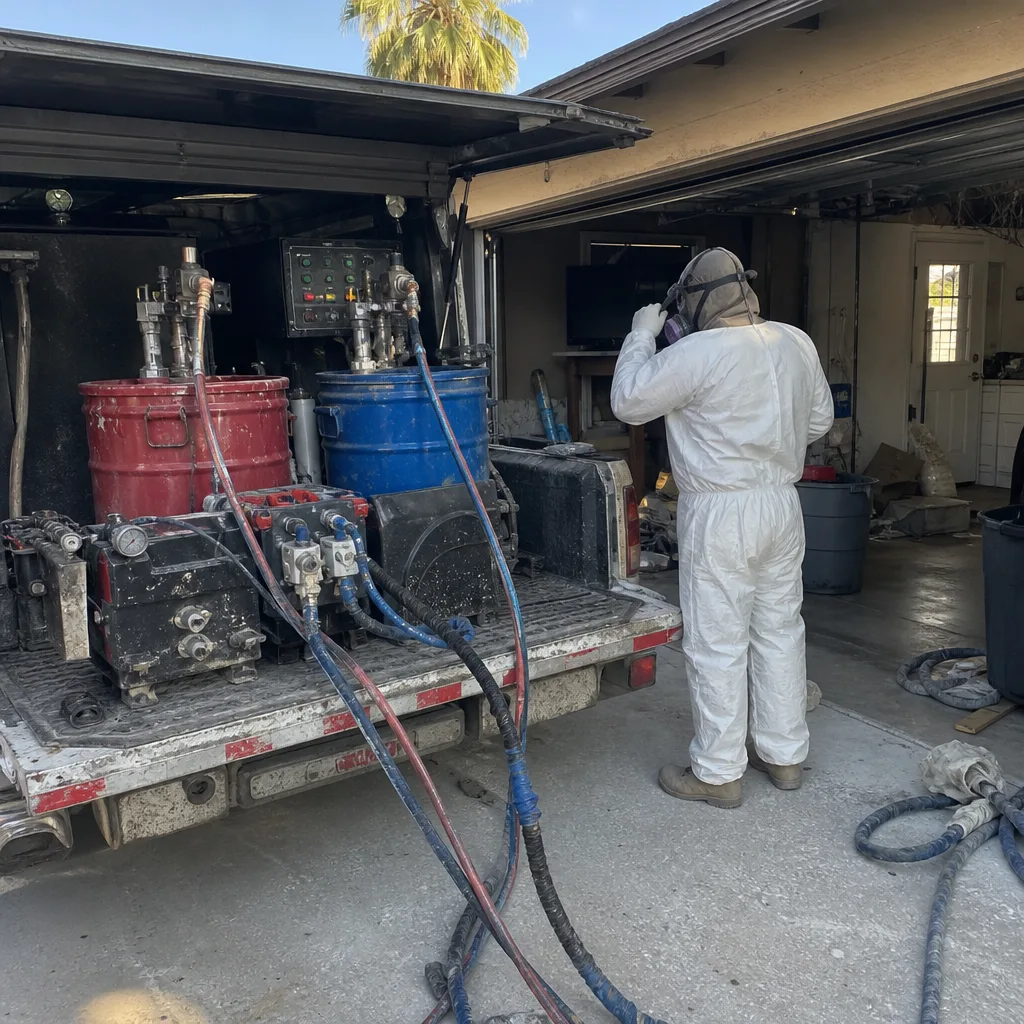
- Off-gassing from off-ratio two-component applications. We’ve walked into Montclair garages where a previous spray foam job still smelled chemical months later. That’s the signature of an improperly mixed two-component system, often from a contractor who rushed the job or used an incorrectly calibrated spray rig. Off-ratio foam also never cures properly, so it won’t hit its R-value and it will off-gas indefinitely. We mix both components precisely and don’t spray when outside temperatures fall outside the manufacturer’s window, which in a Montclair heat wave means we often start at dawn.
Pricing for Spray Foam Insulation in Montclair, CA
Here’s the straight answer, because we’d rather have you budget properly than be surprised later. Attic spray foam in Montclair runs $4,800 to $9,600 for a typical 1,200 to 1,800 square foot ranch home. Wall cavity foam runs $6,500 to $14,000 depending on how much wall area you have and how we access the stud bays. Rim joist sealing is the budget option at $1,800 to $3,400. Garage ceiling foam, which matters if you’ve got a bedroom above the garage or just want a cooler workspace, lands between $1,500 and $2,800. Open-cell runs roughly $2.50 to $4.25 per square foot of coverage; closed-cell runs $4.00 to $6.75 per square foot. We’ll give you a written quote that includes all prep, sealant, waste removal, and cleanup. Call (855) 382-3451 and we’ll schedule a time to come out and measure. Free estimate, and we’ll tell you if foam is overkill and blown-in would do the job.
We Also Serve Cities Near Montclair
Most of our crews roll out of our Van Nuys shop every morning, so serving Montclair alongside the surrounding foothill communities keeps our travel waste low and scheduling predictable. We regularly run jobs in Montclair itself, plus Claremont, Ontario, Upland, and La Verne. If you’re in one of those neighboring cities and want the same level of insulation specialization, reach out. We run a dedicated Spray Foam Insulation crew that handles the whole corridor.
Serving Montclair, CA — Our Local Coverage Area
We’re based in the Montclair area and know this community well. Use the map below to see our service coverage — if you’re nearby, we can almost certainly help.
FAQs About Spray Foam Insulation in Montclair
Yes. When we seal the wall cavity that separates your garage from the house, we cut off the air path that carries salty coastal air from the San Gabriel Valley into your garage. That salty evening air is the single biggest accelerant of spring and hinge corrosion we see in Montclair garages. A galvanized spring lasts longer on its own, but a galvanized spring in a garage that’s no longer being fed salt-laden draft air lasts years longer. Call (855) 382-3451 and we’ll explain what sealing your garage wall would involve and what it costs.
Extreme heat makes spray foam work harder but also reveals bad installations faster. A properly mixed, properly cured closed-cell or open-cell foam handles 140°F attic temperatures without a problem; that’s precisely the condition it’s designed for. The failure mode is off-ratio foam or foam applied to a dirty roof deck, which will shrink, crack, or delaminate under thermal cycling. In Montclair, we prefer to spray during early morning hours in summer, not just for the crew’s comfort but because the deck temperature and the foam’s curing window matter to the final bond. A roof deck at 160°F will cause some foams to set before they’ve fully expanded, and that’s a quiet performance killer.
Indirectly but meaningfully, yes. Your opener chain corrodes because moisture and salt are present in the garage air. That air is coming from somewhere, and in most older Montclair homes it’s coming through unsealed wall cavities and rim joists that communicate with the outside. When we foam-seal those cavities, including the one shared with the garage, the garage becomes a more stable, drier environment. The chain stays cleaner and the opener’s moving parts don’t grind against surface rust the way they did before. It’s not a miracle coating; it’s cutting off the supply of corrosive air. That’s why we recommend combining foam sealing with stainless hinges and a corrosion-resistant spring for older Montclair garages.
Yes, with the right product choice and the right prep. The legitimate concern with stucco homes from the 1950s and 1960s is moisture. If the exterior stucco has cracks or failing paint, closed-cell foam applied to the interior face can trap water that migrates through the stucco. On walls with evident exterior deterioration, we recommend addressing the stucco first or using an open-cell foam that allows the wall to dry inward. Open-cell is vapor-permeable, meaning moisture can move through it rather than being stopped at the wall. The right answer depends on what’s happening on the outside of your house, and we’ll give you a straight answer after looking at the wall in person.
Most Montclair homeowners re-enter their garage within 24 hours. Closed-cell foam typically sets and stops off-gassing quickly; we usually tell homeowners 2 to 4 hours before the garage is safe to enter and 24 hours before they should spend extended time in there or close the door and leave it sealed. Open-cell takes a bit longer to fully cure and off-gas, often 24 to 48 hours. We’ll give you a clear re-entry timeline based on the specific product we use and the ventilation in your garage. During the spray process itself, our crew vacates the area and runs negative-pressure fans to pull fumes out, which is non-negotiable on our job sites.
Contact Thermal Insulation Co for Spray Foam in Montclair
The quickest way to get a number for your attic, walls, or garage is to call us and describe the house. We’ll ask about the year it was built, the square footage, whether it’s stucco, and what the rooms feel like in July. Then we’ll schedule a time to come out to the 91763 ZIP, take measurements, and give you a written quote. No pressure, no upsell. If spray foam is the right material for your Montclair home, we’ll tell you exactly why. If it isn’t, we’ll tell you that too and point you toward the option that actually makes sense. Call (855) 382-3451 and ask for Ruben. He’ll talk you through it.
Written by Ruben Castellano, Owner at Thermal Insulation Co, serving Montclair and the surrounding Inland Empire communities.