
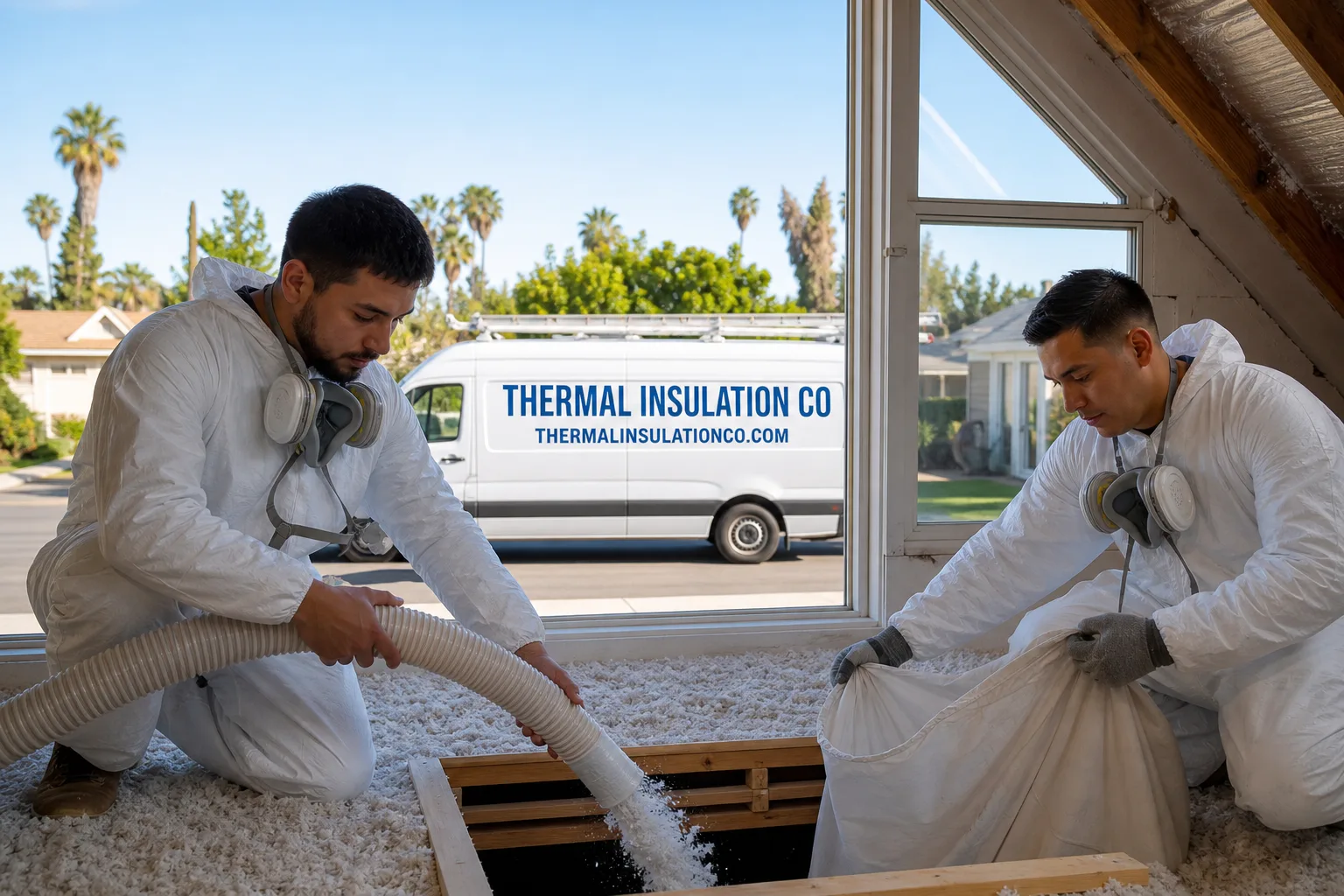
Trusted Spray Foam Insulation for Van Nuys Homeowners
Spray foam insulation in Van Nuys solves a problem every homeowner here knows: rooms that never quite cool down in August, heating bills that spike when the Santa Anas blow through, and dust that finds its way in no matter how tight you seal the windows. Our team at Thermal Insulation Co installs open-cell and closed-cell foam systems from Icynene and Demilec, and we’ve worked on homes across Van Nuys, Valley Glen, and Sherman Oaks. Insulation is all we do, so the person who assesses your attic is the same specialist who installs the product. Call (855) 382-3451 for a free assessment.
Closed Cell Spray Foam Insulation
Closed Cell Spray Foam Insulation is a dense, rigid foam that adds structural strength and a high R-value per inch while acting as a moisture barrier. It’s the right choice when you need maximum thermal resistance in limited space, or when moisture intrusion is a concern, which it often is in our Spray Foam Insulation in Van Nuys crawl spaces and rim joists after winter rains. We install Demilec closed-cell systems when the application calls for that performance profile, and pricing depends entirely on board-foot coverage and depth. It’s not the cheapest option on the shelf, and we’ll tell you that up front, but in the right application nothing else performs the same.
What Closed Cell Does That Other Foams Can’t
Closed cell creates its own vapor barrier. In a Van Nuys garage conversion or a crawl space with damp soil, that single property solves two problems at once. The foam’s rigidity also reinforces wall and roof assemblies, which matters in older Valley homes where framing has settled over decades.
Where We Recommend It
Rim joists, crawl space walls, and undersized roof cavities are the three places we most often specify closed cell here. If your attic has 2×6 rafters and you want to hit code-minimum R-value, closed cell gets you there without building out the roof structure. Same goes for walls in room additions where every inch of interior space counts.
Open Cell Spray Foam
Open Cell Spray Foam is a lower-density foam that expands significantly on application, filling irregular cavities and sealing air leaks with less material per square foot than closed cell. It doesn’t act as a vapor barrier, which actually makes it preferable in attics where we want the roof assembly to breathe. We carry Icynene open-cell products for these applications, and for a typical Van Nuys attic, open cell runs less per board foot than closed cell while still delivering significant air-sealing performance. The choice between the two isn’t about one being better; it’s about which one matches what your house is doing.
Sound Control in Valley Homes
Open cell’s open structure absorbs sound well, which is why we specify it in interior walls and between floors. If you live near the 405 or Van Nuys Airport flight paths, adding open cell to bedroom walls changes what you hear at night. It won’t eliminate noise, but it takes the edge off in a way batt insulation doesn’t.
Attic Rafter Bays and Tight Cavities
Open cell expands to fill odd-shaped voids, making it the more forgiving choice in attics with lots of framing irregularities. In sloped ceilings and knee wall cavities throughout Van Nuys ranches from the 1950s and 60s, that expansion means fewer gaps and fewer callbacks. We recommend open cell when air sealing is the primary goal and vapor drive is not a concern.
Spray Foam Insulation Contractors
Spray Foam Insulation Contractors are specialists who apply two-component foam systems that mix on site and expand into the cavity being insulated. When you need this work in Van Nuys, the most important credential is daily, recent experience with the specific material going into your home, because foam chemistry and application technique vary between open and closed cell, and between brands. Thermal Insulation Co is a dedicated insulation contractor, not a generalist. We install both Icynene and Demilec systems, and we’ve worked in attics, walls, and crawl spaces throughout the San Fernando Valley. That focused experience is what you’re paying for.
Why Specialization Actually Matters
Spray foam is unforgiving of mistakes. Wrong temperature, wrong mix ratio, or incorrect substrate prep, and the foam doesn’t perform as specified. A contractor who frames, roofs, and also happens to spray foam doesn’t have the volume of reps that a dedicated insulation company does. We do this every day, which means we’ve seen the failure modes and know how to avoid them.
Questions You Should Ask Any Bidder
Ask what brand of foam they install and whether they’re trained on it. Ask whether they’ll do a blower door test before and after, or at minimum a visual air-seal inspection. Ask about re-entry time after application, because off-gassing windows vary by product. If the contractor can’t answer those three questions clearly, keep looking.
Spray Foam Attic Insulation
Spray Foam Attic Insulation applies foam directly to the underside of the roof deck, moving the thermal boundary from the attic floor to the roofline. That’s a significant change for a Van Nuys home because it stops heat from entering the attic in the first place, rather than trying to block it at the ceiling. A typical spray foam attic job runs $3,500 to $8,500 in Van Nuys for a 1,200 to 1,800 square foot attic, with closed cell at the higher end, so how much Spray Foam Insulation costs depends on your specific configuration. The payoff shows up in rooms that finally hold temperature and an HVAC system that doesn’t work as hard.
Conditioned Attic vs. Vented Attic
When you foam the roofline, the attic becomes conditioned space, meaning your ductwork is no longer sitting in a 140-degree space in July. For homes with ducts in the attic, which is most of Van Nuys, that’s a major efficiency gain. We’ll assess whether your roof assembly is a good candidate and whether ventilation needs to be reworked.
Ductwork and Air Handler Considerations
If your air handler lives in the attic, moving the thermal boundary is even more valuable. The unit and ducts operate in a moderated environment, reducing thermal loss through the duct walls. We look at existing insulation on the ducts and recommend whether sealing or wrapping makes sense as part of the scope.
Spray Foam Wall Insulation
Spray Foam Wall Insulation fills the cavities in exterior walls, cutting the air infiltration that leaks conditioned air out and pulls Valley heat and smog in. For a wall installation in Van Nuys, the work usually happens in one of two ways: during new construction or a gut remodel, where the cavities are open and spraying is straightforward, or in existing homes through injection methods. Expect to pay $3 to $7 per square foot of wall area depending on foam type and access. The benefit is immediate: walls that don’t radiate heat at sunset and fewer cold spots near outlets and baseboards.
Remodel and New Construction Timing
If you’re opening up walls for a remodel, that’s the window. Spraying foam after drywall is up costs more and limits what we can verify visually. We coordinate with your GC or, if we’re running the insulation scope solo, we’ll schedule right after rough electrical and plumbing inspection.
Retrofit Wall Options
For homes that aren’t being opened up, injection foam through small holes is the workable path. It’s not the same as spraying an open cavity, but it inserts an expanding foam into the void and significantly reduces air movement. We’ll tell you honestly whether your wall assembly makes retrofit worth doing or whether your money is better spent in the attic.
Rim Joist Spray Foam
Rim Joist Spray Foam seals the band board where your floor framing meets the foundation, a spot that leaks air in nearly every home but causes disproportionate problems in raised-foundation Van Nuys houses. A typical rim joist job here involves sealing the perimeter of the crawl space or basement, and most homes need between 60 and 120 linear feet treated, with labor and material running $1,500 to $3,500. Closed cell foam is standard for rim joists because the rim sits close to soil moisture and needs the vapor barrier properties.
Why the Rim Joist Leaks So Much
The rim board is wood, often with gaps around it where it meets the sill plate and subfloor. Warm air rises and escapes through the upper portions of the building, drawing outside air in through the lower leaks: the rim joist. Sealing this path cuts the stack effect that pulls crawl space air, with whatever it carries, into your living space.
Doing It Right, Not Just Doing It
Proper rim joist work means cleaning the surface, applying foam to the full depth of the cavity, and checking for gaps before moving on. A quick spray-and-go doesn’t air seal anything. We work our way around the perimeter and inspect every bay.
Crawl Space Spray Foam Insulation
Crawl Space Spray Foam Insulation seals and insulates the crawl space perimeter, turning a damp, drafty area under your home into a controlled space that stops pulling heat out of the floors above. For a Van Nuys crawl space, which typically sees higher humidity in winter and stays dry as dust through summer, this application usually runs $4,000 to $9,000 depending on square footage and access. The value is in floors that don’t feel cold in January and indoor air that doesn’t smell like the crawl space every time the HVAC cycles.
Open vs. Closed Cell in the Crawl Space
Closed cell is the standard here because it handles ground moisture. Open cell would absorb water vapor over time, which defeats the purpose. We use Demilec closed cell for crawl space work almost exclusively, and it doubles as both insulation and vapor barrier in a single pass.
Pairing with Vapor Barrier Work
If your crawl space has a dirt floor, the foam on the walls only does half the job. A ground vapor barrier, properly sealed at the seams and edges, keeps soil moisture from migrating upward. We’ll assess whether your existing barrier is adequate or if it needs replacement as part of the scope.
Garage Spray Foam Insulation
Garage Spray Foam Insulation treats the garage as part of the conditioned envelope, which matters in Van Nuys because an uninsulated garage can hit 110 degrees by noon in summer and turn the room above it into an oven. Typical garage insulation costs $1,800 to $4,500 for the walls and ceiling, depending on whether the garage is attached and whether you want the door cavity treated. Home gyms, workshops, and bonus rooms all change how we approach the job.
Attached Garage Air Quality
If your garage shares a wall with living space, sealing that wall reduces the transfer of whatever lives in your garage air. Car exhaust, paint cans, stored chemicals, all of it stays put instead of seeping through gaps around outlets and baseboards. Closed cell on that shared wall is a meaningful upgrade over fiberglass batts in this application.
Garage Ceiling vs. Roofline Decisions
In garages with open rafter spaces, you have two choices: insulate the ceiling plane or the roofline. The roofline approach turns the entire garage into conditioned space, which is the right call if you spend time working out there. If the garage is just car storage, ceiling insulation is the more cost-effective path and we’ll say so.
Brands We Service
We install open-cell and closed-cell systems from Icynene and Demilec, and we chose those two because they’re the products we’d put in our own homes. Icynene’s open-cell foam expands reliably, seals well, and has been a consistent performer in attics across the Valley for years. Demilec’s closed-cell formulations give us the rigidity and vapor resistance we want in crawl spaces and rim joists. Carrying both means we’re not steering you toward one brand because it’s all we stock.
You may also have encountered fiberglass products from Owens Corning or Johns Manville, and recycled-content options like GreenFiber. We carry those too, because not every cavity calls for foam. If your home needs batt insulation in a wall that’s already open, or blown-in cellulose in an attic with existing loose fill, we’ll recommend that instead. The brand follows the application, not the other way around.
Signs You Need a Pro Right Now
- Rooms above the garage are 8 to 10 degrees hotter than the rest of the house. That temperature gap usually means the garage ceiling has no insulation, and the heat load is rising straight through the floor assembly. Spray foam on the garage ceiling plane fixes this faster than any other intervention.
- Your energy bills spike every summer and winter, but the house still feels drafty. Air leakage, not missing insulation, is often the primary problem in Valley homes. Foam seals the leaks and insulates in one step, which is why it outperforms batt in retrofit applications.
- You can hear the 405 or Van Nuys Airport clearly from inside with windows closed. Sound transmission through unsealed wall cavities is a sign of air leaks. Open cell foam in those walls reduces both the air movement and the noise traveling through it.
- Dust appears on furniture within days of cleaning, especially near baseboards. That dust is being pulled through the rim joist and wall cavities from the crawl space or outside. Sealing those leak paths with spray foam cuts the particulate load moving through your home.
- Your feet are cold in winter even with the heat running. Cold floors over a crawl space mean the underfloor insulation is inadequate or missing. Crawl space spray foam addresses the air movement and the radiant cold in a single application.
Our Process, Step by Step
- 1
Assessment and walkthrough. We start at the home level: attic, walls, crawl space or basement, garage, and rim joist all get checked. We measure existing insulation depths, identify air leaks, and note moisture conditions in each area before recommending anything.
- 2
Honest scope and estimate. Based on what we find, we’ll tell you which areas need treatment, which method fits each area, and which brand we’d use. If your attic is fine and your crawl space is the real problem, we’ll say so. The estimate is free and detailed.
- 3
Prep and protection. We mask and protect surrounding surfaces before spraying. This includes covering floors, sealing off work areas, and ensuring proper ventilation during application. Spray foam is a professional installation with professional prep requirements.
- 4
Installation. We apply the foam at the specified depth and density, checking fill quality as we go. For closed cell we verify depth per pass; for open cell we confirm the expansion fills the cavity completely. This is where daily reps pay off.
- 5
Inspection and explanation. After the foam cures, we walk the job with you, show you what was installed, and explain what changed. If we found anything unexpected during the work, you’ll hear about it from us before you find it yourself.
How Much Does Spray Foam Insulation Cost in Van Nuys?
A typical spray foam insulation project in Van Nuys runs $2,000 to $9,000 depending on the area being treated and the foam type specified. Attic roofline applications on a 1,400 square foot home usually land between $3,500 and $8,500. Rim joist sealing runs $1,500 to $3,500 for most homes. Crawl space work typically runs $4,000 to $9,000. Wall insulation during a remodel falls in the $3 to $7 per square foot range, and garage work starts around $1,800.
What moves the price: foam type (closed cell costs more per board foot than open cell), depth required to hit your R-value target, access conditions, and the amount of prep work needed. The best way to avoid overpaying is to get a scope that explains exactly what’s being sprayed, at what depth, and why. Our free estimates include that breakdown, so you’re comparing apples to apples when you get multiple bids. Call (855) 382-3451 for a no-pressure quote.
Our Service Area Near Van Nuys
We work throughout Van Nuys and the surrounding San Fernando Valley communities. Our team serves Valley Glen, Sherman Oaks, Encino, Studio City, North Hills, North Hollywood, Northridge, Universal City, San Fernando, Shadow Hills, and Burbank. Most jobs are scheduled within a week of the estimate, and we’re often in Spray Foam Insulation in Valley Glen or Spray Foam Insulation in Sherman Oaks during the same week, so scheduling is flexible.
Serving Van Nuys, CA — Our Local Coverage Area
We’re based in the Van Nuys area and know this community well. Use the map below to see our service coverage — if you’re nearby, we can almost certainly help.
Frequently Asked Questions About Spray Foam Insulation in Van Nuys
Spray foam insulation is a two-component liquid that mixes on site and expands into a foam, filling cavities and sealing air leaks while providing thermal resistance. It’s the only insulation type that combines air sealing and insulating in a single step, and it’s available in open cell and closed cell formulations for different performance needs. In Van Nuys, it’s most commonly applied in attics, crawl spaces, and rim joists where air leakage is significant.
Most single-area projects like an attic roofline or a rim joist are completed in one day, including prep and cleanup. Larger multi-area jobs, like a full crawl space plus rim joist, may take two to three days. The foam itself cures quickly, but we schedule re-entry based on the manufacturer’s off-gassing window to keep you and your family safe.
In Van Nuys, projects range from $1,500 for a smaller rim joist job up to $9,000 for a full crawl space or large attic application, with most homeowners spending $3,000 to $6,000. The price depends on the area treated, foam type, depth required, and site access. Call (855) 382-3451 for a detailed, free estimate specific to your home.
Yes, we install open-cell Icynene and closed-cell Demilec systems, and we carry both because different applications call for different performance profiles. We also install fiberglass from Owens Corning and Johns Manville, as well as GreenFiber cellulose, so the recommendation fits your home rather than our inventory.
We can often schedule urgent work within 24 to 48 hours, especially for issues like exposed rim joists after a leak or a pest intrusion that left insulation compromised. Call (855) 382-3451 and tell us what you’re dealing with, and we’ll be straight with you about timeline.
The foam manufacturers we work with, Icynene and Demilec, offer material warranties on their products, and our workmanship is backed by our own installation warranty. The specific terms depend on the product and application, and we’ll walk you through exactly what’s covered before any work begins.
Clear the work area of stored items, cover anything you can’t move, and plan to stay out of the home during application and for the re-entry period we specify. We’ll handle floor and surface protection in the work zone, and we’ll tell you the exact re-entry window based on the product being installed. That’s usually 2 to 24 hours depending on the foam.
Schedule Your Spray Foam Insulation Service in Van Nuys Today
If you’re tired of high bills and rooms that never hold temperature, call Thermal Insulation Co at (855) 382-3451. We’ll assess your home, tell you honestly whether spray foam is the right investment, and give you a free, detailed estimate with no obligation. Led by Ruben Castellano, we serve Van Nuys and the entire San Fernando Valley with one specialty: insulation done correctly.
Written by Ruben Castellano, Owner at Thermal Insulation Co, serving Van Nuys and the San Fernando Valley.