
Fast, Reliable Spray Foam Insulation Across Encino
Spray foam insulation in Encino usually means sealing the building envelope against two forces the rest of the Valley doesn’t feel as sharply: 100°F+ summer heat that turns attics into ovens, and winter canyon winds that push cold air through every gap in a hillside home’s frame. We’re Thermal Insulation Co, and we work in Encino weekly, from the flat streets south of Ventura Blvd. up into the ridge lines where 1950s ranch homes sit on slopes with irregular attic cavities. Call (855) 382-3451 and we’ll give you a straight answer about what your house actually needs, not a scripted pitch.
Why Thermal Insulation Co Is Encino’s Preferred Spray Foam Insulation Company
We’re a dedicated insulation contractor. That’s the whole trade. When Ruben Castellano started Thermal Insulation Co, he built the company around one idea: an insulation specialist should be able to choose from more than one material and more than one method. That’s why we carry eight brands, including Icynene and Demilec for spray foam, and why we install open-cell, closed-cell, batt, and blown-in systems depending on what the house calls for.
Encino homes are not a single housing type. South of the Blvd. you have flat-lot post-war ranch homes with wide attics. North of the Blvd. you have slope-built custom homes with cathedral ceilings, converted garages, and crawl spaces tucked into hillsides. We see both every week. That local familiarity matters when you’re deciding whether open-cell foam in a garage ceiling makes sense, or whether a hillside crawl space needs closed-cell to handle moisture from the slope side. We also know the response time to Encino from our Van Nuys shop: typically under an hour for a site visit, and same-day starts are common on straightforward jobs.
Crawl Space Spray Foam Insulation in Encino
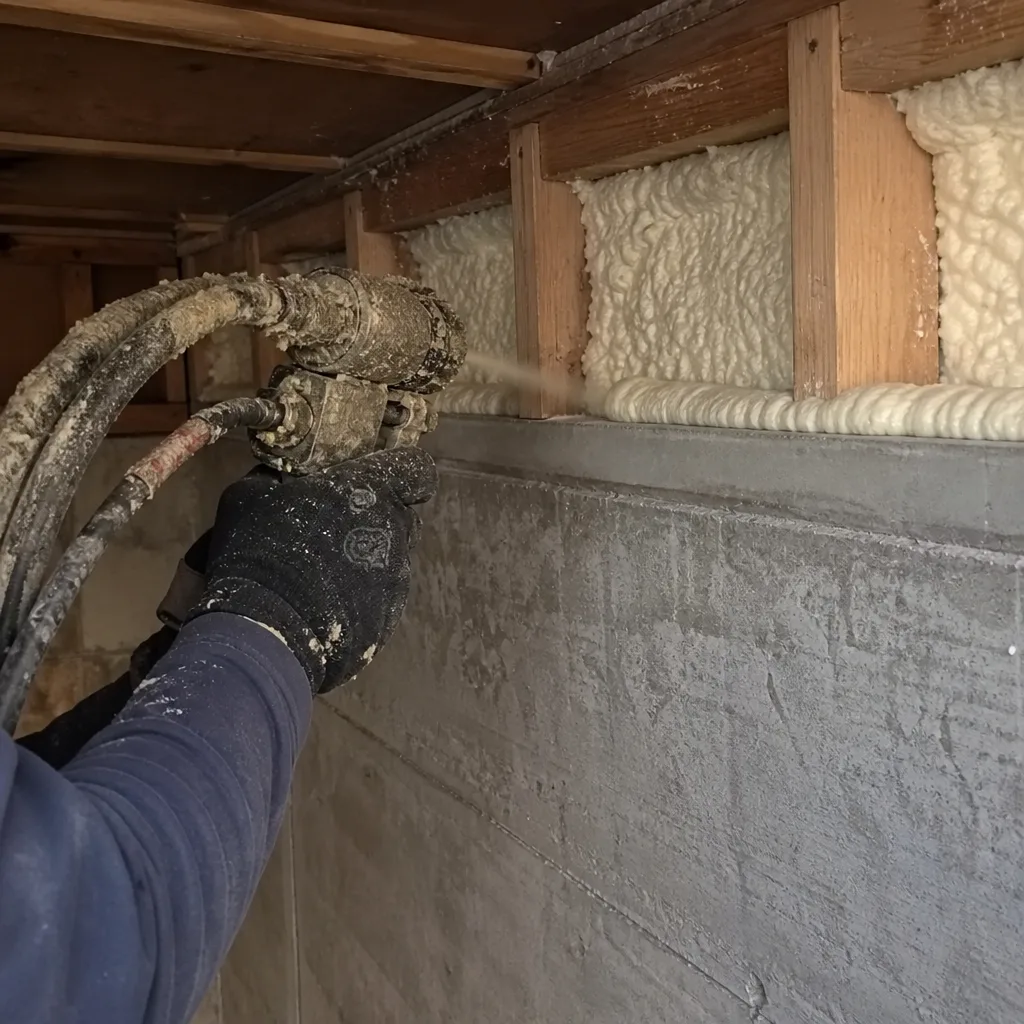
Crawl Space Spray Foam Insulation in Encino addresses a problem that’s especially common in the hills north of Ventura Blvd., where homes are set into slopes and the crawl space on the downhill side often sits against damp earth or catches wind coming up the canyon. In these conditions, fiberglass batts can sag, absorb moisture, and stop performing within a few seasons. Spray foam, applied directly to the rim joist and foundation walls, creates an air seal and a moisture barrier in one pass. A typical crawl space encapsulation with closed-cell foam in Encino runs $2,800 to $6,500 depending on square footage, access height, and how much prep the substrate needs. Slope-side crawl spaces with limited clearance usually run toward the higher end because our crew has to work in tight quarters and carry material by hand rather than feeding a hose from the truck.
Rim Joist Sealing on Hillside Foundations
The rim joist is where the floor framing meets the foundation, and it’s the single leakiest line in most Encino homes built before 1980. On a hillside foundation, that joint is also where wind-driven air from the canyon side enters. We spray closed-cell foam along the entire rim joist perimeter, which stops both air movement and the thermal bridging that makes floors cold in January. The cost for a rim joist sealing job alone typically runs $900 to $2,200 in Encino.
Moisture Control in Slope-Side Crawl Spaces
Encino’s winter cold snaps, combined with the higher humidity near canyon floors, create condensation risks that flat-lot homes in Sherman Oaks don’t face the same way. Closed-cell spray foam acts as a vapor retarder, which means it doesn’t just insulate; it keeps moisture from condensing on the underside of the floor framing. If your crawl space smells musty after rain, the problem is usually air movement carrying moisture in, not standing water. Sealing the envelope fixes it.
Garage Spray Foam Insulation in Encino
Garage Spray Foam Insulation in Encino is often tied to a conversion: the garage became a home office, a gym, a music room, or a bedroom for an aging parent. Encino’s 1950s-1970s housing stock has seen decades of garage conversions, and most of them were done without properly insulating the walls that used to be exterior garage walls. We spray the garage ceiling and the now-interior walls with foam, which also quiets the space considerably. A typical two-car garage ceiling job in Encino runs $1,800 to $4,200, depending on whether we’re also sealing the rim joist and whether the ceiling is flat or follows the roofline.
Garage Ceiling and Beam Cavity Sealing
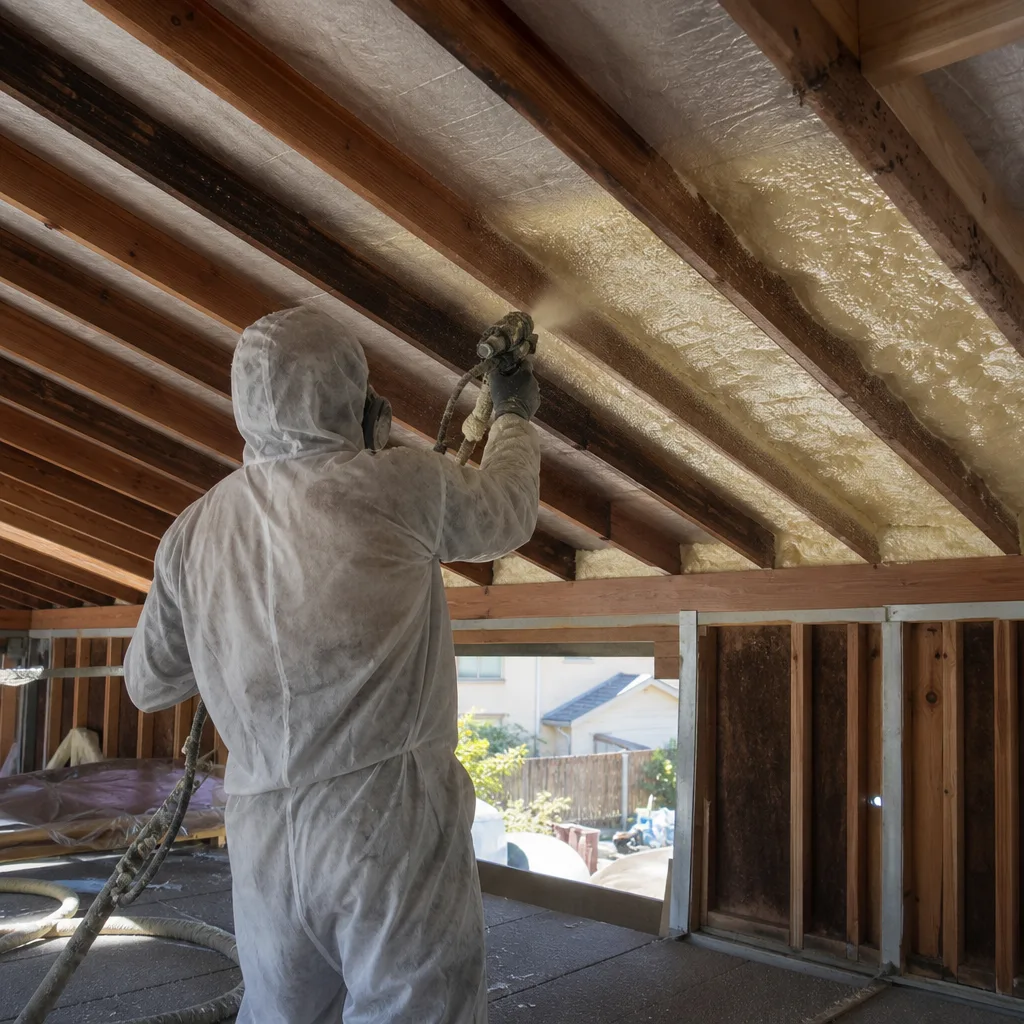
Many Encino garage conversions have open-beam ceilings with exposed rafters. Spraying between those rafters requires careful masking and a consistent pass so the foam doesn’t over-expand and push against the roof deck. We use open-cell foam in most garage ceiling applications because it’s lighter and won’t stress the framing on older 2×4 rafter systems. For garages below living space, closed-cell gives better sound isolation if noise transfer to the room above is the complaint.
Air Sealing Around Ductwork in Converted Garages
When a garage becomes living space, the HVAC contractor often runs ductwork through what was once an unconditioned crawl or ceiling cavity. Gaps around those ducts are air leaks. Spray foam seals around the duct boots and along the seam where the new wall meets the old garage slab. That’s the difference between a converted garage that stays comfortable in July and one that turns into a hotbox by 2 p.m.
Trusted Brands We Service in Encino
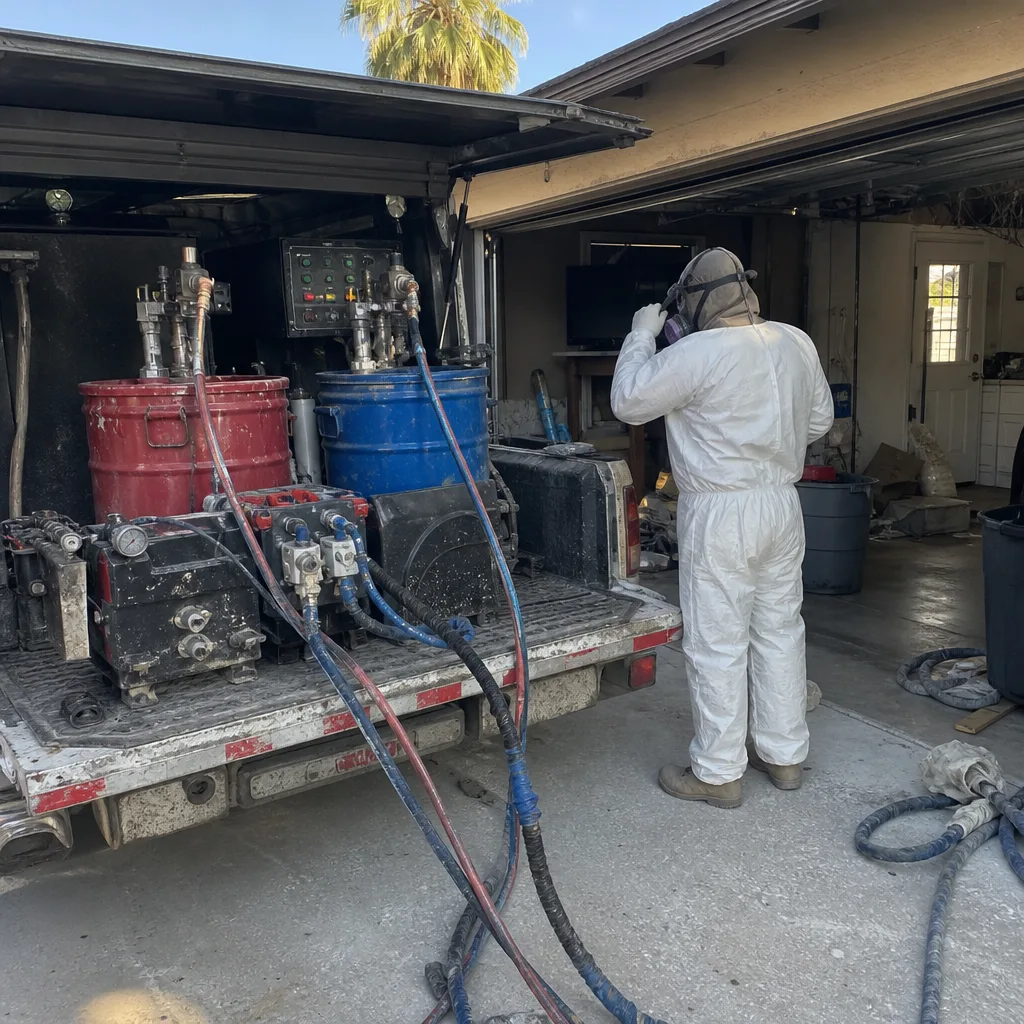
We don’t stock one foam brand and pretend it’s right for every Encino house. We install Icynene and Demilec spray foam systems, and we carry fiberglass product lines from Owens Corning, Johns Manville, and Knauf for jobs where foam isn’t the right call. Our techs keep the chemical drums and rig calibrated for low-VOC application, which matters in occupied Encino homes where residents are home during the job. If you have sustainability priorities, we can also talk through GreenFiber cellulose as an alternative in attic spaces where spray foam isn’t necessary. The point is the material follows the house, not the other way around.
Common Spray Foam Insulation Problems We See in Encino Homes
- Delamination on sloped-roof attics. In hillside homes north of Ventura Blvd., attic surfaces often have decades of dust, old loose-fill, or failing vapor barriers. If the substrate isn’t prepped correctly, the foam skin delaminates within a season or two, leaving gaps that wind-driven drafts find immediately. We clean and prep every surface before spraying, and we check adhesion after the first pass.
- Missing thermal barriers on open-beam ceilings. Encino’s post-war ranch homes with exposed beams are tricky. Spray foam applied over a living space without the required thermal barrier is a code violation and a fire hazard. We always confirm the covering requirement for the specific assembly before we spray, and we won’t cut corners to save a day on the schedule.
- Moisture trapping in garage conversion crawl spaces. When a garage becomes a room, the old crawl space under the slab often gets sealed up and ignored. Foam applied too thickly in one pass on the crawl side can trap moisture and create condensation on the back side of the foam. We spray in lifts with cure time between passes, and we check the relative humidity in the cavity before we shoot.
- Inconsistent temperature zones in room additions. Encino homes have been expanded for sixty years: a bedroom added here, a den pushed out there. The transition seam between original construction and the addition is almost always under-insulated. Spray foam bridges that line and brings the addition into the conditioned envelope, which fixes the “the back bedroom is always 8 degrees hotter” complaint we hear constantly.
Pricing for Spray Foam Insulation in Encino, CA
Encino’s market sits slightly above the Valley average because of the volume of hillside, custom, and converted-structure work. For reference, open-cell spray foam runs $1.10 to $2.40 per board foot, while closed-cell runs $1.90 to $3.80 per board foot. A rim joist job on a flat-lot ranch home is typically $900 to $1,800. A full attic air seal and foam package in a 1,500-square-foot Encino home runs $4,000 to $9,000, with hillside homes on the higher end when access is constrained. We quote line items, not lump sums, so you can see exactly where the money goes. Call (855) 382-3451 for a free estimate; we’ll walk the house, take the measurements, and give you a written number the same day.
One example from our own work: we recently completed a spray foam job for a custom ranch-style home in the Encino hills, just north of Ventura Blvd. The homeowner had converted a garage into a home theater and added a room addition, creating irregular enclosures and a crawl space that was hard to seal. Our crew used Icynene spray foam to insulate the crawl space and garage ceiling, sealing gaps around the new ductwork and eliminating drafts that had been causing inconsistent temperatures. The result was a quieter, more energy-efficient space that integrated with the home’s smart climate controls.
We Also Serve Cities Near Encino
Our Spray Foam Insulation crews cover the whole central Valley from our Van Nuys shop. If you’re in Sherman Oaks, Van Nuys, Valley Glen, or Northridge, we can be at your door just as quickly as we get to Encino. The same brands, the same methods, the same written line-item pricing.
Serving Encino, CA — Our Local Coverage Area
We’re based in the Encino area and know this community well. Use the map below to see our service coverage — if you’re nearby, we can almost certainly help.
FAQs About Spray Foam Insulation in Encino
Spray foam addresses wind-driven drafts in Encino’s canyon-edge homes by creating a continuous air seal across every surface it touches, which fiberglass batts and blown-in cellulose cannot do. Wind pushing against a hillside wall creates positive pressure on one side and negative pressure on the other; any small gap becomes an active air leak. Closed-cell foam, applied to the rim joist, wall cavities, and roofline, blocks that pressure differential at its source. We typically recommend closed-cell for canyon-edge homes because it adds structural rigidity and acts as a vapor retarder, which matters when nighttime temperatures drop into the 30s and condensation forms inside wall cavities. Call (855) 382-3451 and we’ll do a blower-door test to show exactly where your house leaks, then fix it.
Yes, spray foam is actually the best option for the tight, sloped-roof attics common in Encino hills because the foam is applied as a liquid and expands to fill irregular cavities that blown-in equipment cannot reach. Standard blown-in hoses need clearance to maneuver; many hillside attics north of Ventura Blvd. have less than 18 inches of clearance at the eaves. Our crew works with hand-held spray guns and extension wands designed for exactly this application. We typically use open-cell foam in sloped-roof assemblies where the roofline is the insulation boundary, then verify the foam depth with a depth gauge before the thermal barrier goes on.
For most Encino homes, closed-cell spray foam is the better choice for exterior walls and rim joists because it provides roughly R-6.5 per inch and acts as an air and vapor barrier in a single product, which handles both the 100°F summer afternoons and the near-freezing winter nights. Open-cell foam, at about R-3.7 per inch, works well for interior partition walls, garage ceilings, and sound control applications where moisture is not a concern. The right answer depends on your building assembly; call (855) 382-3451 and we’ll give you a recommendation based on how your home is actually framed, not a stock answer.
We handle spray foam in a converted garage with irregular framing by mapping the entire cavity layout before spraying, because uneven stud spacing, old electrical runs, and new ductwork each require different spray patterns and passes. Encino’s converted garages often have framing that’s a patchwork of original 1950s construction and newer addition work. We spray in multiple lifts to prevent over-expansion and to avoid trapping moisture, and we mask around recessed lights, outlets, and any re-used ceiling boxes to keep foam out of electrical junctions. The job ends with a visual inspection of every sprayed cavity and a thermal camera scan to confirm no gaps were missed.
Spray foam installed in Encino homes requires coordination with your existing ventilation, and in some assemblies it changes the ventilation strategy entirely. When you spray the roofline, you’re creating what’s called an unvented attic, which means the attic no longer breathes through soffit and ridge vents; the foam becomes the air seal and the attic becomes interior space. That’s fine in Encino’s dry climate, but it means any existing attic fans or gable vents should be disabled to avoid pulling conditioned air out of the house. Our crew identifies all existing vents before we spray, seals the ones that should be sealed, and leaves the assembly code-compliant with the right thermal barrier in place. If you’re not sure whether your roof assembly can handle unvented insulation, call (855) 382-3451 and we’ll assess it during the estimate.
Written by Ruben Castellano, Owner at Thermal Insulation Co, serving Encino from our Van Nuys shop.