
Fast, Reliable Spray Foam Insulation Across Marina del Rey
Spray foam insulation in Marina del Rey typically runs $2.50 to $6.50 per board foot installed, with most whole-home or large retrofit projects landing between $3,800 and $12,500 depending on cavity depth and access. We serve every corner of Marina del Rey, from the canal-front condos off Via Marina to the apartment complexes along Admiralty Way, with same-week scheduling in most cases. Thermal Insulation Co is a dedicated insulation contractor, not a generalist, and we carry both open-cell and closed-cell systems from Icynene and Demilec. Call (855) 382-3451 for a free estimate, and we’ll tell you exactly which method makes sense for your building.
Why Thermal Insulation Co Is Marina del Rey’s Preferred Spray Foam Insulation Company
Marina del Rey’s housing stock demands a specific kind of insulation expertise. The buildings here aren’t like the single-family homes of the Valley or the South Bay. They’re 1960s through 1980s wood-frame and stucco apartment and condo complexes, often with flat roofs, tight wall cavities, and shared walls where one unit’s moisture problem becomes another unit’s mold problem. Our crew works in these buildings every week. We know what a Via Marina condo’s wall assembly looks like from the inside. We know how marine-layer fog behaves on a canal-front property in July. Ruben Castellano, who leads our team, has spent years matching insulation methods to the specific demands of coastal Los Angeles construction. That’s why we recommend closed-cell foam for most Marina del Rey exterior and shared-wall applications, while open-cell remains the right call for interior partitions and sound control between bedrooms. We’re not guessing. We’re reading the building.
Our clients span the full range of Marina del Rey’s landscape: owners of 1970s condo units near the Ritz-Carlton, landlords maintaining apartment buildings off Lincoln Boulevard, and property managers overseeing high-rise units along Admiralty Way. What they all get is the same thing: an honest recommendation grounded in how their specific structure handles moisture, air movement, and thermal load. Because we carry eight insulation brands including Owens Corning, Johns Manville, and Demilec, plus three installation methods under one roof, the answer is never forced. The building tells us what it needs.
Garage Spray Foam Insulation in Marina del Rey
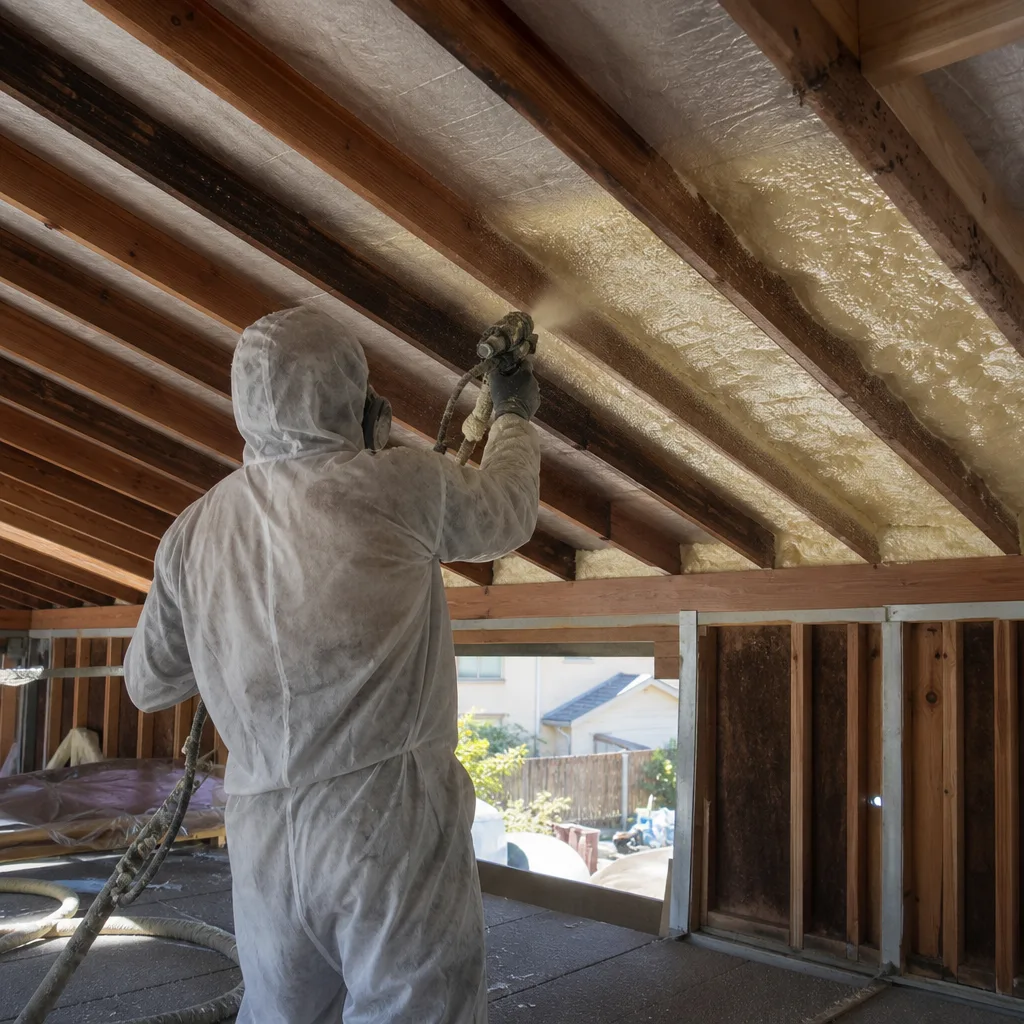
Garage Spray Foam Insulation is one of the most common projects we handle for Marina del Rey residents, especially in the apartment and condo complexes where garages sit directly below living space or share walls with bedrooms. In these buildings, an uninsulated garage ceiling becomes a thermal drain that makes the living room above it impossible to keep comfortable. We apply spray foam to the garage ceiling and shared wall cavities to create an air seal that fiberglass batts simply can’t achieve in tight, awkward framing. For a typical single-car garage ceiling in Marina del Rey, expect $1,400 to $2,800. A two-car garage with both ceiling and shared wall coverage runs $2,600 to $5,200.
Why garage ceilings come first
Garage ceilings in Marina del Rey’s older buildings are frequently the largest uninsulated surface separating conditioned space from the outside. The marine layer doesn’t just cool the air; it keeps garage spaces damp for months at a time. Closed-cell foam on a garage ceiling blocks both heat transfer and moisture migration, which fiberglass cannot do once humidity saturates it.
Shared-wall sound and moisture control
When a garage shares a wall with an interior bedroom or hallway, open-cell foam provides real noise reduction. In buildings where the garage wall faces the marina or a canal, we step up to closed-cell to prevent salt-laden air from working into the cavity.
Closed Cell Spray Foam Insulation in Marina del Rey
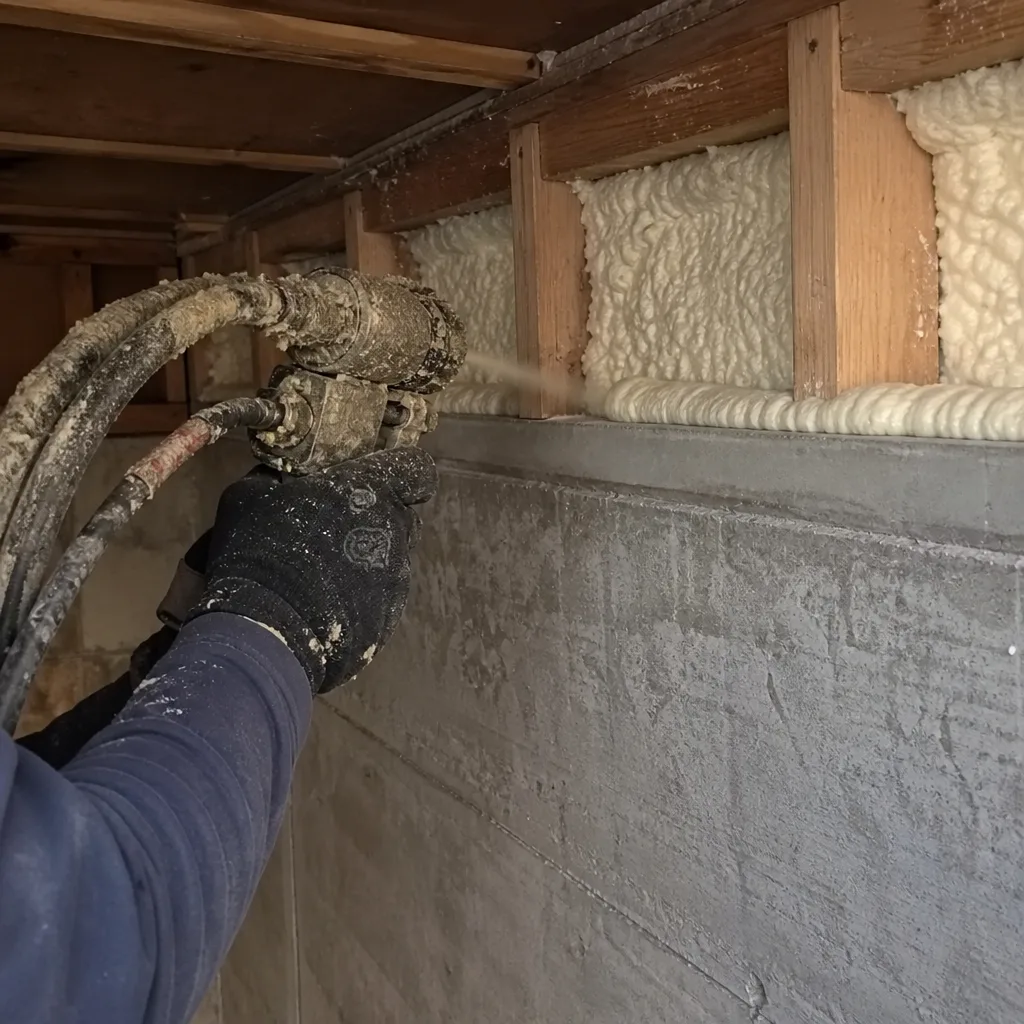
Closed Cell Spray Foam Insulation is, for most Marina del Rey buildings within a block of the water, the only retrofit that makes structural sense. That’s a strong statement, and we’ll stand behind it with building science. Closed-cell foam cures into a rigid, impermeable layer that stops air, vapor, and bulk water all at once. In a 1970s wood-frame condo along the canal where the original vapor barrier has degraded from decades of salt spray, closed-cell foam essentially replaces that barrier. It also adds structural rigidity, which matters in older wood framing that’s seen forty or fifty years of coastal moisture. Expect closed-cell foam at 2 inches of depth to run $2.75 to $4.25 per board foot for wall cavities, and $3.00 to $5.00 per board foot for roof decks. A full shared-wall retrofit in a two-bedroom Marina del Rey condo typically falls between $4,500 and $9,500.
Where salt spray makes closed-cell non-negotiable
Buildings directly facing the marina or the canals get hit with airborne salt every day. That salt accelerates corrosion of metal fasteners and framing. It also breaks down the polyethylene vapor barriers installed in the 1970s. Once that barrier fails, moisture moves into the wall cavity and saturates whatever insulation is there. Closed-cell foam doesn’t absorb water, doesn’t support mold, and doesn’t lose R-value when damp. For canal-front properties in the 90292 ZIP, there is no substitute.
When open-cell is the smarter spend
Interior walls, ceilings between floors of the same unit, and applications where sound control is the priority don’t need the moisture impermeability of closed-cell. Open-cell foam gives you the air-sealing benefit and strong acoustics at roughly half the material cost. We’ll tell you when it’s the right choice, because carrying both Icynene open-cell and Demilec closed-cell means we’re never forcing one product onto a building that needs the other.
Trusted Brands We Service in Marina del Rey
We carry Demilec and Icynene because they represent the two established leaders in spray foam chemistry, and we carry Owens Corning and Johns Manville because batt and board still have their place in certain coastal retrofits. What this means for Marina del Rey customers is simple: the recommendation you get isn’t dictated by what we happen to stock. Ruben Castellano’s team is authorized to install across these brands, and we maintain local inventory for fast turnaround on the applications Marina del Rey buildings need most. When a canal-front condo has a failing vapor barrier and needs closed-cell foam next week, we’re not waiting on a distributor. We have the material, and we know how to prep the surface so it bonds.
Common Spray Foam Insulation Problems We See in Marina del Rey Homes
- Failed vapor barriers on 1970s canal-front buildings. The original polyethylene barriers crack and perforate after decades of salt spray and fog cycles. Moisture then saturates fiberglass batts and grows mold inside the wall cavity, often invisible until demolition happens.
- Spray foam delamination on damp substrates. Flat-roofed buildings in Marina del Rey trap condensation above the ceiling plane. If a previous contractor sprayed foam onto a surface that wasn’t fully dried, the foam peels away and leaves gaps. We dry and prep every surface before application.
- Corroded fasteners compromising foam adhesion. Salt-laden marine air rusts the staples and nails in older framing. Foam applied over corroded metal doesn’t bond reliably. We inspect and address this before spraying.
- Inadequate depth on shared walls. Some buildings had minimal insulation added in the 1980s, and tenants and owners have been living with noise transfer and drafts for thirty years. A proper closed-cell retrofit at 2 inches of depth transforms the acoustic and thermal performance of the unit.
Pricing for Spray Foam Insulation in Marina del Rey, CA
Here are the numbers we quote in Marina del Rey week in and week out. Open-cell spray foam runs $1.50 to $3.50 per board foot. Closed-cell runs $2.75 to $5.50 per board foot depending on depth and whether we’re working in an attic, a wall cavity, or a roof deck. A standard single-car garage ceiling is $1,400 to $2,800. A shared wall in a two-bedroom condo starts around $4,500 and can reach $9,500 if we’re removing failed insulation and remediating moisture damage first. The factors that move the price: access (canal-front upper-floor units sometimes require lifts), the condition of the existing vapor barrier, and whether removal of old fiberglass is required. Our estimates are free, and we give you a line-item breakdown before any work begins. Call (855) 382-3451 and we’ll walk the building with you.
We Also Serve Cities Near Marina del Rey
Our crews work throughout the coastal South Bay and Westside. Beyond Marina del Rey, we regularly serve Lawndale, Hermosa Beach, Redondo Beach, and Hawthorne. If you own or manage a property in any of those cities, our Spray Foam Insulation team can assess your building with the same coastal-expertise lens we apply to every Marina del Rey project.
Serving Marina del Rey, CA — Our Local Coverage Area
We’re based in the Marina del Rey area and know this community well. Use the map below to see our service coverage — if you’re nearby, we can almost certainly help.
FAQs About Spray Foam Insulation in Marina del Rey
Closed-cell foam is impermeable to water vapor, which means it acts as both insulation and a vapor barrier. In canal-front condos where original 1970s vapor barriers have degraded from salt spray and marine-layer fog, open-cell foam would allow moisture to pass through and condense inside the wall cavity. Closed-cell foam stops that cycle. Call (855) 382-3451 and we’ll show you exactly where your building sits on that spectrum.
Yes. We routinely inject closed-cell foam into 2×4 wall cavities from the interior or exterior using small access holes, without removing stucco. The foam expands into the cavity, fills gaps and voids, and creates a continuous air and moisture barrier. This is the standard approach for the wood-frame apartment and condo complexes that make up most of Marina del Rey’s housing stock.
Salt spray is primarily a threat to the substrate and the existing vapor barrier, not to cured closed-cell foam itself. Once installed, closed-cell foam resists salt and moisture indefinitely. The problem is what happens before installation: salt corrodes framing fasteners and breaks down old polyethylene barriers, so proper surface prep and inspection are critical. We account for this on every marina-adjacent building we touch.
We remove the saturated fiberglass, remediate any mold or corrosion on the framing, and then apply closed-cell spray foam at 2 inches of depth to the affected cavities. On a 1970s wood-frame condo complex along Via Marina, our crew found the original fiberglass batts in the shared wall cavities saturated from years of fog intrusion and salt spray, with visible mold on the stucco backside. We removed the failed insulation, applied closed-cell spray foam (Icynene) to the tight cavities, and restored the vapor barrier, stopping the moisture cycle that had plagued the units. That’s the standard playbook for buildings of this era and location.
Yes, garage spray foam insulation is one of our most common Marina del Rey services. In apartment and condo buildings where garages sit below living space, an uninsulated garage ceiling leeches heat from the unit above and allows marine dampness into the structure. Spray foam seals the garage ceiling and shared walls, cutting both thermal loss and moisture migration. For exact pricing on your garage, call (855) 382-3451, estimates are free.
Written by Ruben Castellano, Owner at Thermal Insulation Co, serving Marina del Rey and greater Los Angeles.