
Fast, Reliable Spray Foam Insulation Across Crestline
Spray foam insulation in Crestline typically runs $3.50-$7.00 per board foot for closed-cell and $1.80-$3.20 for open-cell, with most whole-cabin retrofits landing between $8,000 and $22,000 depending on the roof deck and wall cavity work involved. The catch in this town is that many homes here were never built with an attic in the first place. That changes everything about how we approach the job. If you own one of the A-frames or 1950s-70s cabins around Lake Gregory Drive, Lake Drive, or the Darby Creek drainage, you already know the problem: heat pours out of the vaulted ceiling all winter, and the walls are too thin to hold anything. We spend a lot of time in Crestline because the housing stock here demands a different insulation strategy than the tract homes downhill. Call Ruben Castellano’s team at (855) 382-3451 and we’ll tell you straight whether spray foam is the right call for your particular cabin, and what it will cost before anyone lifts a ladder.
Why Thermal Insulation Co Is Crestline’s Preferred Spray Foam Insulation Company
We are a dedicated insulation contractor, not a general remodeler who also happens to spray foam. That matters more in Crestline than almost anywhere else we work. The homes here, mostly mid-century mountain cabins, A-frames, and vacation-turned-primary residences built between the 1950s and 1980s, present problems you won’t find in Muscoy or San Bernardino. Vaulted ceilings with no attic access. Exposed roof decking. 2×4 exterior walls with nothing in the cavities. Old knob-and-tube-era wiring running right where the foam needs to go. Our installers know these conditions because we’ve worked them repeatedly across the 92325 zip code, and Ruben Castellano has built the company around matching the material and method to the home, not the other way around.
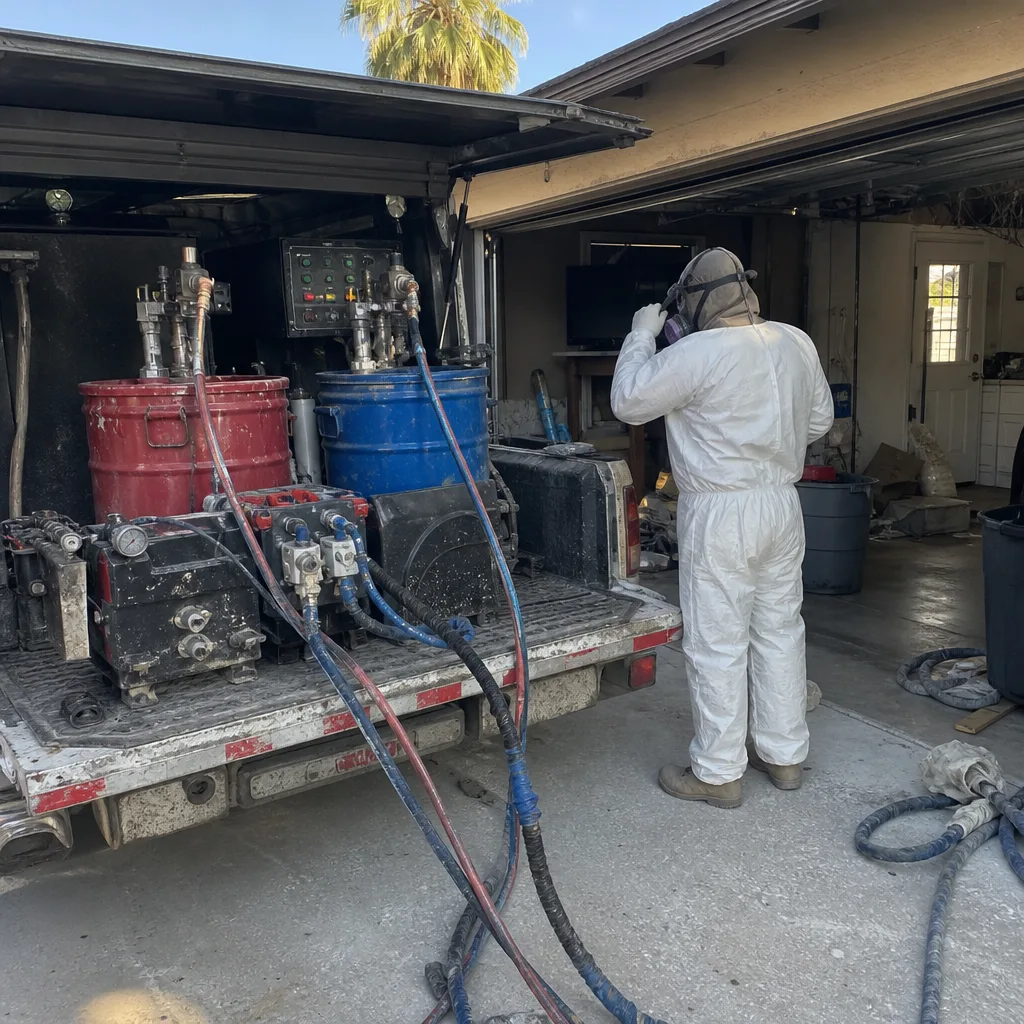
Customers in Crestline call us because we carry both open-cell and closed-cell spray foam systems from Icynene and Demilec, plus a full material portfolio spanning eight brands if foam turns out to be the wrong tool for the job. We do not push one product line on every house. A closed-cell roof deck application on an A-frame off Lake Gregory Drive is a completely different specification than an open-cell cavity fill in a standard attic, and we will tell you which one actually makes sense for your structure. Our response time to Crestline is same-day for estimates and typically 2-4 business days for scheduled work, weather permitting. Mountain roads and snow do affect scheduling in January and February; we plan around it.
Spray Foam Attic Insulation in Crestline
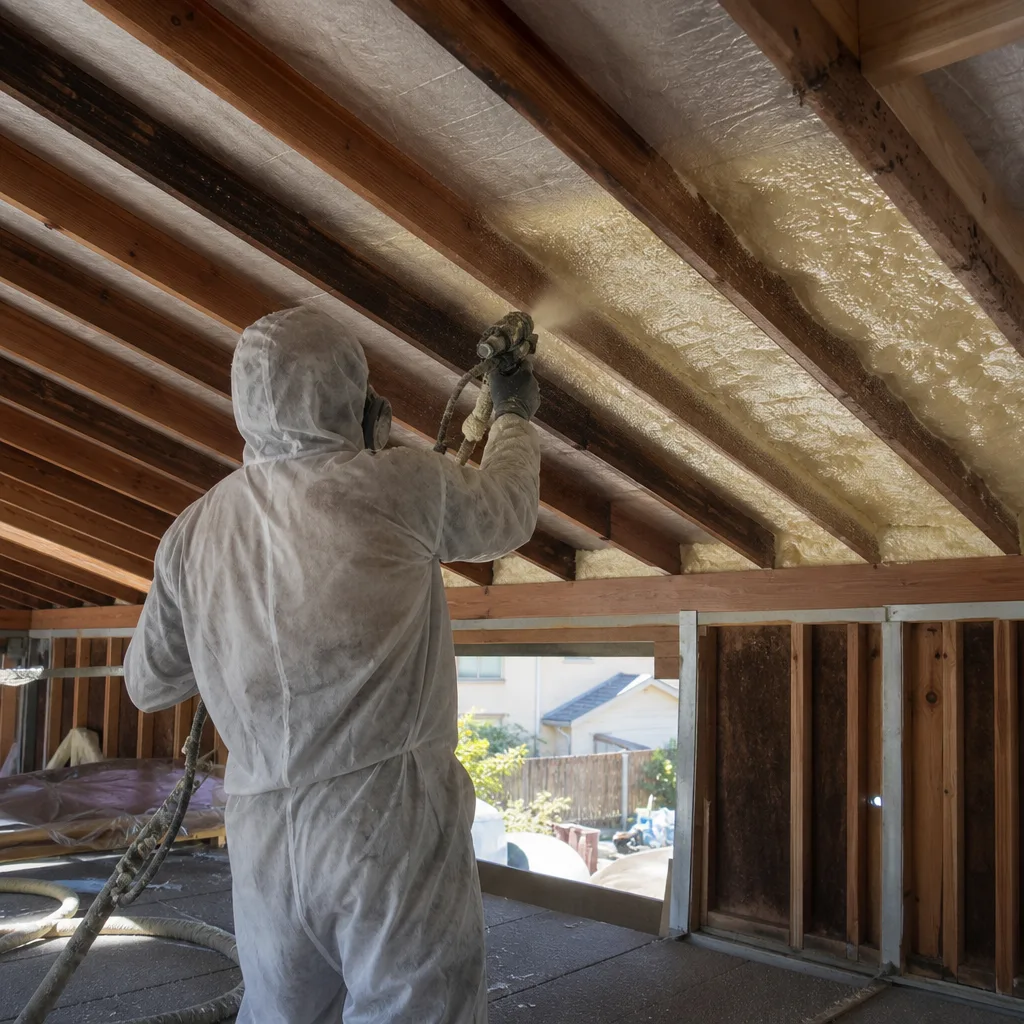
Spray foam attic insulation in Crestline is often applied against the underside of the roof deck rather than on an attic floor, because so many homes here have cathedral ceilings with no horizontal attic space at all. The first sentence of any estimate starts with identifying whether you actually have an accessible attic. If you do, open-cell foam at the ceiling plane runs $1.80-$3.20 per board foot and does an excellent job slowing air movement and heat loss. If you don’t, and the framing is exposed from the living space upward, closed-cell foam against the deck is usually the correct call, at $3.50-$7.00 per board foot installed. The price difference reflects material density, R-value per inch, and the vapor-control role closed-cell plays in unvented assemblies.
Unvented Roof Deck Assemblies on A-Frames
Most Crestline A-frames have no attic, no ridge vent, and no soffit ventilation path worth mentioning. Pair those conditions and the building science answer is an unvented, conditioned attic assembly sealed with closed-cell spray foam against the underside of the roof deck. That seals the thermal boundary at the roofline, stops warm interior air from condensing against cold sheathing on freezing mountain nights, and dramatically reduces ice-damming risk. We spray to the depth required to hit the R-value target for climate zone 16A here, specification first.
Ember-Resistant Soffit Detailing
The surrounding San Bernardino National Forest means wildfire is not a hypothetical in Crestline. Any roof deck insulation job has to account for ember intrusion at the eaves, soffits, and any gable-end venting old cabins still carry. We detail those penetrations with ember-resistant mesh and work the foam to maintain any Class A fire-rated assembly requirements the structure already has. This is standard practice for us in 92325 and not something we would skip to save a few hundred dollars.
Spray Foam Wall Insulation in Crestline
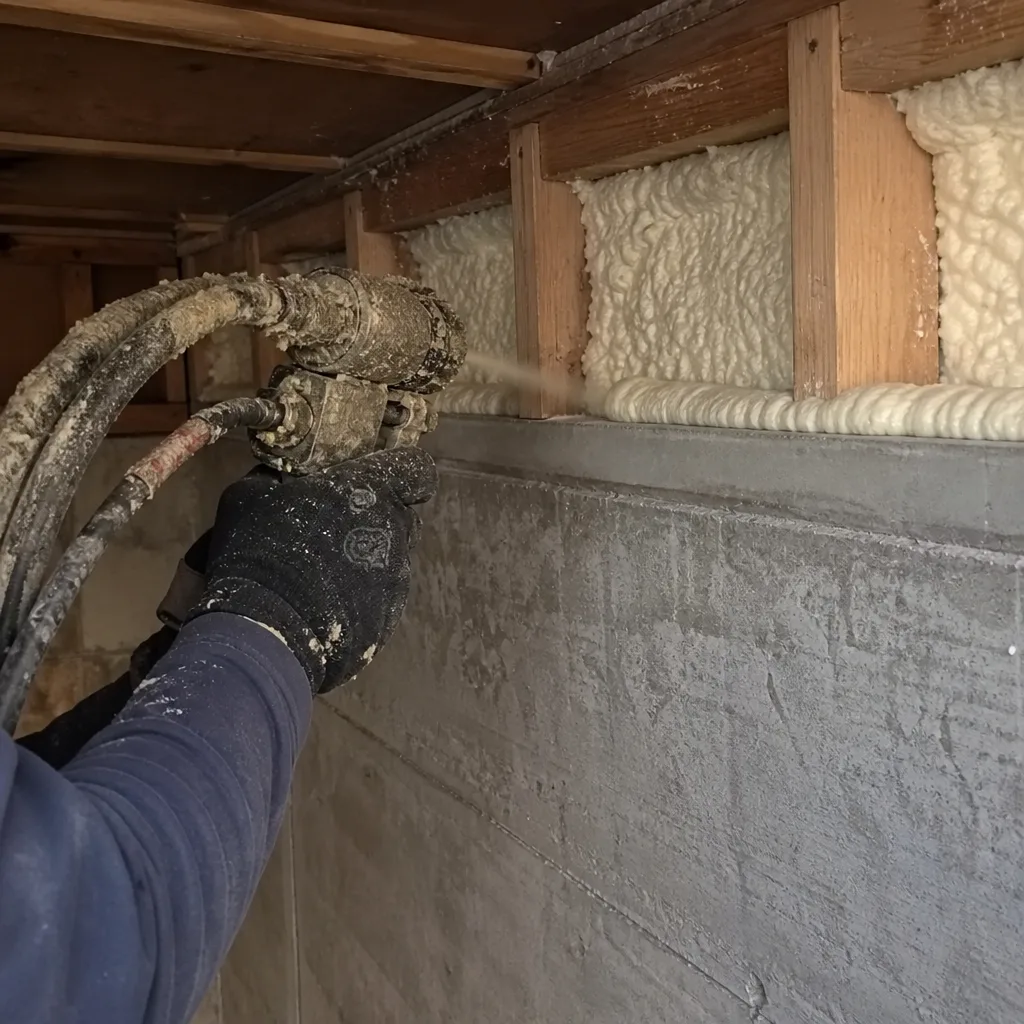
Spray foam wall insulation in Crestline is how we deal with the thin 2×4 exterior walls on the older cabins and A-frames that dominate this housing stock. These walls were typically built empty, or with a single layer of degraded fiberglass batt matted down to almost nothing. Closed-cell foam at $3.50-$7.00 per board foot gives you roughly R-6.5 to R-7 per inch, which means even a shallow 2×4 cavity can reach meaningful cold-weather performance. Open-cell at $1.80-$3.20 per board foot works too, though it nets about half the R-value per inch and doesn’t act as a vapor retarder the way closed-cell does. For walls in a town that sees freezing nights and periodic heavy snow, we usually recommend closed-cell where the budget allows.
Working Around Legacy Wiring
Before any foam touches a Crestline cabin’s wall cavities, our crew maps the electrical. Many of these homes still have knob-and-tube-era or early Romex wiring running through the stud bays, and spraying foam directly over aged conductors is a fire hazard and a code problem in many cases. We work with a licensed electrician when needed, reroute or sleeve conductors, and only then spray. This adds time and sometimes cost, but skipping it is not an option we will take with your home.
Thermal Bridging on Exposed Framing
On cabins with exposed interior framing or log-style walls, the studs themselves conduct cold straight through the assembly even after cavities are filled. Closed-cell foam helps by adding a continuous air-seal that reduces convective losses, but the framing is still a thermal bridge. Where a homeowner wants to go further, we can over-frame interior walls, add a continuous foam board layer under new drywall, or spray the exterior sheathing. The right answer depends on how far you want to go and what the wall assembly can physically accommodate.
Trusted Brands We Service in Crestline
We’re authorized to install spray foam from Icynene and Demilec, two of the industry’s most established foam manufacturers, and we carry both open-cell and closed-cell product lines from each. We stock local inventory for Crestline jobs and order mountain-specific materials ahead of the snow months so we’re not waiting on a truck from the valley mid-project. Beyond foam, we’re also installers for Owens Corning, Johns Manville, and GreenFiber, because some Crestline projects, especially those with accessible attics or budget constraints, are better served by blown-in or batt work. The point is that we will tell you which product actually fits your home rather than selling you whatever is on the truck.
Common Spray Foam Insulation Problems We See in Crestline Homes
- No attic to spray into. A-frames and cathedral-ceiling cabins were often built as uninsulated weekend retreats, so the conditioned living space runs right up to the roof sheathing. Every one of these becomes a roof deck application, not an attic floor job.
- Moisture trapped in unvented cathedral decks. When open-cell foam is sprayed against a cold roof deck without a proper vapor-control strategy, warm interior air condenses inside the assembly on freezing nights. That leads the framing to rot slowly and contributes to ice dams at the eaves.
- Knob-and-tube-era wiring in the cavities. We find legacy electrical conductors in wall and ceiling cavities on a regular basis in 92325. Spraying foam over them without addressing the wiring first is a real fire risk, so we map, sleeve, or replace before any material leaves the rig.
- Ember entry at soffits and gable vents. Cabins backing onto the national forest need foam detailing that also closes ember pathways. We see uncovered gable-end vents and open soffit gaps on homes all over Crestline, and every one of those is a potential ignition point during Santa Ana conditions.
Pricing for Spray Foam Insulation in Crestline, CA
We Also Serve Cities Near Crestline
Our Spray Foam Insulation team works the whole mountain corridor, so if you own a cabin or full-time home in Lake Arrowhead, we do a lot of roof deck and wall work up there too. We also serve Muscoy, San Bernardino, and Highland for more standard attic and wall spray foam jobs, though those tend to be tract homes rather than mountain cabins. If your property sits anywhere in the San Bernardino Mountains around Crestline, call us and we will tell you honestly which insulation method fits.
Serving Crestline, CA — Our Local Coverage Area
We’re based in the Crestline area and know this community well. Use the map below to see our service coverage — if you’re nearby, we can almost certainly help.
FAQs About Spray Foam Insulation in Crestline
Can you spray foam an A-frame cabin in Crestline that has no attic to blow insulation into?
Yes, and it’s one of the most common jobs we do in 92325. The roof deck becomes the insulation surface, with closed-cell foam sprayed directly against the sheathing from the interior to create an unvented, conditioned assembly. This seals the thermal boundary at the roofline, handles the moisture-control role that an attic vent normally would, and works with the exposed cathedral framing these cabins were built with. It’s more involved than a standard attic blow, but for A-frames it’s often the only practical path to real winter performance. Call (855) 382-3451 for a site assessment.
Why does spray foam spec differ in Crestline versus the low desert 30 minutes downhill?
Crestline sits at roughly 4,500 feet, so the insulation challenge is cold winter nights, heavy snow, and ice-damming risk, not the desert heat you’d spec for in San Bernardino or Highland. A foam assembly that works fine at 1,000 feet can fail up here if it doesn’t account for vapor drive, condensation on cold sheathing, and the unvented cathedral decks common to mountain construction. Add in wildfire exposure from the national forest and the ember-resistance detailing requirement, and you’re specifying a fundamentally different assembly than anything downhill. The material might look the same; the assembly is not.
What do you do about old knob-and-tube-era wiring before spraying a cabin’s walls?
We map every circuit in the cavity before we spray, and any legacy wiring that’s deteriorated, improperly routed, or carrying more load than it should gets evaluated by a licensed electrician we work with regularly in the mountains. The wiring either gets sleeved, rerouted, or replaced before foam goes in. Spraying closed-cell foam directly over aging conductors can trap heat and create a fire risk, so this is a hard prerequisite on our jobs, not an upsell.
How do you make spray foam ember-resistant on a cabin backing onto the San Bernardino National Forest?
The foam itself is not the ember barrier; the detailing is. We close soffit gaps, gable-end vents, and any penetration where an ember could get driven into the assembly during a Santa Ana event, and we install ember-resistant mesh at those locations so the vent function is preserved but the ignition path is blocked. On roof deck applications we maintain the structure’s required Class A fire-rated assembly and work with the homeowner on any wall or eave detail that doesn’t meet current wildfire-zone expectations. For cabins that genuinely back onto forest land, this detailing becomes part of the scope, not an add-on.
Is spray foam the right call for a thin-walled 1960s vacation cabin that’s now a full-time Crestline home?
Usually yes, and specifically closed-cell foam, because it delivers the most R-value per inch in a 2×4 cavity and acts as a vapor retarder, which matters on thin mountain walls. Open-cell has its uses, but in a 1960s cabin with no attic and walls that were built empty, closed-cell against the roof deck and in the stud bays gives you both the air-seal and the cold-weather performance these structures were never designed to have. The one honest caveat is cost; but call (855) 382-3451 and we’ll walk you through the open-cell versus closed-cell numbers for your actual cabin before you commit to anything.
Call Thermal Insulation Co for Spray Foam in Crestline
If you’re tired of heating the forest around your cabin all winter, we’ll look at your roof deck, your walls, your wiring, and your wildfire exposure, then tell you exactly which foam spec makes sense and what it costs. Ruben Castellano has built Thermal Insulation Co around one specialty: insulation. Spray foam, blown-in, or batt, we’ll tell you which method actually fits your home. Call (855) 382-3451 for a free estimate.
Written by Ruben Castellano, Owner at Thermal Insulation Co, serving Crestline and the San Bernardino Mountains. Our team is authorized to install Icynene and Demilec spray foam systems, plus fiberglass, mineral wool, and recycled cellulose products from Owens Corning, Johns Manville, Knauf, CertainTeed, Rockwool, and GreenFiber.