
Fast, Reliable Spray Foam Insulation Across Wrightwood
Spray foam insulation in Wrightwood typically runs $2.50 to $6.50 per board foot installed, with most full attic or roof deck jobs landing between $4,800 and $11,200 depending on foam type, square footage, and how much old material we need to remove first. We serve the entire 92397 zip code, from the village center off Highway 2 up to the cabins along Angeles Crest. Our crews know mountain-road timing and Angeles National Forest access constraints because we run jobs here regularly, not occasionally. Call (855) 382-3451 and we’ll schedule a free estimate, usually within three to five business days of your call.
Why Thermal Insulation Co Is Wrightwood’s Preferred Spray Foam Insulation Company
Most insulation contractors work the flatlands. We’re not most contractors. Ruben Castellano has built Thermal Insulation Co around a simple idea: carry enough material brands and installation methods that the home gets what it actually needs, not what we happen to have on the truck. That matters in Wrightwood because mountain cabins with vaulted ceilings, irregular framing, and absentee-owner freeze cycles don’t respond to a one-product pitch. Homeowners here ask different questions than a Rancho Cucamonga tract house owner asks. We answer them with specifics.
Our Spray Foam Insulation team brings both open-cell and closed-cell systems from Demilec and Icynene to Wrightwood jobs, so the recommendation follows the building, not our inventory. We also carry fiberglass from Owens Corning and Johns Manville, mineral wool from Rockwool, and GreenFiber cellulose for homes where spray foam isn’t the right tool. That range means when we tell a Wrightwood homeowner that closed-cell foam on a roof deck is the correct call for their freeze-thaw exposure, it’s because we weighed it against every other option we could have installed. Not because foam is all we know.
Response time to Wrightwood runs 24 to 48 hours for emergency calls during winter, when a rodent-compromised attic or frozen pipe situation won’t wait. Standard estimates are scheduled within the week. We’d rather be straight about timing than promise same-day service and miss it.
Closed Cell Spray Foam Insulation in Wrightwood
Closed Cell Spray Foam Insulation is the workhorse for Wrightwood’s hardest conditions: roofs that carry snow, rim joists that leak cold air, and cabins that sit empty through hard freezes. Closed-cell foam cures dense, roughly 2 pounds per cubic foot, and adds structural racking strength to roof decks while creating an air and vapor barrier in one pass. In Wrightwood, that air barrier is what protects pipes from freezing during a January cold snap when the cabin is empty and the thermostat is set low. Open-cell foam won’t stop air the same way.
Roof Deck Applications
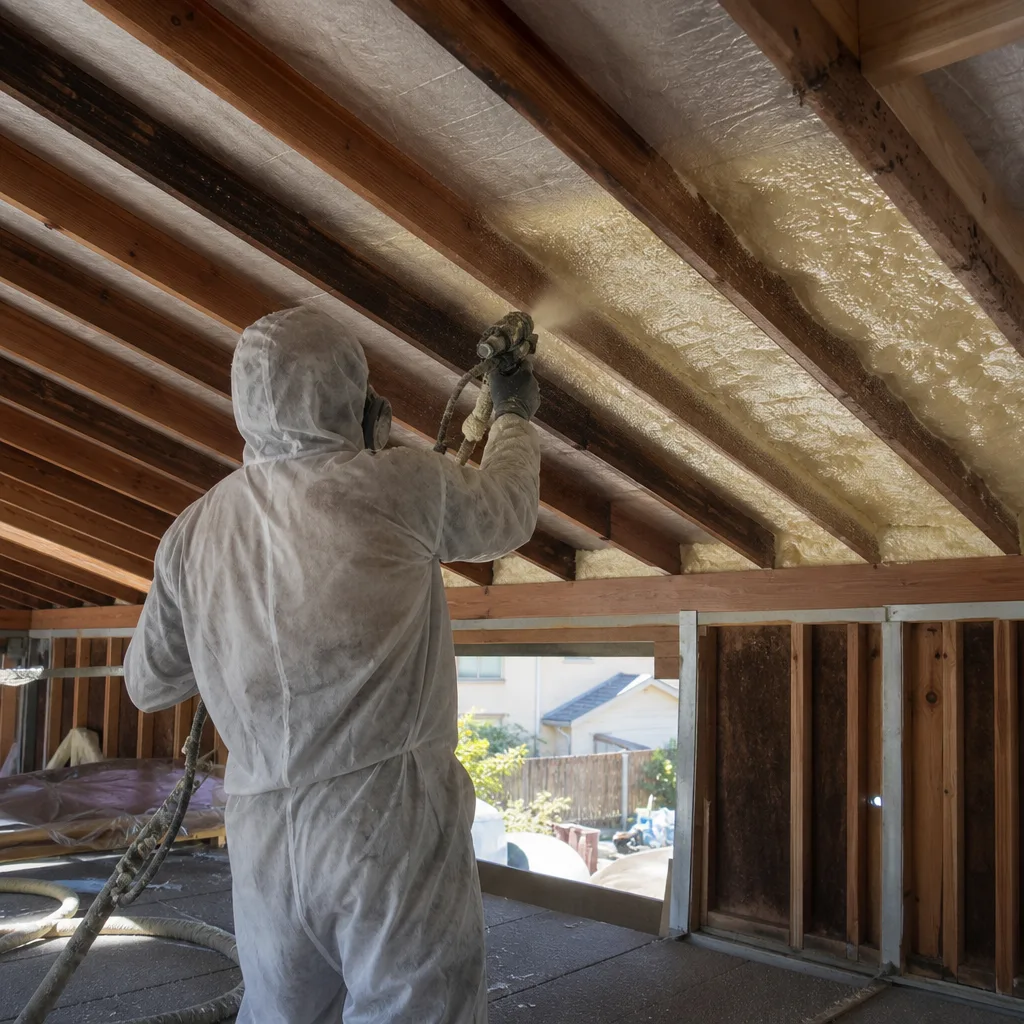
Applying closed-cell foam directly to the underside of a Wrightwood roof deck converts the attic into a conditioned space. That’s a real advantage when the ceiling is vaulted, the framing bays are irregular, and the old fiberglass has slumped or been chewed through. The foam fills the bays completely, adheres to the sheathing, and blocks the air movement that causes ice-dam-style problems at roof edges during snowmelt.
Rim Joist and Crawlspace Sealing
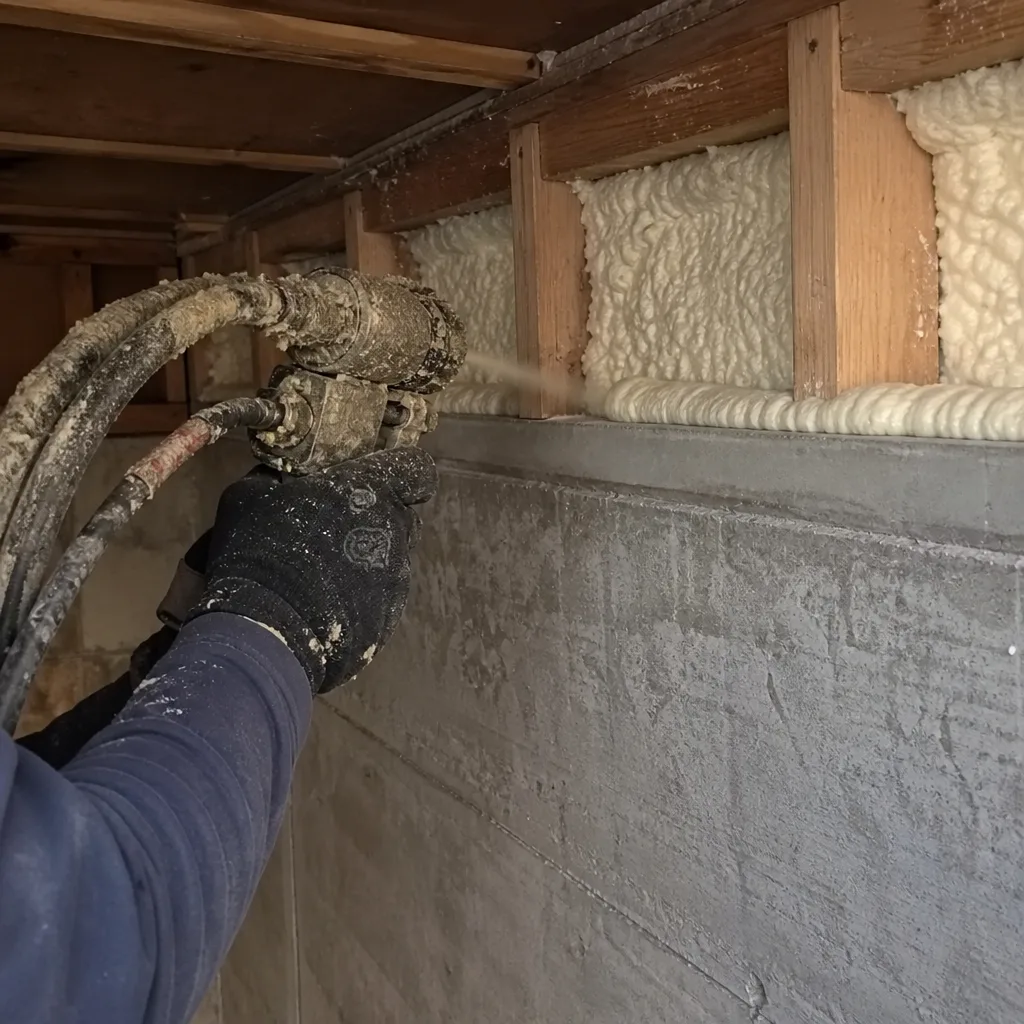
Wrightwood cabins built between the 1940s and 1980s often have rim joists that were never insulated at all. Cold air pours through the band joist, chills the floor framing, and freezes plumbing at the wall. Two inches of closed-cell foam at the rim joist solves most of this and costs $350 to $900 for a typical cabin perimeter.
Open Cell Spray Foam in Wrightwood
Open Cell Spray Foam is the right tool in Wrightwood when the goal is sound control and thermal performance in vented attics where moisture is already managed. It expands more than closed-cell, fills irregular framing voids well, and costs roughly half of closed-cell per board foot, typically $1.40 to $3.00 per board foot installed. The trade-off is air permeability and no vapor barrier, which makes open-cell the wrong choice for a roof deck that sees snowmelt or a crawlspace that sees ground moisture. We’ll tell you when it’s wrong for your cabin.
Interior Wall and Floor Cavities
For Wrightwood homeowners who want to quiet the sound of Highway 2 traffic or a neighbor’s snowblower, open-cell foam in interior partition walls is effective. The foam fills every void, kills echo, and adds R-value without the cost of closed-cell. This application runs $1,000 to $2,800 for a typical cabin interior.
Attic Floor Applications
When a Wrightwood attic is properly vented and the cabin is occupied full-time, open-cell foam on the attic floor can work. But we recommend it only after checking that ventilation is sufficient and the roof deck isn’t developing condensation. Most 1940s-1980s Wrightwood cabins fail that ventilation check, so we usually steer toward closed-cell on the roof deck instead.
Trusted Brands We Service in Wrightwood
We stock Demilec closed-cell and open-cell foam systems specifically for Wrightwood jobs, and we carry Icynene when the project calls for it. For cabins where spray foam isn’t the answer, we keep Owens Corning and Johns Manville fiberglass options on hand, plus Rockwool mineral wool for fire-resistance applications near wood stoves and chimneys. We stock these locally because we don’t want a Wrightwood homeowner waiting on a parts run down the mountain. When we quote a job, the material is already accounted for, not something we’ll “figure out” later.
Common Spray Foam Insulation Problems We See in Wrightwood Homes
- Rodent-chewed open-cell foam in unoccupied attics. Cabin attics that sit quiet for weeks become rodent territory. Once they tunnel through open-cell foam, the air barrier is gone and frozen pipes follow. Closed-cell foam resists this far better because it’s denser and harder to chew through, but we also recommend sealing all penetrations with fire-rated caulk and reinforcing vulnerable areas during installation.
- Missing or compromised vapor barriers in vaulted ceilings. Many Wrightwood cabins were built before vapor control was standard practice. When warm interior air hits cold roof sheathing in winter, condensation forms inside the ceiling cavity. Closed-cell foam acts as its own vapor barrier, which is why we recommend it for vaulted ceilings in this climate rather than trying to retrofit a separate barrier.
- Irregular framing voids in added-on cabins. Decades of additions mean framing bays that don’t match, headers that block access, and odd cavities that batts never filled correctly. Spray foam conforms to whatever shape the bay is, which is why it beats fiberglass in most Wrightwood retrofit work. Closed-cell’s rigidity also helps tie irregular framing together.
- Snowmelt intrusion at poorly insulated roof edges. When roof edges aren’t insulated correctly, snow melts unevenly and refreezes at the eaves, causing ice dams. The fix is continuous insulation from the soffit up to the ridge. Spray foam is the only realistic way to achieve that in an existing Wrightwood cabin.
Pricing for Spray Foam Insulation in Wrightwood, CA
Here are the ranges we quote most often in Wrightwood. Closed-cell spray foam on a roof deck runs $4.50 to $6.50 per board foot installed. Rim joist sealing runs $350 to $900 per cabin depending on perimeter length and access. Open-cell spray foam in walls or attic floors runs $1.40 to $3.00 per board foot installed. A full vaulted-ceiling retrofit with closed-cell on a 1,200-square-foot cabin typically lands between $8,500 and $12,000. What moves the number: foam depth, how much old insulation we remove, how many penetrations we seal, and whether we need to address rodent damage first. We give a firm line-item quote before work starts, and estimates are free. Call (855) 382-3451 and we’ll walk the cabin with you.
We Also Serve Cities Near Wrightwood
Thermal Insulation Co runs spray foam jobs throughout Wrightwood and the surrounding mountain and high-desert communities. We regularly work in Piñon Hills, Phelan, Oak Hills, and San Antonio Heights. If your cabin is on the Angeles Crest side or down toward the 15, call (855) 382-3451 and we’ll confirm we cover your road before scheduling.
Serving Wrightwood, CA — Our Local Coverage Area
We’re based in the Wrightwood area and know this community well. Use the map below to see our service coverage — if you’re nearby, we can almost certainly help.
FAQs About Spray Foam Insulation in Wrightwood
Part-time occupancy changes the priority from comfort to freeze protection. A cabin that sits empty for weeks needs an air barrier that keeps cold out and prevents pipes from freezing, which is why we recommend closed-cell foam on roof decks and rim joists for most Wrightwood second homes. Closed-cell foam’s air-sealing capability protects even when the thermostat is low. Call (855) 382-3451 and we’ll assess whether your cabin’s insulation is doing that job.
Closed-cell spray foam adds structural racking strength to roof decks and handles Wrightwood’s snow loads and freeze-thaw cycles well because it’s rigid and doesn’t absorb moisture. The freeze-thaw cycle that causes ice dams at roof edges is driven by air leaks and uneven roof temperatures, both of which closed-cell foam addresses. Open-cell foam does not provide the same structural or moisture benefits in this climate.
Remove it and replace it with closed-cell spray foam. Rodent-chewed insulation, especially open-cell foam or fiberglass, has lost its air-sealing value and often contains nesting debris that should come out. Our crew recently sprayed closed-cell foam in a 1960s cabin off Highway 2 near the Wrightwood village center, where the original open-cell foam had been chewed through by rodents in the empty attic, leaving the vaulted ceiling vulnerable to winter freezing. We removed the damaged foam, sealed the wiring penetrations with fire-rated caulk, and applied closed-cell foam to the roof deck and rim joists, then verified with a blower door test that the cabin could hold heat during absentee periods. We can do the same for your cabin.
Spray foam fills the entire ceiling cavity and air-seals the roof deck in one step, which older Wrightwood homes with vaulted ceilings almost never have. Most vaulted ceilings in 1940s-1980s cabins have thin fiberglass that has slumped, leaving gaps at the top of each bay. Closed-cell foam fills those gaps, bonds to the sheathing, and stops the air movement that makes rooms drafty in winter and hot in summer. The result is a cabin that holds heat during absentee periods and burns less propane when occupied.
Yes. Installers here must plan around Angeles National Forest access, mountain-road delivery, and real winter weather. We schedule Wrightwood jobs with extra time for road conditions and coordinate material delivery so we aren’t hauling foam up Highway 2 on a snow day. The installation itself also has to account for freeze-safe detailing and vapor control that desert or coastal contractors often skip. We do this work year-round, but winter jobs get a hard look at ice and snow timing before we commit a date.
Written by Ruben Castellano, Owner at Thermal Insulation Co, serving Wrightwood and the surrounding San Gabriel Mountain communities. Call (855) 382-3451 for a free spray foam estimate.