
Fast, Reliable Spray Foam Insulation Across Portola Hills
Spray foam insulation in Portola Hills typically runs $2.50 to $6.50 per board foot installed, with most full attic jobs landing between $4,800 and $9,200 depending on square footage and whether you choose open-cell or closed-cell foam. We’re in Portola Hills regularly, working through the 92610 ZIP code and the tract communities that climb the foothills off Saddleback Ranch Road and Glenn Ranch Road. Our crews know these 1980s and 1990s homes well – the wood-frame construction, the original batts that have settled, and the attics that bake in summer. Call (855) 382-3451 for a free estimate, and we’ll have someone out to Portola Hills within 24 to 48 hours.
Why Thermal Insulation Co Is Portola Hills’s Preferred Spray Foam Insulation Company
Insulation is all we do. That focus matters in Portola Hills because the homes here have specific problems – original R-11 to R-19 fiberglass batts that have compressed over decades, aging radiant barriers peeling from roof decks, and attics that hit 140°F in August. We’re not a general contractor adding insulation as a side service. We’re a dedicated insulation contractor, and our team works with eight material brands – Owens Corning, Johns Manville, Knauf, Rockwool, CertainTeed, Icynene, Demilec, and GreenFiber – so we can match the right product to your specific house rather than pushing whatever single brand we happen to stock.
Ruben Castellano leads our crew, and he’s spent years working in Orange County’s inland foothill communities. When we quote a spray foam job in Portola Hills, we account for the fire-hardening requirements baked into California code for this zone, not just the R-value target. That’s the difference between a contractor who reads a spec sheet and one who knows what the inspector will look for on a Portola Hills job.
We carry Icynene and Demilec because both manufacturers build open-cell and closed-cell systems that hold up in hot, dry attic environments. For Portola Hills homeowners dealing with duct sweat and uneven room temperatures, the closed-cell option often makes the most sense. We’ll tell you honestly when it doesn’t.
Garage Spray Foam Insulation in Portola Hills
Garage spray foam insulation in Portola Hills addresses a problem most homeowners in this part of the 92610 ZIP code feel every summer: garages that become ovens by mid-afternoon and radiate heat into adjacent living spaces. In the tract homes off Glenn Ranch Road and Saddleback Ranch Road, garage ceilings sit directly beneath bedrooms and bonus rooms. When the garage attic isn’t properly insulated, the heat penetrates that shared wall and forces your AC to run longer. We typically spray the garage ceiling and rim joist cavities, sealing the thermal boundary between the garage and the rooms above it.
Most garage spray foam jobs in Portola Hills run $1,800 to $3,600 for a standard two-car garage ceiling, depending on foam type and depth. Closed-cell foam costs more per board foot but adds structural rigidity and a vapor barrier – worth considering here because the inland heat pushes moisture into wood framing during summer, then the cool winter nights pull it back out. That cycling is tough on wood and tough on whatever insulation sits against it.
Rim Joist Sealing in Tract Home Garages
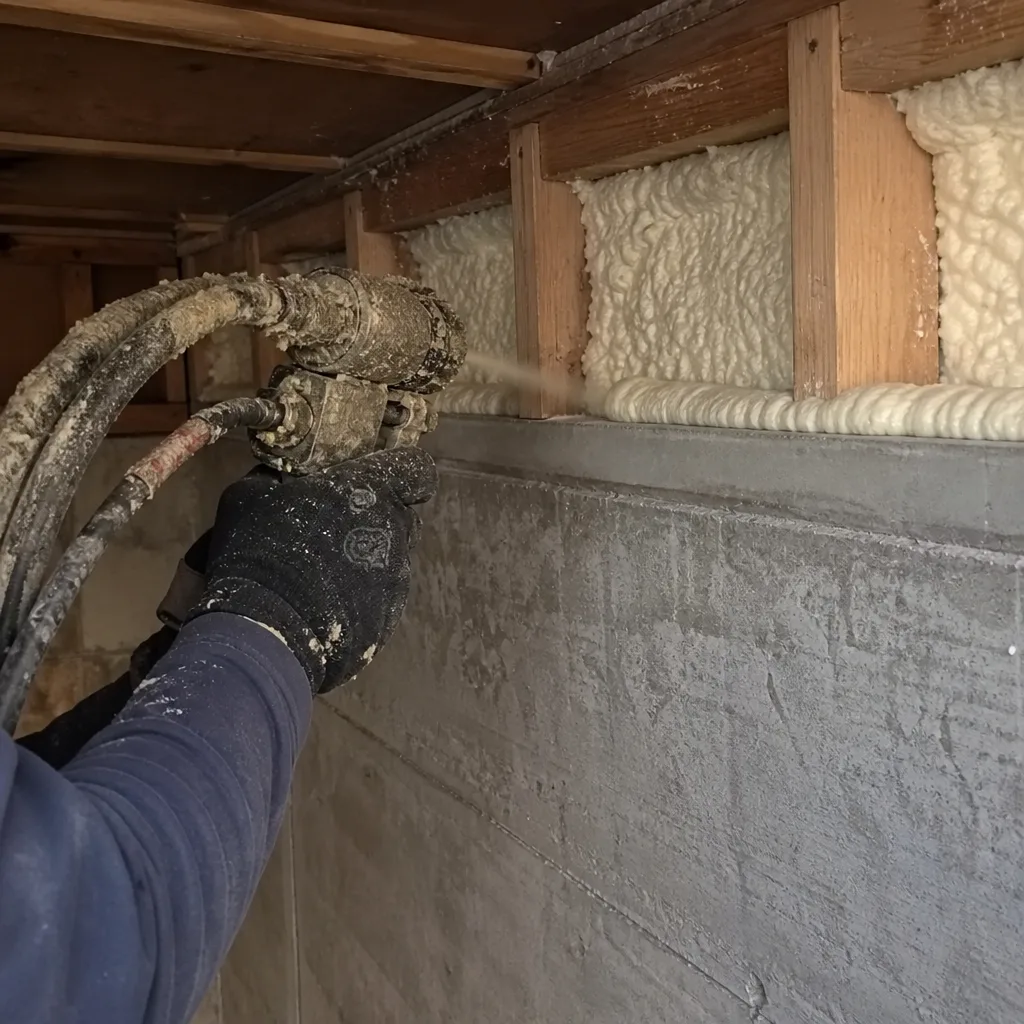
The rim joist – the band of wood where your garage floor framing meets the foundation – is a chronic air leak in Portola Hills homes. Original fiberglass batts stuffed into rim joist cavities degrade and fall out, leaving gaps that pull hot outside air into the garage in summer and cold air in winter. We spray closed-cell foam into these cavities to stop the stack effect and keep garage temperatures more stable.
Garage Door Opener and Insulation Together
One thing we see often in Portola Hills: homeowners whose garage door openers fail repeatedly because the door itself is a heavy one-piece unit, and the opener gears strip under load. That’s a mechanical issue, not an insulation issue. But we mention it because if the dead opener keeps you from opening the garage, your attic access point may be blocked, and a spray foam job gets delayed. We’ll work around it, and on more than one Saddleback Ranch Road job, Ruben has pointed homeowners toward a reliable LiftMaster replacement before we started spraying.
Closed Cell Spray Foam Insulation in Portola Hills
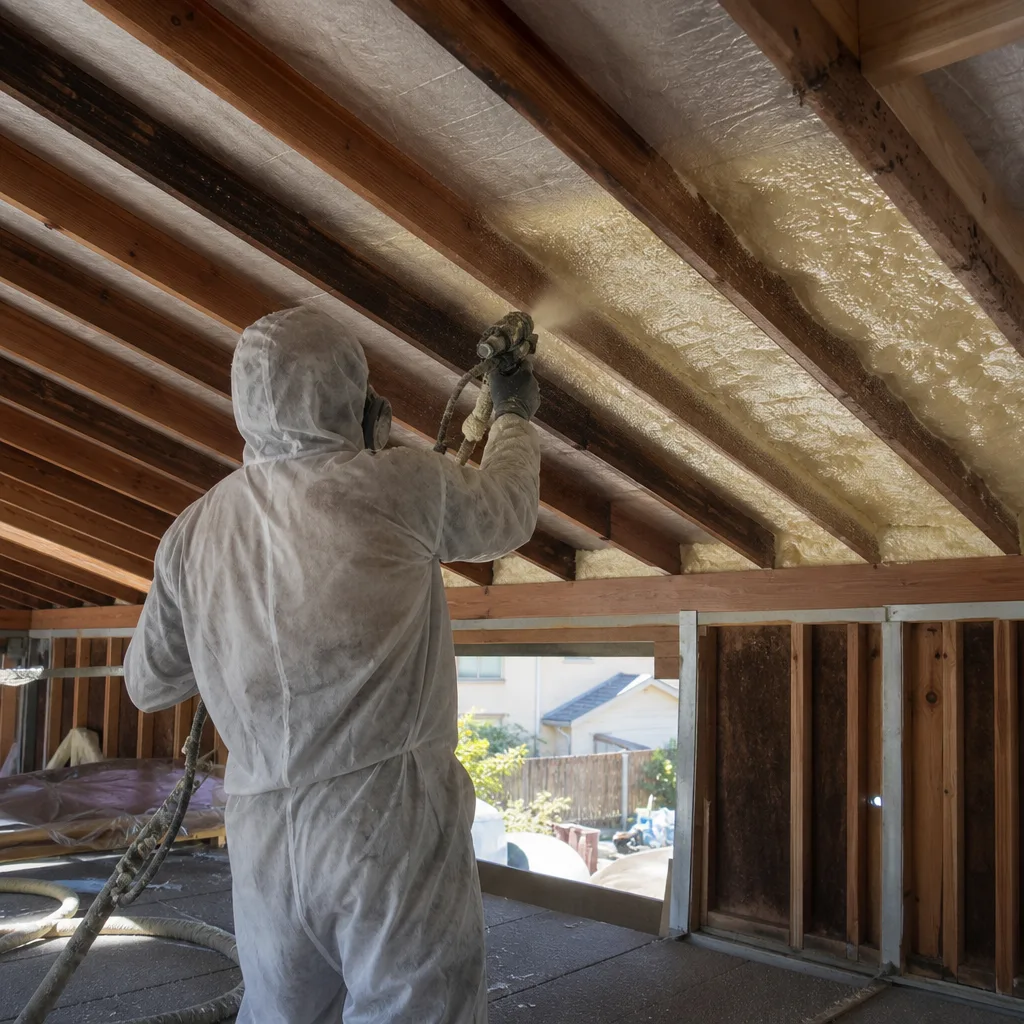
Closed cell spray foam insulation in Portola Hills is the higher-density option we recommend for fire-hazard-zone attics, roof decks, and areas where moisture control matters as much as R-value. Closed-cell foam cures into a rigid, air-tight layer at roughly R-6.5 to R-7 per inch – about double the R-value of open-cell. In a Portola Hills home where attic temperatures hover above 140°F in summer, that density makes a measurable difference in how much heat actually transfers through the ceiling into living space.
Closed-cell jobs in Portola Hills run $3.50 to $6.50 per board foot installed. A typical 1,200-square-foot attic with 2 inches of closed-cell foam lands between $7,000 and $11,000. It’s more expensive than open-cell up front, but for homeowners in the high-fire-hazard zone, the moisture-resistance and air-sealing properties often justify the cost. We quote both options and explain what each does in your specific attic.
Roof Deck Application for Fire-Hardening Zones
Portola Hills sits in a zone where Cal Fire and local building officials scrutinize what’s in your attic. Closed-cell foam applied to the underside of the roof deck creates an unvented attic assembly, which reduces the paths embers can take into your home. When we spray a roof deck here, we coordinate with your venting setup – Portola Hills homes frequently need ember-resistant mesh screens paired with the foam to meet code. This isn’t true of every Orange County city. It’s a Portola Hills requirement.
Attic Floor Sealing After Radiant Barrier Failure
Many of the homes we service off Saddleback Ranch Road still have original radiant barriers stapled to the rafters – barriers that are now torn, peeling, or fully degraded. Once that barrier fails, heat transfers directly through the roof deck. Closed-cell foam on the attic floor compensates by sealing the thermal boundary and stopping what the radiant barrier used to reflect. It won’t replace the radiant barrier, but it changes the equation enough that most homeowners stop worrying about roof-deck heat transfer once the attic floor is sealed properly.
Trusted Brands We Service in Portola Hills
We stock and install Icynene and Demilec spray foam products because both brands hold up under sustained heat exposure without off-gassing issues, and both offer open-cell and closed-cell formulations we can match to the job. For Portola Hills homeowners who want a fiberglass or mineral wool alternative for certain applications, we also work with Owens Corning, Johns Manville, and Knauf. The point isn’t brand loyalty – it’s fit. A 1980s tract home with failing batts and a sagging radiant barrier may need closed-cell foam, not another layer of fiberglass. We carry Rockwool because some Portola Hills homeowners want the fire resistance of mineral wool in specific cavities, and we carry GreenFiber for those who prioritize recycled content. Five brands, each with a reason.
Common Spray Foam Insulation Problems We See in Portola Hills Homes
- Compressed original batts leaving thermal gaps: The R-11 fiberglass batts installed when these tract homes were built in the 1980s and 1990s have settled, compressed, and drifted out of place. In the summer, you feel it as hot ceilings and bedrooms that never cool down even with AC running full blast.
- Degraded radiant barriers not reflecting heat: Radiant barriers installed decades ago peel, tear, and lose their reflectivity. Once the foil surface is compromised, it stops bouncing heat back through the roof deck, and your attic becomes a heat sink.
- Uneven open-cell batches from previous contractors: We’ve opened Portola Hills attics where a prior spray foam job was applied at inconsistent depths – thick in the center, thin at the eaves. That leaves thermal bridges exactly where heat enters the living space. We fix it with a proper re-application at uniform depth.
- Ductwork sweating in unsealed attics: Inland foothill summers push attic air past 130°F. When AC ducts run through an unsealed attic, condensation forms on the duct exterior and drips onto ceiling drywall. Closed-cell foam on the attic floor seals the thermal boundary and keeps duct surface temperatures more stable.
Pricing for Spray Foam Insulation in Portola Hills, CA
Here’s what Portola Hills homeowners can expect to pay. Open-cell spray foam runs $2.50 to $4.00 per board foot. Closed-cell runs $3.50 to $6.50 per board foot. A standard 1,000-square-foot attic with open-cell foam lands between $3,200 and $5,400. The same attic with closed-cell runs $5,800 to $9,800. Garage ceiling spray foam for a two-car garage runs $1,800 to $3,600. Rim joist sealing typically adds $900 to $1,800 for a full Portola Hills tract home. What affects cost: foam depth, square footage, whether we need to remove old batts first, and whether ember-resistant vent screens need replacing to meet fire-zone code. Every quote is free and line-itemed. Call (855) 382-3451 and we’ll have someone out to measure within two days.
We Also Serve Cities Near Portola Hills
Our crews cover Portola Hills and the surrounding foothill communities. We’re in Foothill Ranch, Lake Forest, Mission Viejo, and Trabuco Canyon every week. If you’re in one of these neighboring cities and need Spray Foam Insulation, call us. And if you’re reading this from Portola Hills itself, we’re the local insulation team at Portola Hills who knows this housing stock, this climate, and this fire-zone code.
Serving Portola Hills, CA — Our Local Coverage Area
We’re based in the Portola Hills area and know this community well. Use the map below to see our service coverage — if you’re nearby, we can almost certainly help.
FAQs About Spray Foam Insulation in Portola Hills
Yes – Portola Hills is in a designated high-fire-hazard zone, and California code requires attic venting with ember-resistant mesh screens, non-combustible materials in certain attic assemblies, and careful coordination between insulation and fire-hardening components. Closed-cell spray foam is widely accepted for roof deck and attic floor applications in these zones because it seals against ember intrusion and doesn’t burn. We check current code requirements for every Portola Hills job before we quote, so you don’t get a surprise during inspection. Call (855) 382-3451 and we’ll walk you through what applies to your specific house.
If your original fiberglass batts have compressed, shifted, or fallen out – which we see in nearly every 1980s and 1990s tract home we open in Portola Hills – adding more batts on top doesn’t fix the problem. The air gaps remain, and batts don’t seal against air movement. Spray foam does both: it insulates and air-seals in one application. If your attic shows settled batts, a torn radiant barrier, or rooms that stay hot with AC running, spray foam is usually the better fix. We’ll inspect it for free.
Not directly – a garage door opener fails because of stripped gears, worn circuits, or a door that’s too heavy for the unit, not because of insulation. But in Portola Hills tract homes, we see the two problems together: a hot garage that overheats the opener motor and a degraded opener that blocks safe attic access for insulation work. We’ll point you toward the right opener replacement and then get the garage ceiling and rim joists insulated. That combination keeps the garage cooler and the door cycling properly.
Let us look at it first. If the radiant barrier is still intact and reflecting, spray foam on the attic floor can work alongside it. If it’s torn and peeling – which is common in Portola Hills homes after 30-plus years of heat cycling – the barrier has essentially failed and isn’t doing much. In that case, closed-cell foam on the attic floor or roof deck becomes the primary thermal boundary. We’ll remove degraded barrier material where needed and advise whether to keep or replace what’s left. Call (855) 382-3451 for an honest assessment.
We install Icynene and Demilec spray foam systems, and both perform well in Portola Hills’ climate when applied at the correct depth. For the high-heat conditions in this foothill zone, we often recommend closed-cell Icynene foam for roof decks and attic floors because of its density, moisture resistance, and air-sealing performance. Demilec’s closed-cell product handles similar conditions well. Open-cell works where budget is the priority and the attic already has decent venting. We’ll specify the right brand and formulation for your house, not ours to clear off the warehouse shelf.
Got a Portola Hills attic that needs attention? Call Thermal Insulation Co at (855) 382-3451 for a free estimate. We’ll inspect the attic, explain your options in plain terms, and give you a line-itemed quote. Ruben and the team know these foothill homes, and we’ll tell you what actually makes sense for yours.
Written by Ruben Castellano, Owner at Thermal Insulation Co, serving Portola Hills and surrounding Orange County foothill communities.