
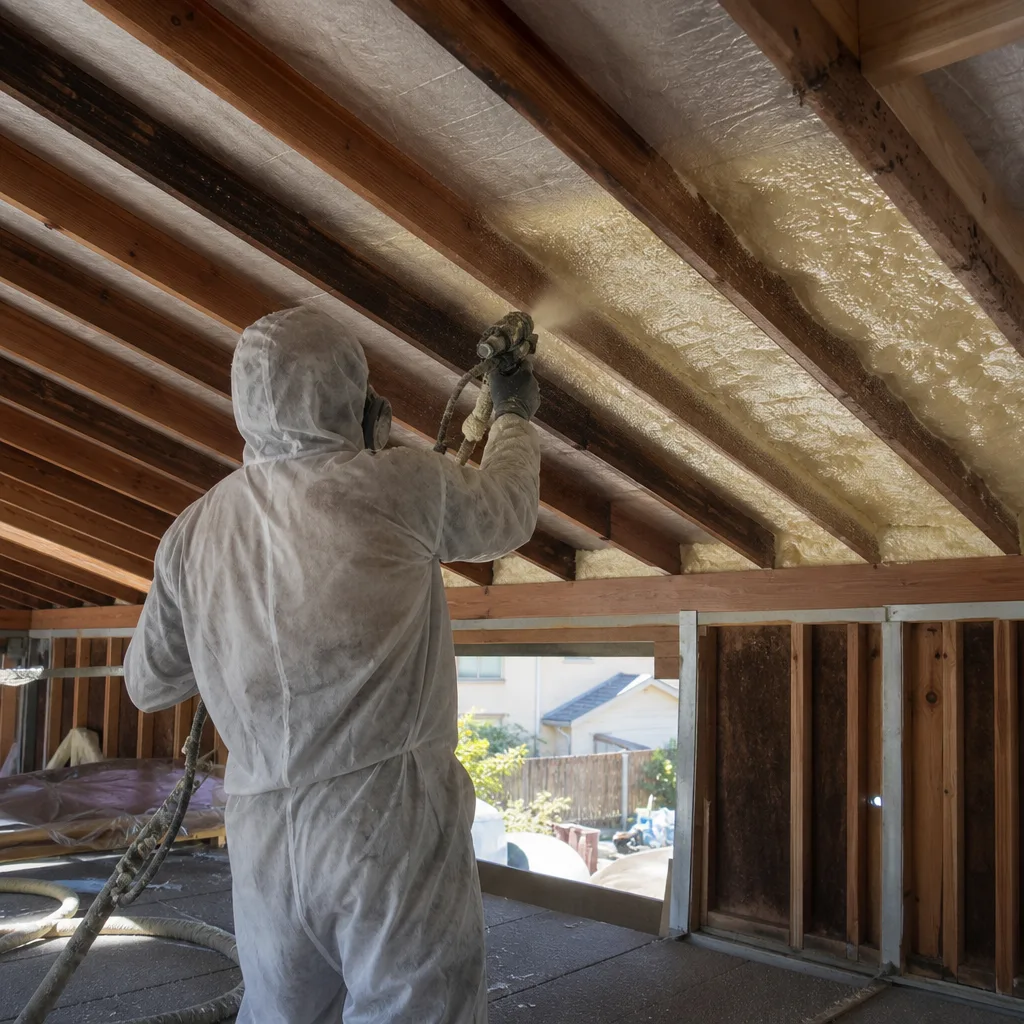
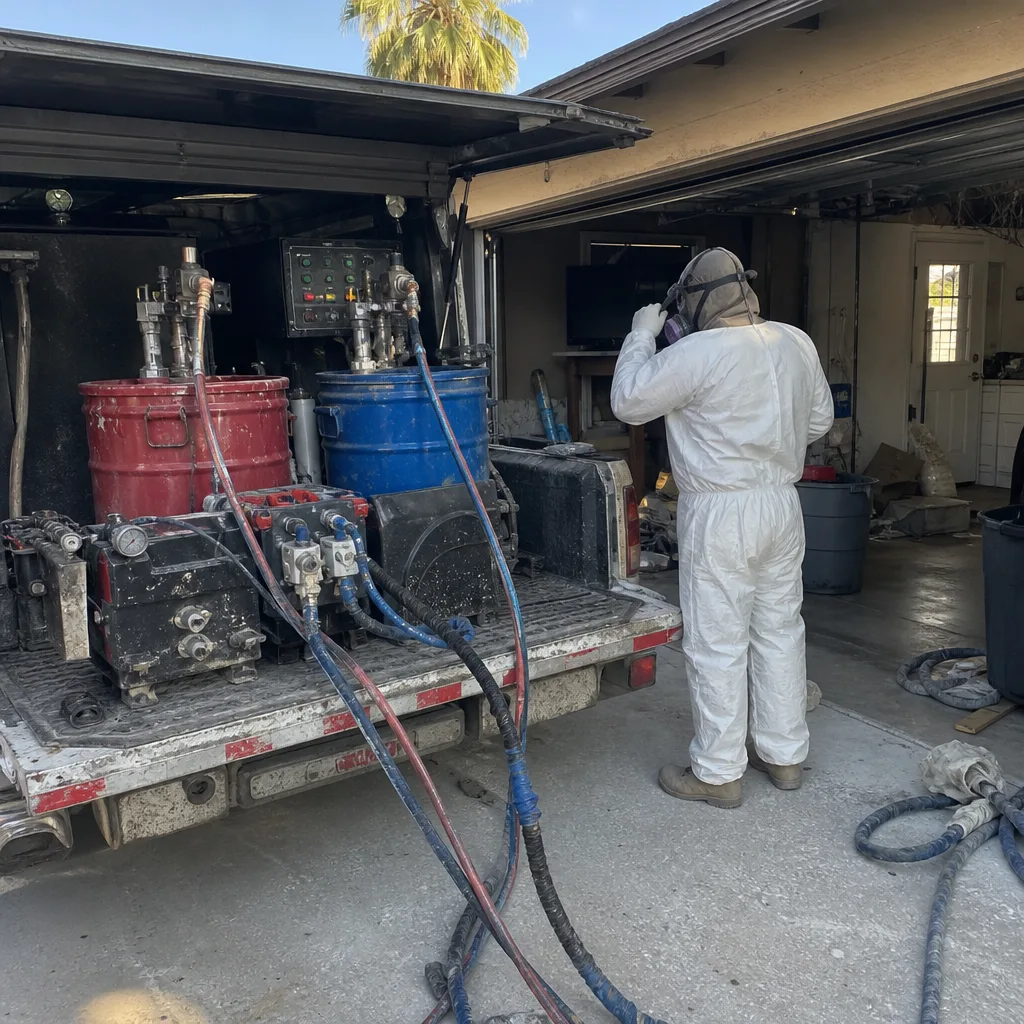
Fast, Reliable Spray Foam Insulation Across Ontario
Spray foam insulation in Ontario, CA typically runs $2.50 – $6.50 per board foot installed, with a full attic air-seal and foam package on a 1,500-square-foot ranch home landing between $3,800 and $7,200. Our crews reach most Ontario neighborhoods within 45 – 60 minutes from our Van Nuys yard, and we stock Demilec and Icynene foam systems specifically matched to the inland-valley heat and Santa Ana dust conditions that define this city’s insulation challenges. If your attic bakes all summer or your garage is unusable by 10 a.m., call (855) 382-3451 for a free estimate.
Ontario isn’t a coastal climate. It’s a hot, wind-scoured inland basin where insulation decisions hinge on radiant-heat rejection and dust control far more than winter warmth. Homeowners in ZIP codes 91761, 91762, 91764, and 91758 need a contractor who understands that difference. We do.
Why Thermal Insulation Co Is Ontario’s Preferred Spray Foam Insulation Company
Thermal Insulation Co is a dedicated insulation specialist, not a general contractor who picked up a foam rig. We carry eight nationally recognized insulation brands across three installation methods, which means the recommendation you get is driven by what your Ontario home actually needs, not whatever single product line we happen to stock. Most single-trade insulation companies carry one or two brands. We carry Owens Corning, Johns Manville, Knauf, Rockwool, CertainTeed, Icynene, Demilec, and GreenFiber because different homes, different moisture conditions, and different dust exposures call for different materials.
Led by Ruben Castellano, our team works regularly in Ontario’s older tract neighborhoods around Campus Avenue, Euclid Avenue, and the warehouse corridor near Ontario International Airport. We know the housing stock here: mid-century ranch homes with thin original attic insulation, vented crawl spaces that fill with wind-driven dust, and garage ceilings that radiate heat into bedrooms above. That local knowledge shapes every spray foam recommendation we make.
We offer free estimates throughout Ontario, and our response time for emergency or time-sensitive jobs – a failed rim joist seal before a heat wave, a garage that’s become unusable – is typically same-day or next-day for Ontario addresses. Call (855) 382-3451 and we’ll schedule a walkthrough.
Crawl Space Spray Foam Insulation in Ontario
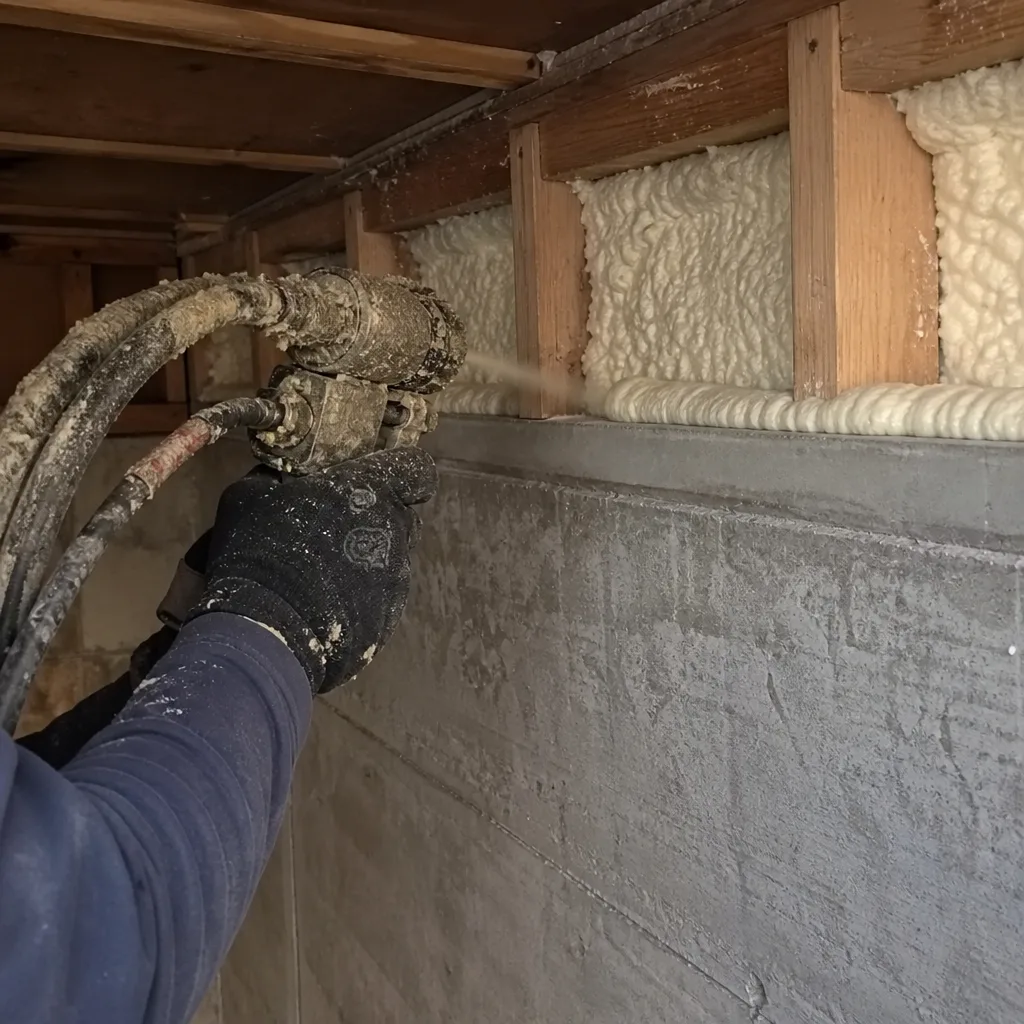
Crawl space spray foam insulation in Ontario is where we see the biggest payoff for older homes, and it’s a job most insulation companies in the Inland Empire treat as an afterthought. Here’s what it involves: we apply closed-cell foam directly to the crawl space walls and rim joists, sealing the cavity against both heat transfer and the fine dust that Santa Ana winds push through foundation vents all summer and fall.
A typical crawl space spray foam job in Ontario runs $2,800 – $6,500 depending on square footage, access clearance, and whether we’re also removing degraded fiberglass. The homeowner who needs this is usually in a 1950s – 1970s ranch home in ZIP 91762 or 91764, dealing with cold floors in winter, hot floors in summer, and a persistent layer of dust on everything despite weekly cleaning.
Why Closed-Cell, Not Open-Cell
Ontario’s dry Santa Ana winds off the Cajon Pass drive fine particulate through foundation vents with surprising force. Open-cell spray foam in a vented crawl space acts as a dust filter – the porous surface traps particulate, which clogs the pores and degrades the insulation value over a few seasons. We specify closed-cell foam here because its dense surface resists dust adhesion and its higher R-value per inch suits the shallow cavities Ontario’s ranch homes typically have.
Sealing the Rim Joist
Rim joists are the most overlooked thermal weak spot in any Ontario crawl space. Wind-driven dust packs against the foam edge over time if the seal isn’t perfect from day one. We prep the substrate carefully, removing settled dust and old fiberglass before applying foam, because foam applied over contaminated surfaces fails to bond – creating hidden air pockets that let heat bypass the new insulation entirely.
Garage Spray Foam Insulation in Ontario
Garage spray foam insulation in Ontario addresses a problem nearly every homeowner here knows too well: by mid-morning in July and August, the garage is 15 – 20 degrees hotter than the rest of the house, and that heat bleeds into adjacent rooms and any bedroom above the garage. We apply closed-cell foam to the garage ceiling and shared walls, which cuts radiant heat transfer dramatically and makes the space usable during Ontario’s 100°F summer afternoons.
Expect to pay $2,200 – $5,400 for a typical two-car garage ceiling spray foam job in Ontario, depending on whether the attic above is accessible and whether existing insulation needs removal first. Homes near Ontario International Airport and the logistics corridor often need additional attention because massive warehouse roofs nearby dump heat into the surrounding air, raising ambient temperatures around the property.
Garage Ceiling and Shared Wall Coverage
The garage ceiling is critical, but don’t overlook the shared wall between the garage and the house. In mid-century Ontario tract homes, that wall is often nothing more than drywall on 2×4 studs with no insulation at all. Foaming the ceiling without addressing the shared wall leaves a thermal pathway that undoes much of the improvement. We treat both.
UV Protection for Exposed Foam
Ontario’s inland sun is intense. Spray foam left exposed to direct UV through attic vents or garage windows degrades within a few seasons – it chalks, becomes brittle, and loses R-value. We recommend closed-cell foam with an intumescent coating or mechanical barrier wherever foam may see direct sunlight. This is not a concern in coastal LA jobs, but it’s standard practice in Ontario.
Trusted Brands We Service in Ontario
We’re authorized to install Demilec and Icynene spray foam systems in Ontario, and we carry them because they hold up under the specific conditions this city throws at insulation: sustained 95 – 105°F attic temperatures, dry Santa Ana winds, and fine dust intrusion. We also stock GreenFiber cellulose for attic top-up and air-sealing projects, and Owens Corning and Johns Manville products for hybrid jobs where spray foam pairs with traditional batts in Ontario’s older ranch homes. Fast turnaround matters here – we keep our Ontario-focused inventory stocked so a foam job or top-up doesn’t get delayed waiting on a distributor shipping from LA.
Common Spray Foam Insulation Problems We See in Ontario Homes
- Settled and dust-degraded attic insulation. In Ontario’s 1950s – 1970s tracts around 91762 and 91764, we regularly find blown-in fiberglass that has settled to half its original depth after decades of 100°F attic heat and wind-blown dust blowing through soffit vents. The R-value is far below what the depth suggests.
- Open-cell foam clogged with dust in vented crawl spaces. Santa Ana winds push fine particulate through foundation vents, and open-cell foam acts as a filter. The cured surface traps dust, which clogs the pores and reduces insulation value within a few seasons. We see this most often in homes where a previous contractor used open-cell to save money.
- Foam laid over contaminated fiberglass. Applying spray foam directly over settled, dust-contaminated fiberglass in an old Ontario attic without removing the degraded material first leads to poor bonding. Hidden air pockets form, and radiant heat bypasses the new foam layer entirely – a failure that only becomes obvious on the next 105°F day.
- Rim joist gaps where dust has packed against the foam edge. If wind-driven dust isn’t addressed during installation, it accumulates against the foam edge over time and eventually separates the seal. The fix is meticulous substrate prep and proper closed-cell application from the start, not a callback patch job.
Pricing for Spray Foam Insulation in Ontario, CA
Ontario’s spray foam pricing reflects the inland-valley market – generally 10 – 20% below coastal LA rates due to lower crew travel costs from our Van Nuys yard, but with the same material quality. Here’s what homeowners can expect: closed-cell crawl space spray foam runs $3.50 – $5.50 per board foot installed; garage ceiling foam runs $2,200 – $5,400 for a typical two-car garage; a full attic air-seal with 2 inches of closed-cell foam on a 1,500-square-foot ranch home lands between $3,800 and $7,200. What moves the number: whether we’re removing degraded existing insulation, access clearance in tight crawl spaces, and whether rim joists need full treatment. Estimates are free, and we’ll give you a line-item quote before any work starts. Call (855) 382-3451 to schedule.
We Also Serve Cities Near Ontario
Our crews work throughout the western Inland Empire, including Ontario and the surrounding communities of Montclair, Upland, Chino, and San Antonio Heights. If you’re in one of those areas and dealing with the same Santa Ana dust and summer heat, the same closed-cell recommendations apply. Our full Spray Foam Insulation team covers the same territory with the same eight-brand material lineup.
Serving Ontario, CA — Our Local Coverage Area
We’re based in the Ontario area and know this community well. Use the map below to see our service coverage — if you’re nearby, we can almost certainly help.
FAQs About Spray Foam Insulation in Ontario
Closed-cell foam is the right choice in Ontario because Santa Ana winds drive fine dust through foundation vents, and open-cell foam’s porous surface traps that dust, clogging the pores and degrading insulation value within a few seasons. Closed-cell has a dense surface that resists dust adhesion and delivers higher R-value per inch, which matters in the shallow crawl space cavities most Ontario ranch homes have. Call (855) 382-3451 for a crawl space assessment and exact pricing.
Yes, closed-cell spray foam on the garage ceiling cuts radiant heat transfer dramatically, typically bringing the garage temperature to within 5 – 10 degrees of the house’s interior even on 100°F Ontario afternoons. The ceiling is the primary surface to treat, but we also address the shared wall between garage and house in mid-century tract homes, which is often uninsulated. A typical two-car garage job in Ontario runs $2,200 – $5,400.
Ontario’s sustained 95 – 105°F attic temperatures accelerate UV and thermal degradation of spray foam surfaces, especially any foam exposed to direct sunlight through attic vents or garage windows. Closed-cell foam with an intumescent coating or mechanical barrier holds up well; unprotected open-cell tends to chalk and lose R-value within a few seasons here. Coastal LA installations don’t face the same intensity of sustained heat or UV exposure.
Yes, closed-cell spray foam applied to crawl space walls and rim joists seals the primary dust entry points – foundation vents and rim joist gaps – that Santa Ana winds exploit in Ontario’s older ranch homes. This is not an atmospheric fix; it’s a physical barrier that stops wind-driven dust at the source, which is far more effective than trying to clean or filter it after the fact.
For Ontario’s heat, we recommend 2 inches of closed-cell foam on garage ceilings, which delivers about R-13 to R-14 and a complete air seal – adequate for blocking radiant heat transfer from the attic above. If the garage shares a wall with living space, we also apply 1.5 – 2 inches on that wall. Open-cell would need more thickness to hit similar R-value and would still face the dust-clogging problem. Call (855) 382-3451 for a free assessment tailored to your garage’s exact construction.
Ontario’s Dust Problem Is the Real Insulation Story
Most spray foam pages written for LA or Bay Area audiences talk about moisture and marine air. Ontario’s challenge is the opposite. The dry Santa Ana winds that come off the Cajon Pass, especially in September through November, drive fine particulate into attic and crawl space cavities with enough force to degrade insulation materials. Fiberglass batts collect dust, lose loft, and drop in effective R-value. Open-cell spray foam’s open pore structure traps dust on its cured surface, which clogs the pores and reduces insulation performance over several seasons. In a vented crawl space or a wind-swept rim joist in Ontario, open-cell foam is often the wrong product – regardless of what a budget-minded contractor might recommend. We specify closed-cell foam in those applications precisely because it blocks dust intrusion as much as it blocks heat. This is a dual threat that coastal LA or Bay Area spray foam pages never address, because those climates don’t have Ontario’s combination of sustained 100°F heat and wind-driven particulate.
In a 1962 ranch off Campus Avenue in ZIP 91762, we found original R-7 fiberglass batts in the attic collapsed under decades of 100°F heat and Santa Ana dust, while the vented crawl space had no barrier at all. We removed the degraded batts and applied 2 inches of closed-cell spray foam to the crawl space walls and rim joists, sealing the dust path and stabilizing the floor above. The homeowner reported the AC no longer ran continuously on 105°F afternoons. That’s what the right material, matched to the right conditions, actually does here.
If you’re in Ontario and your home’s insulation was installed decades ago or chosen without accounting for dust and radiant heat, we can help. Ruben Castellano leads our team, and our recommendations are driven by building science and local conditions, not brand loyalty or inventory surplus. We carry eight brands and three installation methods so the material fits the home, not the other way around. Call (855) 382-3451 for a free estimate, and we’ll walk your attic, crawl space, and garage with you and explain exactly what we’re seeing and what it costs to fix.
Written by Ruben Castellano, Owner at Thermal Insulation Co, serving Ontario since our first Inland Empire crawl space retrofit.