
Fast, Reliable Spray Foam Insulation Across Monterey Park
Spray foam insulation in Monterey Park typically costs $2.50 – $6.50 per board foot installed, which puts a full attic retrofit on a 1,200-square-foot home somewhere between $3,000 and $7,800. Most jobs take one to two days once the foam is applied and cured. If you’re calling from Monterey Park, we can usually get a technician to your property within 24 to 48 hours for an assessment and quote. Call (855) 382-3451 to schedule yours.
The homes we work on in Monterey Park aren’t new construction. They’re 1950s and 1960s tract houses, ranch builds, and small apartment buildings along Atlantic and Garvey that have been remodeled, re-roofed, and added onto multiple times over the decades. That changes how spray foam has to be scoped and applied. We know this because we’ve spent years working in 91754, 91755, and 91756, mapping the oddities of local attics and wall cavities that a technician who mostly works new builds would miss entirely.
Why Thermal Insulation Co Is Monterey Park’s Preferred Spray Foam Insulation Company
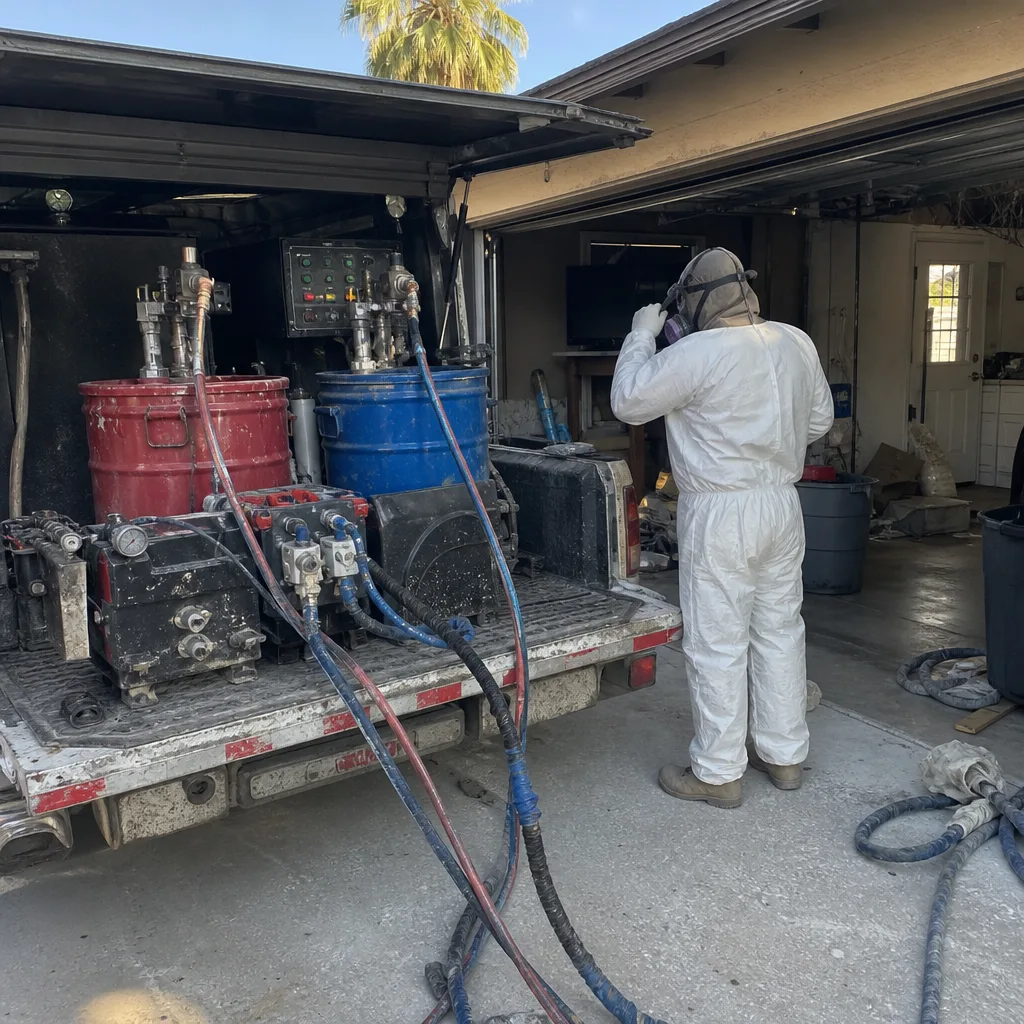
Most insulation contractors in the San Gabriel Valley carry one or two product lines and push whatever they stock. We don’t work that way. Thermal Insulation Co is a dedicated insulation specialist with access to eight manufacturers, including Icynene and Demilec for spray foam. That means when we recommend open-cell versus closed-cell for a Monterey Park attic, the recommendation is driven by what your house actually needs: an unvented enclosed attic with moisture concerns gets a different foam than a detached garage ceiling that just needs air sealing and R-value.
Ruben Castellano leads our team, and he’s built the company around a simple principle: match the material and method to the home, not the other way around. We’ve worked on re-roofed ranch houses off Garvey, stucco tract homes near Monterey Park’s library, and small multifamily buildings east of Atlantic. The recurring pattern in Monterey Park is the same: older homes with undocumented additions, buried wall lines, and attics that have been drywalled over their original vented design. Homeowners here want a contractor who can explain why the foam stopped partway across the ceiling and what it’ll take to fix it correctly.
Spray Foam Attic Insulation in Monterey Park
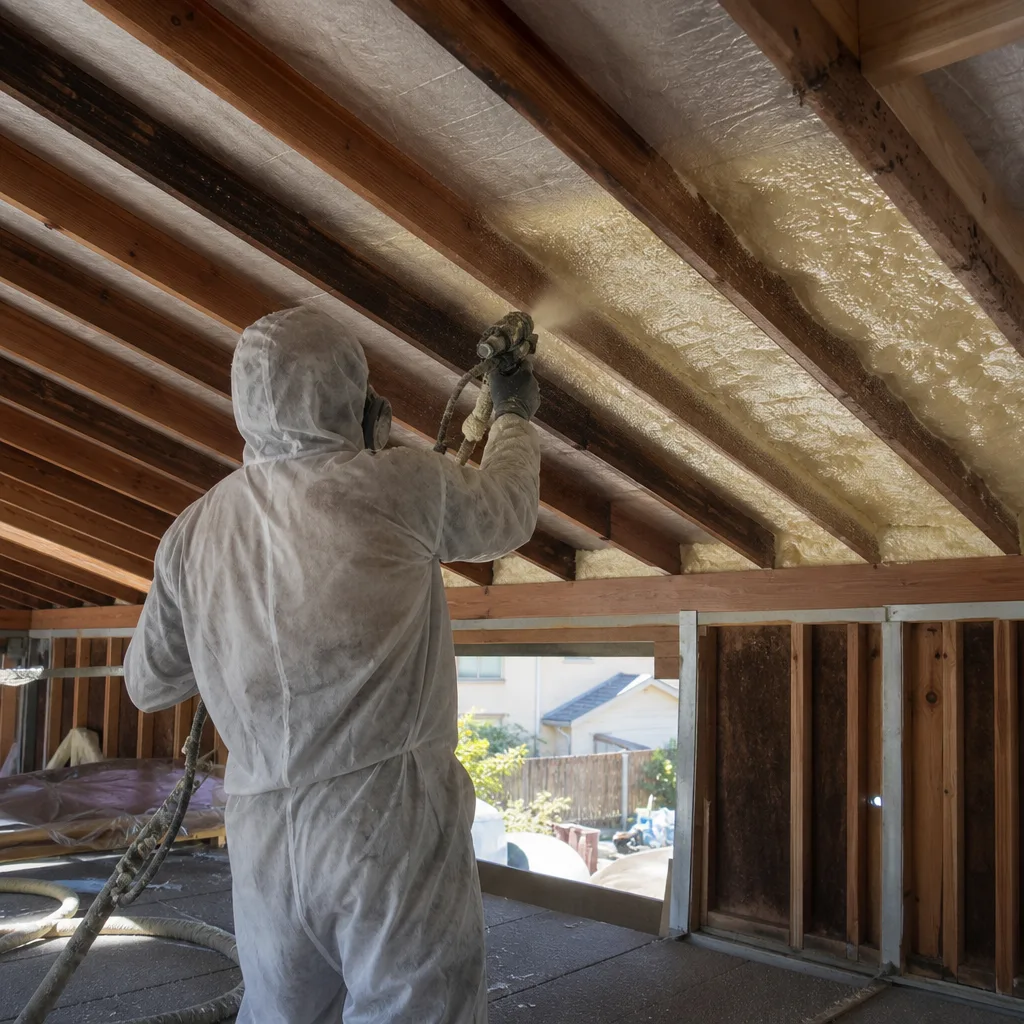
Spray foam attic insulation in Monterey Park is rarely a straightforward job, because so many local attics have been re-entered multiple times for HVAC runs, recessed can lights, and room additions. That’s the whole point of using spray foam here: it’s the only insulation method that can be detailed around existing penetrations and tie together discontinuous thermal boundaries without tearing out the ceiling.
Open-Cell for Unvented Attic Decks
Open-cell spray foam is the right call for enclosed attics above drywalled-over vented ceilings, which we see constantly in Monterey Park. Because open-cell is vapor-permeable, it lets moisture move through the assembly rather than trapping it against the deck. On a flat-roof or low-pitch section common to ranch homes here, we apply it to the underside of the roof deck to create a conditioned attic space, sealing the can-light penetrations and soffit gaps in the same pass.
Closed-Cell for Rim Joists and Garage Ceilings
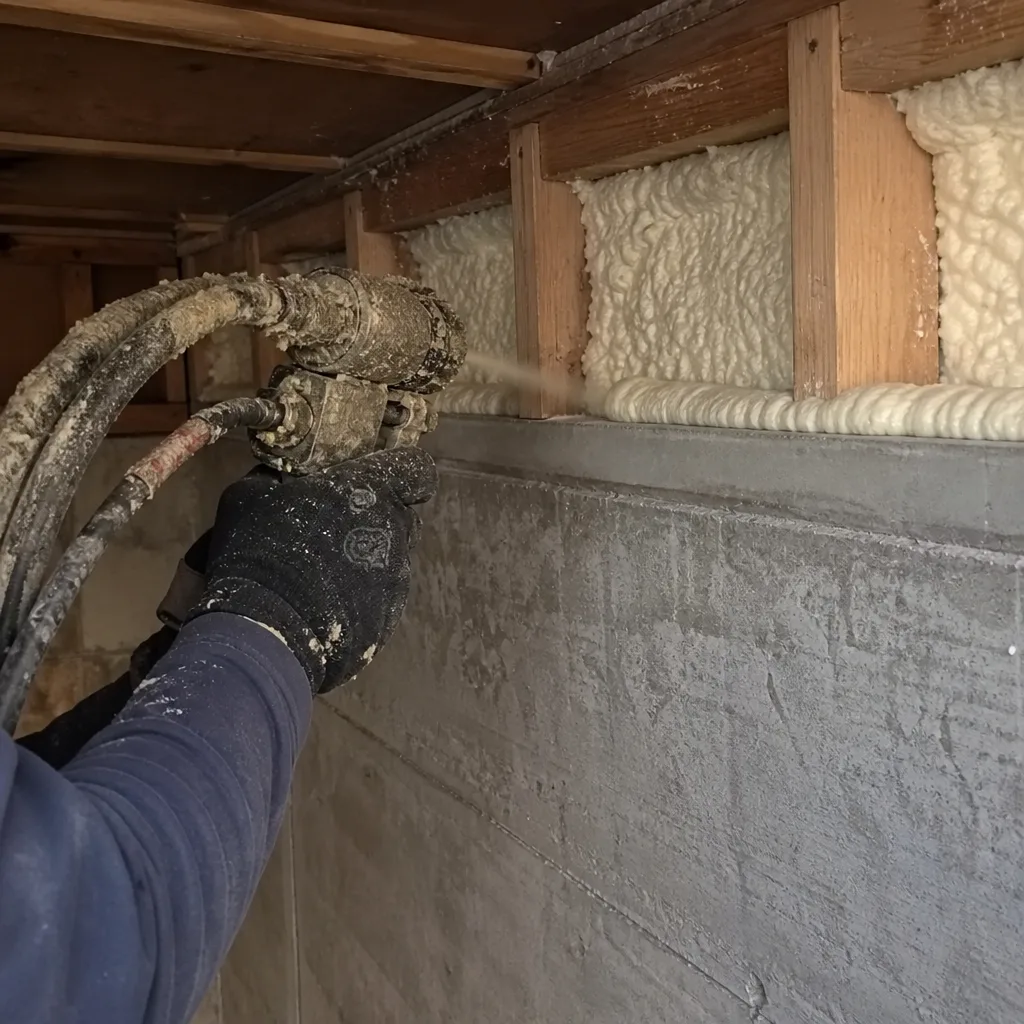
Closed-cell spray foam runs roughly $3.50 – $6.50 per board foot in Monterey Park and is the better choice when you need both air sealing and high R-value in a tighter space. We use it on rim joists, kitchen overhangs from later additions, and detached garage ceilings where the goal is to stop radiant heat gain from a sun-baked roof. The denser foam also adds structural rigidity, which matters on older framing that’s been notched and re-framed over the years.
Spray Foam Wall Insulation in Monterey Park
Spray foam wall insulation in Monterey Park is most common during a remodel, when a stucco exterior wall is opened up and the original fiberglass or mineral wool has settled or been pulled out. Given the area’s 1950s – 1970s housing stock, we also apply it as a retrofit in enclosed cavities we can access from the attic or crawl space, especially where a later addition left a stud bay open to the outdoors.
Sealing the Pre-Addition Wall Line
On a re-roofed ranch house off Garvey near Atlantic, our technician found the enclosed attic’s fiberglass batts buried under the flat-roof build-up from a 1980s addition. Can lights had been punched through the drywalled-over original vented ceiling, and the insulation stopped dead at a wall line that no longer matched the home’s actual thermal boundary. We cut fire-blocking, sealed the can-light penetrations with Icynene foam, and tied the new closed-cell layer into that older exterior wall line so the R-value held across the addition. The homeowner got before-and-after photos for the SCE rebate paperwork in the same trip.
Wall Cavities After Room Additions
When a Monterey Park homeowner adds a room, the new wall cavity often sits directly against the old exterior stucco, which creates a hidden gap that reads fine on a surface check but leaks conditioned air year-round. We address this by spraying a thin closed-cell flash coat against the old exterior sheathing, then filling the remaining cavity with open-cell or blown-in, depending on the cavity depth and whether the wall is exposed to afternoon sun from the west.
Trusted Brands We Service in Monterey Park
We carry spray foam systems from Icynene and Demilec because both have proven performance in the San Gabriel Valley’s heat profile: Icynene’s open-cell foam holds its air-seal over decades of attic temperature swings, and Demilec’s closed-cell products deliver the high R-value-per-inch that matters on low-pitch and flat-roof sections. We also work with Owens Corning, Johns Manville, Knauf, and Rockwool for hybrid applications, like pairing a closed-cell rim joist seal with mineral wool batt in a wall cavity. Because we’re not tied to one manufacturer, our Monterey Park customers get a recommendation based on building science, not inventory left over from the last job. Visit our Spray Foam Insulation overview to see how we select materials by application.
Common Spray Foam Insulation Problems We See in Monterey Park Homes
Monterey Park has a particular set of spray foam failure modes that stem from the age and modification history of its housing stock. Here’s what we encounter most often in 91754, 91755, and 91756:
- Foam shot over dead-stopped fiberglass: The original batt insulation stops at a pre-addition exterior wall line, and a previous contractor simply sprayed foam over it without extending the thermal boundary. The surface looks covered, but the gap leaks air at the edge every time the sun hits the west-facing wall.
- Unsealed can lights and soffits from later remodels: Recessed lights punched into drywalled-over vented ceilings leave penetrations that no amount of foam around them will fix. The can has to be sealed or boxed first, then the foam can be detailed for airtightness.
- Unvented enclosed attics without moisture management: When a vented attic is enclosed during a re-roof, and spray foam is applied to the deck without addressing humidity, condensation forms between the foam and the sheathing. Over a few Monterey Park summers, the foam can delaminate and lose its air-seal completely.
- Detached garage ceilings with zero air barrier: Many detached garages off Monterey Park’s alley-served lots have open eaves and exposed rafter tails. Spraying foam onto the ceiling drywall alone doesn’t stop the stack effect; the eave line has to be sealed in the same pass to make the garage usable as a workshop.
Pricing for Spray Foam Insulation in Monterey Park, CA
Open-cell spray foam in Monterey Park runs $2.50 – $4.00 per board foot installed; closed-cell runs $3.50 – $6.50. A typical attic retrofit on a 1,000 – 1,400-square-foot ranch home lands between $2,800 and $6,500 for open-cell on the roof deck, while a garage ceiling plus rim joist package runs $1,800 – $3,200. Wall cavity injection runs $3.00 – $5.00 per board foot depending on access. The biggest cost variable in Monterey Park isn’t the foam itself: it’s the prep work, which includes cutting fire-blocking, sealing can-light penetrations, and mapping where the existing insulation actually stops. Call (855) 382-3451 for a free estimate, and we’ll walk you through exactly what your house needs before we quote a number.
We Also Serve Cities Near Monterey Park
Our service area for Spray Foam Insulation in Monterey Park extends to the surrounding communities. Homeowners in South San Gabriel, Alhambra, East San Gabriel, and East Los Angeles call us for the same retrofit expertise: older housing stock, undocumented additions, and attics that require scoping before spraying. If you’re in any of these cities, the same team and the same material approach apply.
Serving Monterey Park, CA — Our Local Coverage Area
We’re based in the Monterey Park area and know this community well. Use the map below to see our service coverage — if you’re nearby, we can almost certainly help.
FAQs About Spray Foam Insulation in Monterey Park
That stopping point is almost always an old exterior wall line from before a room addition or re-roof. In Monterey Park’s 91754 and 91755 ZIP codes, we find this in roughly a third of the homes we inspect. The original insulation was installed when that wall was the outside of the house; when the addition went up, nobody extended the insulation to the new roof line. The fix is to map the thermal boundary, then spray foam the gap and tie it into the existing attic insulation so the whole assembly is continuous. Call (855) 382-3451 and we’ll scope it during the estimate.
Yes, and that’s the standard retrofit for Monterey Park homes where the original gable or soffit vents were covered during a re-roof. The key is using open-cell foam on the roof deck rather than closed-cell, because open-cell is vapor-permeable and won’t trap moisture against the sheathing. We also detail any can lights and penetrations before spraying so the air seal is continuous. This is a routine job for our team, not an edge case.
Yes. Monterey Park’s inland-adjacent heat makes attic and roof-deck insulation the highest-impact upgrade you can make, especially on a west-facing roof that gets hit with direct sun from about 2 PM until sunset. Closed-cell foam on the underside of the deck creates a radiant and conductive barrier that keeps attic temperatures from spiking to 130°F-plus in July and August, which means your air handler isn’t fighting a hot attic all afternoon.
Yes, and we take them as a standard part of every Monterey Park job. SCE and SoCalGas rebate programs for attic insulation upgrades require photographic proof of existing R-value before any new material is installed, plus photos of the finished work. Because so many Monterey Park attics have discontinuous insulation from old additions, those before-photos are often the difference between an approved rebate and a denied one. We document everything and provide the images on the same trip.
One trip, almost always. Detached garages in Monterey Park, especially the alley-served lots behind pre-1970 homes, are small enough that we can scope, prep, and spray the ceiling and rim joists in a single day. The exception is if the garage has open eaves or exposed rafter tails that need sealing before the foam goes in; even then, it’s a one-day job with a short prep phase. Call (855) 382-3451 to confirm timing for your specific garage.
Thinking About Spray Foam in Monterey Park? Start With a Conversation.
We’d rather walk you through what your Monterey Park attic actually needs than quote you a generic number over the phone. Whether you’re in a 1950s ranch off Garvey, a stucco tract home near Monterey Park’s civic center, or a 1960s multifamily building along Atlantic, call (855) 382-3451 to schedule a free assessment. We’ll map your thermal boundary, check for buried wall lines, and tell you which foam and method makes sense for your home. Estimates are free, and there’s no obligation.
Written by Ruben Castellano, Owner at Thermal Insulation Co, serving Monterey Park and the surrounding San Gabriel Valley with spray foam, attic, and blown-in insulation expertise.