
Fast, Reliable Spray Foam Insulation Across Long Beach
Spray foam insulation in Long Beach costs between $2.10 and $4.85 per board foot installed, with a typical rim joist job running $1,450 – $2,800 and a full attic roof deck application ranging $4,200 – $9,600 depending on square footage and whether you need open-cell or closed-cell foam. We serve every Long Beach ZIP from Bluff Park to El Dorado Park with same-week scheduling in most cases. Call (855) 382-3451 for a free estimate and we’ll tell you which foam actually makes sense for your home, not just whichever product we happen to stock.
Why Spray Foam in Long Beach Is Different From Every Inland City
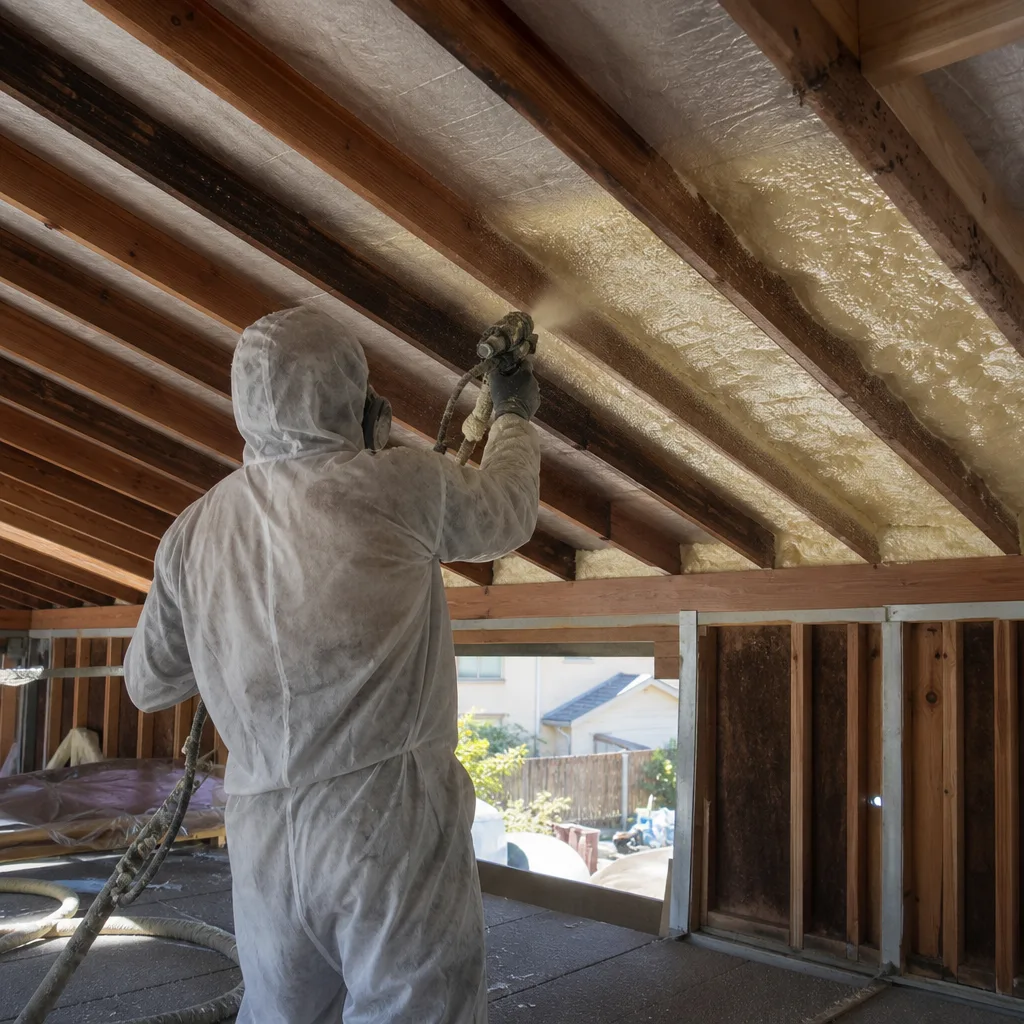
Long Beach sits in a coastal marine climate that punishes insulation in ways Riverside or San Bernardino never see. The marine layer rolls in most mornings between May and September, leaving attics, rim joists, and crawl spaces damp with condensation before the sun burns off. That means Spray Foam Insulation here has to solve a moisture problem first and an R-value problem second. We’ve pulled back fiberglass batts in Belmont Shore attics that were soaked through at 8 a.m. from nothing more than ocean air hitting an unvented roof deck. Closed-cell foam applied to a dew-wet surface traps that moisture inside the assembly, where it feeds mold for years. You cannot treat Long Beach like an inland job. The dew point check matters as much as the spray pattern.
Our crews do this work in Long Beach weekly. We know which homes in Bluff Park were built with no vapor retarder at all, and which 1950s tract houses near 90808 have attic venting that actually makes condensation worse. The salt air off the harbor corrodes garage door track anchors and opener chains while the foam is still curing. None of this shows up on a generic insulation quote, but it’s the difference between a retrofit that performs and one that fails in three years.
Key Takeaways for Long Beach Homeowners
- Spray foam in Long Beach must be vapor-managed first. Dew-wet surfaces prevent proper adhesion and trap moisture.
- Closed-cell foam is the standard choice for coastal rim joists and crawl spaces because it resists moisture migration from marine air.
- Salt corrosion of fasteners and hardware runs years ahead of inland timelines, so pre-spray inspections matter here more than anywhere in LA County.
- Expect rim joist work to run $1,450 – $2,800 and open-cell attic retrofits starting around $4,200 in Long Beach.
- We stock both Icynene and Demilec foam systems, so the recommendation is driven by your home’s conditions, not brand loyalty.
Why Thermal Insulation Co Is Long Beach’s Preferred Spray Foam Insulation Company
We’re a dedicated insulation contractor, not a general remodeler who picked up a foam rig last year. That matters in Long Beach because coastal retrofits require more than a spray gun. Our crews understand the building science behind marine-layer condensation, and we carry both open-cell and closed-cell foam from Icynene and Demilec, which means we can match the product to the application instead of forcing one material onto every job. Ruben Castellano has built our reputation on exactly this: telling homeowners which method fits, even when it means recommending a less expensive product. We’d rather you call us back in five years than sell you the wrong foam today.
Long Beach customers call us for what we catch before spraying. A rim joist that looks solid from the crawl space entrance can be salt-corroded and condensation-soaked once you get into the corners. Our crews check for that. We check dew point before applying closed-cell foam on morning jobs in coastal ZIPs. We’re licensed and insured, and we stand behind the work with a satisfaction guarantee. When you call (855) 382-3451, you’ll get a straight answer about what your home needs.
Rim Joist Spray Foam in Long Beach
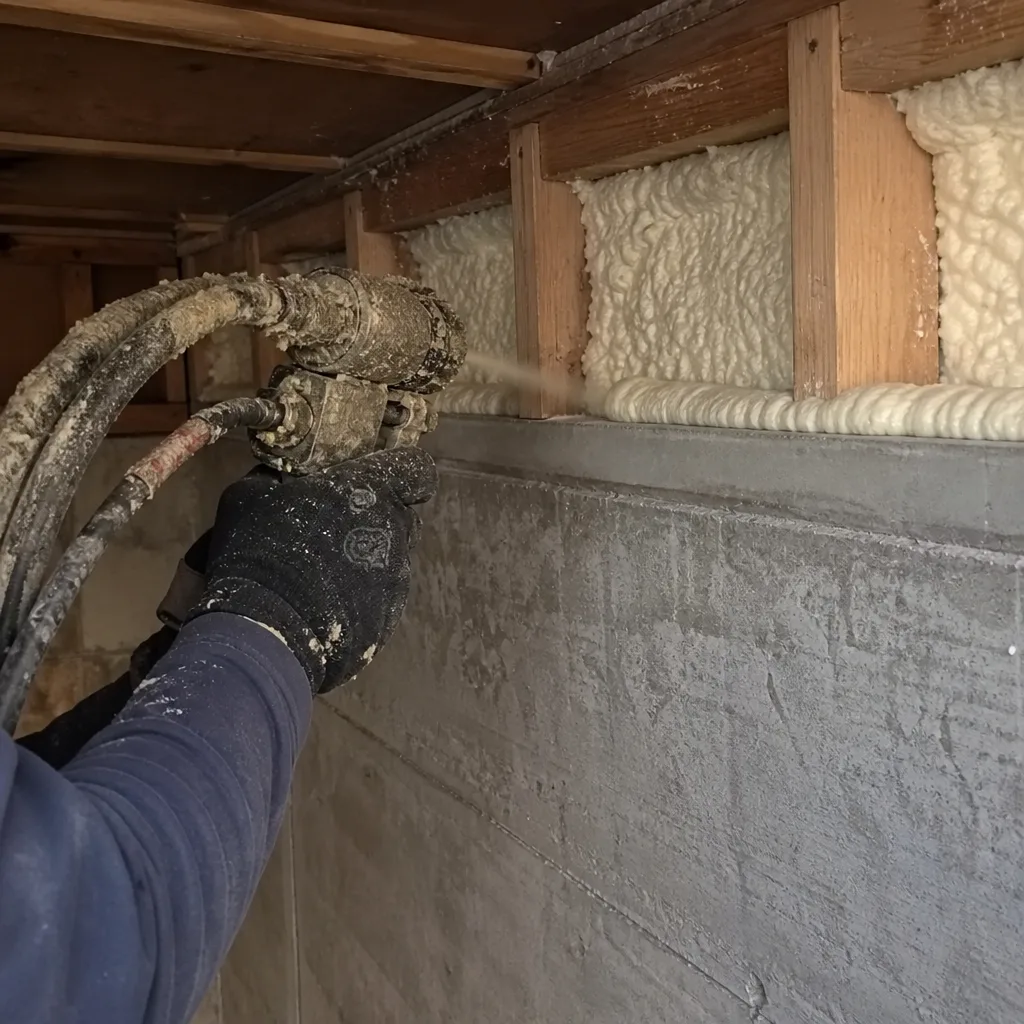
Rim joist spray foam in Long Beach is the single highest-impact air sealing upgrade for older coastal homes, because the rim joist is where conditioned air leaks out and marine air gets pulled in. The job involves spraying closed-cell foam across the band joist where your floor framing meets the foundation wall, sealing the gap that fiberglass batts leave wide open. In a 1940s Spanish Revival bungalow off Belmont Shore, our crew found the rim joist and subfloor band already salt-corroded and condensation-soaked from years of an unpainted crawl space vented straight to the ocean air. We removed the compromised fasteners, sprayed closed-cell foam across the rim and crawl space walls to seal the marine air out, and coupled it with a proper vapor retarder; the owner’s recurring musty smell in the hallway stopped that season. That’s what this work actually does in Long Beach.
What a Rim Joist Retrofit Involves Here
We prep the rim by checking for corrosion and trapped moisture before any foam goes on. In Long Beach, morning dew on the band joist is common, and spraying closed-cell foam onto a wet surface creates a sealed-in moisture problem you won’t see until the mold starts. We verify surface dryness, then apply foam to a consistent depth that stops air movement. The work typically takes half a day.
Signs Your Long Beach Rim Joist Needs Attention
You’ll feel drafts near the floor in winter, even when windows are closed. You may smell dampness in the crawl space or notice higher humidity in the rooms above. In coastal Long Beach homes, rusted fasteners and darkened wood at the rim are signs that decades of marine air have been moving through that gap. If your energy bill climbs every summer despite mild coastal temperatures, the rim joist is often the culprit.
Crawl Space Spray Foam Insulation in Long Beach
Crawl space spray foam insulation in Long Beach works differently than it does inland because the crawl space air here carries salt and moisture from the Pacific, not just heat. We spray closed-cell foam directly onto crawl space walls and the subfloor band to stop that marine air from moving into your living space. This is especially urgent in Belmont Shore, Naples, and the Peninsula, where crawl spaces vented to the ocean air stay damp for most of the year. A correctly applied closed-cell foam layer acts as both an air seal and a vapor barrier, which is what a vented Long Beach crawl space actually needs. Expect $2,900 – $6,400 for a typical 1,200 – 1,800 square foot crawl space depending on access and prep work.
Why Vented Crawl Spaces Fail Along the Coast
Older Long Beach bungalows were built with open foundation vents, which made sense in the 1930s before anyone analyzed coastal air movement. But now those vents pull damp, salty air under the house every night. The moisture condenses on cool wood surfaces, and you get the musty smell, the warped subfloor, the rusted nails. Foam on the walls without sealing the vents properly still leaves a path for that air. Our crews factor vent sealing and vapor retarder placement into every coastal crawl space quote, because the foam alone will not fix a vented marine crawl.
Moisture Testing Before We Spray
We check wood moisture content before applying foam in Long Beach crawl spaces. If the framing has been sitting in damp air for decades, spraying foam over saturated wood locks the moisture in. In some cases we recommend a drying period or remediation first. It’s slower, but it prevents the exact failure that gives spray foam a bad name in coastal neighborhoods.
Trusted Brands We Service in Long Beach
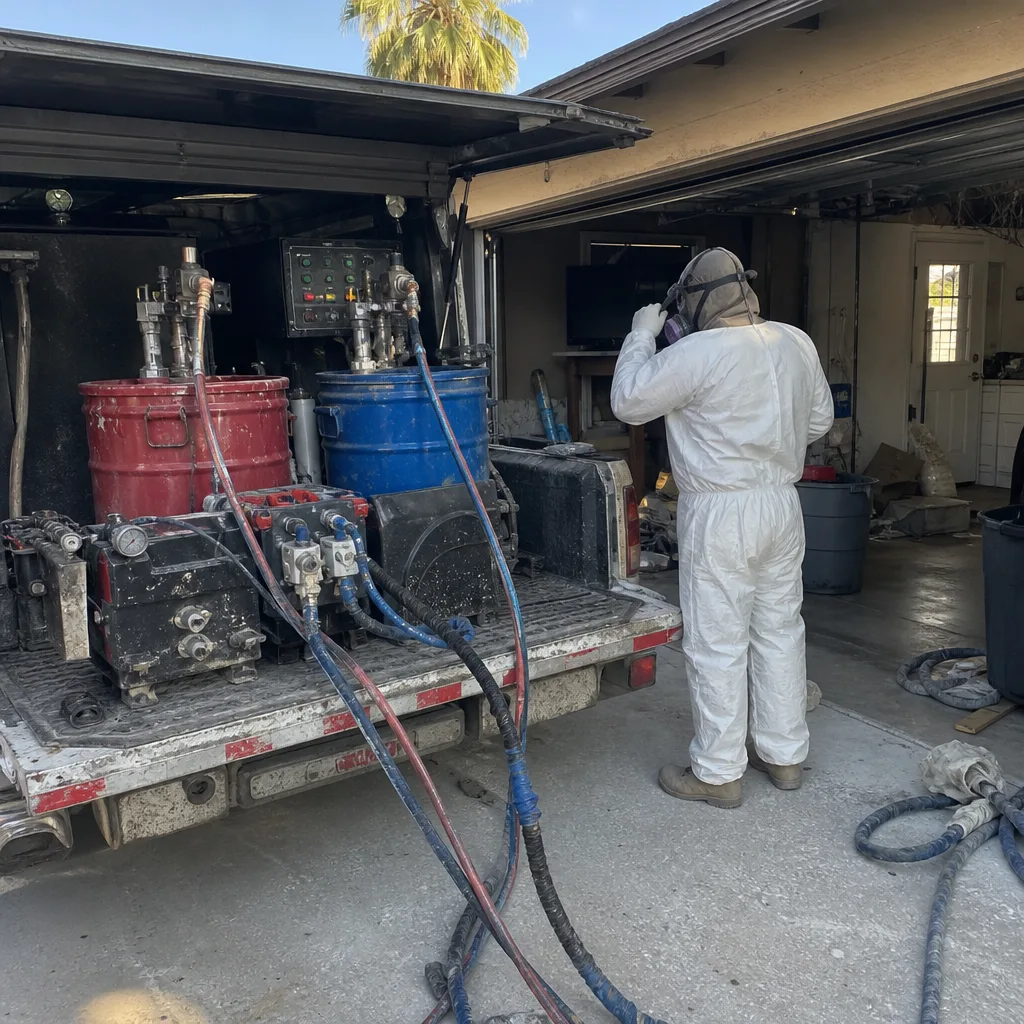
We’re authorized to install Icynene and Demilec foam systems, which gives us real flexibility on coastal jobs. Open-cell Icynene works well for interior wall cavities and some attic applications where you want breathability with a high R-value per inch. Demilec closed-cell is our go-to for Long Beach rim joists and crawl spaces where moisture resistance is non-negotiable. We also carry Owens Corning and Rockwool products for hybrid approaches where foam alone isn’t the right answer. Parts and materials are stocked locally for Long Beach jobs, so we’re not waiting on a shipment from out of state when your project is scheduled.
Common Spray Foam Insulation Problems We See in Long Beach Homes
- Foam sprayed over dew-wet decking. Morning marine-layer condensation leaves attic sheathing damp from May through September. A crew that doesn’t check surface conditions traps that moisture behind the foam, and the homeowner gets mold inside a sealed roof assembly.
- Salt-corroded garage hardware failing while the foam holds. Openers, track anchors, and hinges in coastal garages rust years ahead of inland hardware. We inspect those fasteners before spraying around garage ceilings and rim joists, because the foam will outlast the metal it’s attached to.
- Open-vented crawl spaces that defeat closed-cell foam. If the foundation vents are still pulling ocean air under the house, the foam on the walls gets wet from condensation on the unsealed side. Vent closure and vapor retarder placement have to be part of the job.
- Uninsulated stucco walls with knob-and-tube wiring nearby. Many 1920s – 1940s Spanish Revival homes in Bluff Park and Belmont Shore still have old wiring in the wall cavities. Spray foam against knob-and-tube is a fire hazard. We verify what’s in the walls before recommending foam versus blown-in alternatives.
Pricing for Spray Foam Insulation in Long Beach, CA
Here’s what we see across Long Beach as of 2026:
- Open-cell spray foam (attic roof deck): $2.10 – $3.25 per board foot. A 1,200 sq ft attic at 5.5 inches runs roughly $4,200 – $5,800.
- Closed-cell spray foam (rim joist): $1,450 – $2,800 for a typical single-family home, depending on accessibility and linear footage.
- Closed-cell spray foam (crawl space walls): $2,900 – $6,400 for homes between 1,200 and 1,800 sq ft.
- Garage ceiling spray foam: $1,800 – $3,900, with coastal prep and hardware inspection adding $150 – $400 when corrosion is present.
What pushes cost up in Long Beach specifically is prep work: moisture correction, vent sealing, and hardware replacement before foam goes in. That’s not overhead padding. It’s the difference between a foam job that lasts and one that’s quietly failing behind the drywall. Estimates are free. Call (855) 382-3451 and we’ll give you a number you can plan around.
We Also Serve Cities Near Long Beach
Our crews regularly work in Signal Hill, Lakewood, Carson, and West Carson, so we know the housing stock and building patterns across this part of LA County. If you’re just outside Long Beach proper, Long Beach is still our home base for scheduling and material stock. Call (855) 382-3451 and we’ll confirm your address and get on the calendar.
Serving Long Beach, CA — Our Local Coverage Area
We’re based in the Long Beach area and know this community well. Use the map below to see our service coverage — if you’re nearby, we can almost certainly help.
FAQs About Spray Foam Insulation in Long Beach
Belmont Shore attics see daily marine-layer condensation from May through September, and if foam is applied to a dew-wet roof deck, the moisture gets sealed inside and feeds mold. Homes in 90805 are far enough from the ocean that this condensation window doesn’t occur with the same intensity. The failure isn’t about the foam product; it’s about surface conditions and dew point at the time of application. We check both before spraying any coastal attic. Call (855) 382-3451 if your attic shows signs of trapped moisture.
Yes, closed-cell spray foam on crawl space walls and the rim joist stops marine air from moving into the space, which reduces the condensation source at the framing level. But it only works if the foundation vents are also sealed and a proper vapor retarder is in place; otherwise damp ocean air still gets pulled under the house. The foam is one part of a moisture-managed assembly, and we quote it that way in Long Beach.
We will not spray foam over corroded fasteners or into a garage ceiling until those fasteners are replaced, because the foam will outlast the metal by decades and hide a structural failure. In Long Beach garages, salt air rusts track anchors and opener chains well before the rest of the garage shows wear. We inspect, advise on replacement, and then foam. Call (855) 382-3451 for an inspection.
We use Icynene open-cell for interior cavities where breathability matters, and Demilec closed-cell for rim joists, crawl spaces, and any application where moisture resistance is the priority. Both are nationally recognized foam systems, and we were authorized to install them because we train crews specifically on coastal application conditions, including dew point checks and vapor retarder integration.
Often yes. A 1950s Long Beach bungalow typically has soffit and ridge venting designed for fiberglass batts, and if you switch to spray foam without adjusting the ventilation strategy, you can trap moisture inside the sealed attic assembly. We evaluate the venting on every foam quote and tell you if changes are needed before we spray. It’s part of getting the job right in Long Beach’s marine climate.
Written by Ruben Castellano, Owner at Thermal Insulation Co, serving Long Beach and surrounding LA County communities with dedicated spray foam expertise.