
Spray Foam Insulation in Huntington Park: What It Costs and Why Older Homes Need It
Spray foam insulation in Huntington Park typically runs $2.80 to $5.60 per square foot installed, depending on whether you need open-cell or closed-cell foam and where we’re applying it. Most Huntington Park jobs fall between $2,400 and $7,800 total when you account for the city’s smaller homes and dense multi-family buildings. The work is usually completed in one to two days, and the payoff here is different from what you’d expect in Burbank or Torrance: in Huntington Park, you’re buying sound control and heat-gain reduction more than anything else.
That’s worth saying plainly. Huntington Park’s housing stock runs small, old, and tightly packed along streets like Pacific Boulevard, Florence Avenue, and Gage Avenue. What a homeowner in this city needs from Spray Foam Insulation often has as much to do with the freight trains rumbling past the industrial edges as it does with summer cooling bills. We’ll get into exactly what that means below, including the condition of the framing in these pre-1960 bungalows and why that changes how foam should be applied. If you want a direct answer on your particular house, call (855) 382-3451. We’ll send a crew out and give you a straight take.
Fast, Reliable Spray Foam Insulation Across Huntington Park
We work in Huntington Park every week, and we know the blocks between Salt Lake Park and the rail lines well enough to describe the houses without seeing them first. They’re mostly 1920s through 1960s single-story stucco bungalows with flat or low-pitched roofs, many of them expanded over the decades, few of them insulated to any modern standard. When you call us at (855) 382-3451, you’re not calling a general contractor who occasionally installs insulation. You’re calling a company whose entire trade is insulation, and we can typically get a crew to Huntington Park within a day or two of your estimate.
That local familiarity matters because spray foam is not a one-size job. The foam that works in a 2010 track home in Santa Clarita is not automatically the foam that works in a 1948 stucco bungalow off Florence Avenue with original plank sheathing and a crawl space that breathes more than it should. We’ve spent enough time inside Huntington Park attics and crawl spaces to know what those cavities look like before we open them up.
Why Thermal Insulation Co Is Huntington Park’s Preferred Spray Foam Insulation Company
The reason homeowners and small landlords in Huntington Park call us back has less to do with marketing and more to do with how we approach the job. Ruben Castellano runs Thermal Insulation Co, and he built the company around a simple idea: carry more material options than you need on any given day so you can pick the right one for the house in front of you. We’re authorized to install products from Owens Corning, Johns Manville, Knauf, Rockwool, CertainTeed, Icynene, Demilec, and GreenFiber, and we choose among them based on what the home actually requires.
For a Huntington Park bungalow with shrunk plank sheathing and a noise problem, that selection process matters. We carry Icynene and Demilec spray foam systems specifically because those two brands give us open-cell and closed-cell options that behave differently in old framing. We also stock fiberglass and mineral wool for areas where spray foam would be the wrong call. Most insulation companies in this area carry one or two product lines. We carry eight, and we’ll tell you honestly which one fits your attic, your crawl space, or your garage ceiling.
Response time to Huntington Park is straightforward: we’re based in Van Nuys, and the drive down the 110 or the 710 takes us about 30 to 45 minutes depending on traffic. We schedule Huntington Park jobs with that drive in mind, and our crews know to plan for the narrow alleys and tight parking that come with the territory on residential blocks near Walnut Park and Bell Gardens. Call us at (855) 382-3451 and we’ll give you a window that holds.
Crawl Space Spray Foam Insulation in Huntington Park
Crawl Space Spray Foam Insulation in Huntington Park is often the single highest-impact upgrade we can make on these 1920s-1950s stucco homes, because most of them sit over shallow, vented crawl spaces that were built for a different climate than the one Los Angeles actually has now. The original builders left those spaces open to the outside air on purpose, assuming the mild coastal weather would never require sealing. Fifty or seventy years later, that openness means hot air rises into the home’s floor in summer, and on blocks near the industrial corridors and rail lines, street noise and diesel exhaust come up through the same gaps.
In Huntington Park, crawl space spray foam typically runs $3,000 to $6,200 for a standard 800 to 1,100 square foot single-story home, which includes sealing the rim joist, applying closed-cell or open-cell foam to the subfloor, and addressing the foundation vents the right way. The cost is higher than a simple fiberglass re-batt, but the difference in performance is substantial. Closed-cell Demilec or Icynene in the crawl space creates an air seal as well as a thermal break, and it doesn’t sag, settle, or become a nesting shelf for rodents the way fiberglass batts do over time.
What We Seal and Why It Stops the Noise
The crawl space in a narrow-lot Huntington Park home usually has plank subfloor boards running perpendicular to the joists, and after decades of seasonal movement those boards gap at the seams. Spray foam fills those seams completely and bonds to the wood, which creates a continuous barrier that batt insulation can’t match. On blocks where train horns and truck rumble are the primary complaint, that seam-filling is what actually blocks the sound. The foam also stops the thermal stack effect: hot air pulling up from the crawl space into the living area in summer, which makes central air work harder than it should.
One caution worth stating: spray foaming a crawl space in an old home requires managing foundation vents properly. We’ve seen crews in this area spray closed-cell foam over all the vents and call the job done, which can trap ground moisture and cause rot under the subfloor. We don’t do that. The correct approach on these Huntington Park homes is to seal the rim joist and subfloor while leaving or appropriately reconditioning the vent system, and we’ll explain exactly what we’re doing before we start.
When a Small Apartment Building Needs Crawl Space Foam
Huntington Park has a large number of small multi-family buildings from the 1920s and 1930s: four-to-eight unit courtyard apartments and converted duplexes on narrow lots along streets like Miles Avenue and Rugby Avenue. Those buildings often share a single crawl space, and the noise and heat problems multiply through the floor into every unit. We’ve used Demilec in those shared crawl spaces to block both ground moisture and street noise coming up through the floors, and the improvement in tenant comfort and sound transfer between units is something landlords notice immediately. For a four-unit building, your cost range is roughly $7,000 to $14,000 depending on square footage and access.
Garage Spray Foam Insulation in Huntington Park
Garage Spray Foam Insulation in Huntington Park is in demand for two very specific reasons that don’t show up as clearly in other cities. First, a large share of these older bungalows have attached garages that were never insulated at all, and on summer afternoons they turn into ovens that radiate heat into the adjoining kitchen or bedroom wall. Second, many Huntington Park garages have been converted, legitimately or otherwise, into living space, laundry rooms, or home offices. Those converted garages are almost always uninsulated in the walls and ceiling, and spray foam is often the only material that can be applied without opening up the original stucco exterior.
Garage spray foam in Huntington Park typically runs $1,800 to $4,600 for a standard 200 to 420 square foot garage, including the ceiling and the common wall. If the garage has been converted into living space, the price runs higher because code compliance matters, and we’ll need to assess the wall cavities, any added-on framing, and the existing window and door openings. On a garage with exposed ceiling joists, an open-cell Icynene application gives you good thermal performance without the curing stiffness of closed-cell on old lumber.
Garage Ceilings and the Heat That Sits Up There
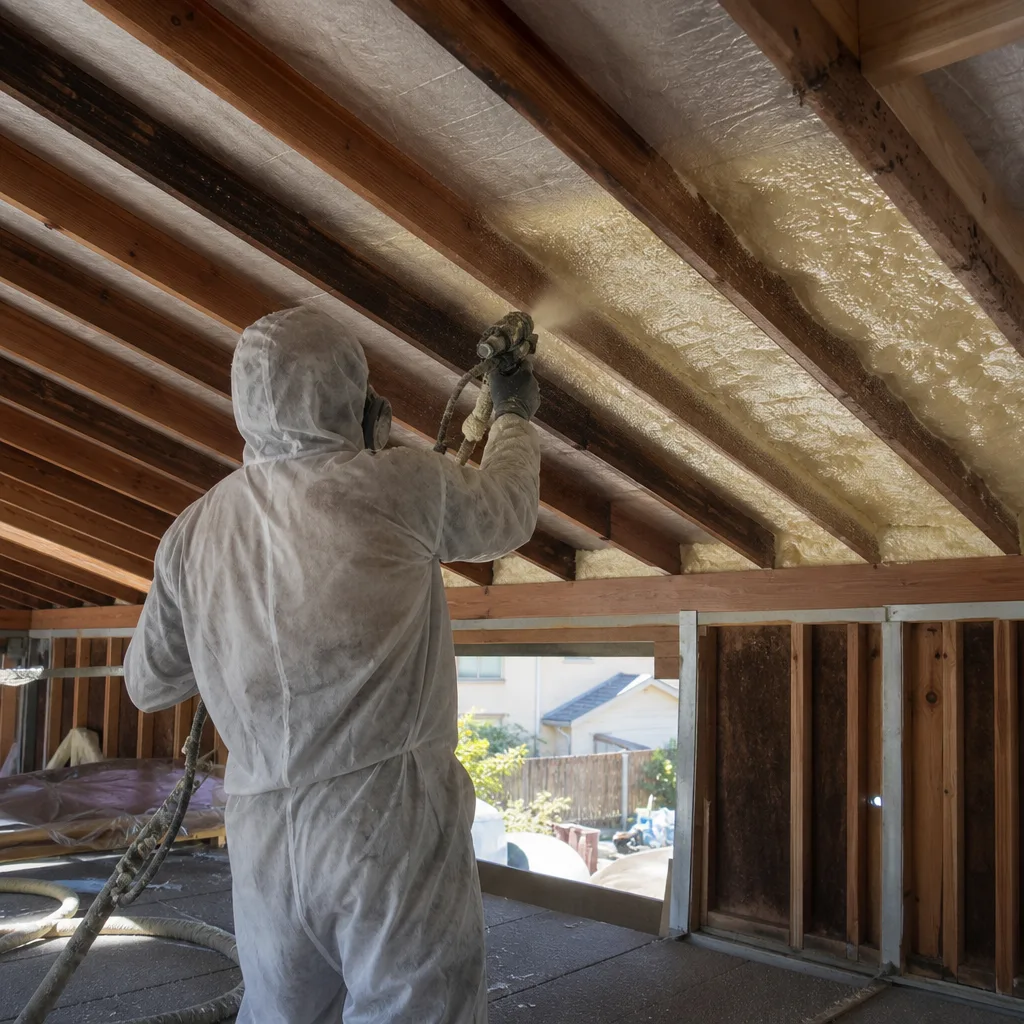
The garage ceiling is the main source of the problem. In a flat-roofed Huntington Park bungalow, the garage roof is often barely insulated, and the heat loading from the sun builds up all afternoon. Spraying the ceiling underside of the roof deck with closed-cell foam creates a thermal and air barrier in one pass. It also stiffens the roof a little, which on old plank sheathing is a real benefit. We apply it directly to the deck, not to the ceiling joists below, so the foam seals the entire attic plane rather than leaving a hot, unventilated air gap above the insulation.
Converted Garages and Wall Cavities That Were Never Built for This
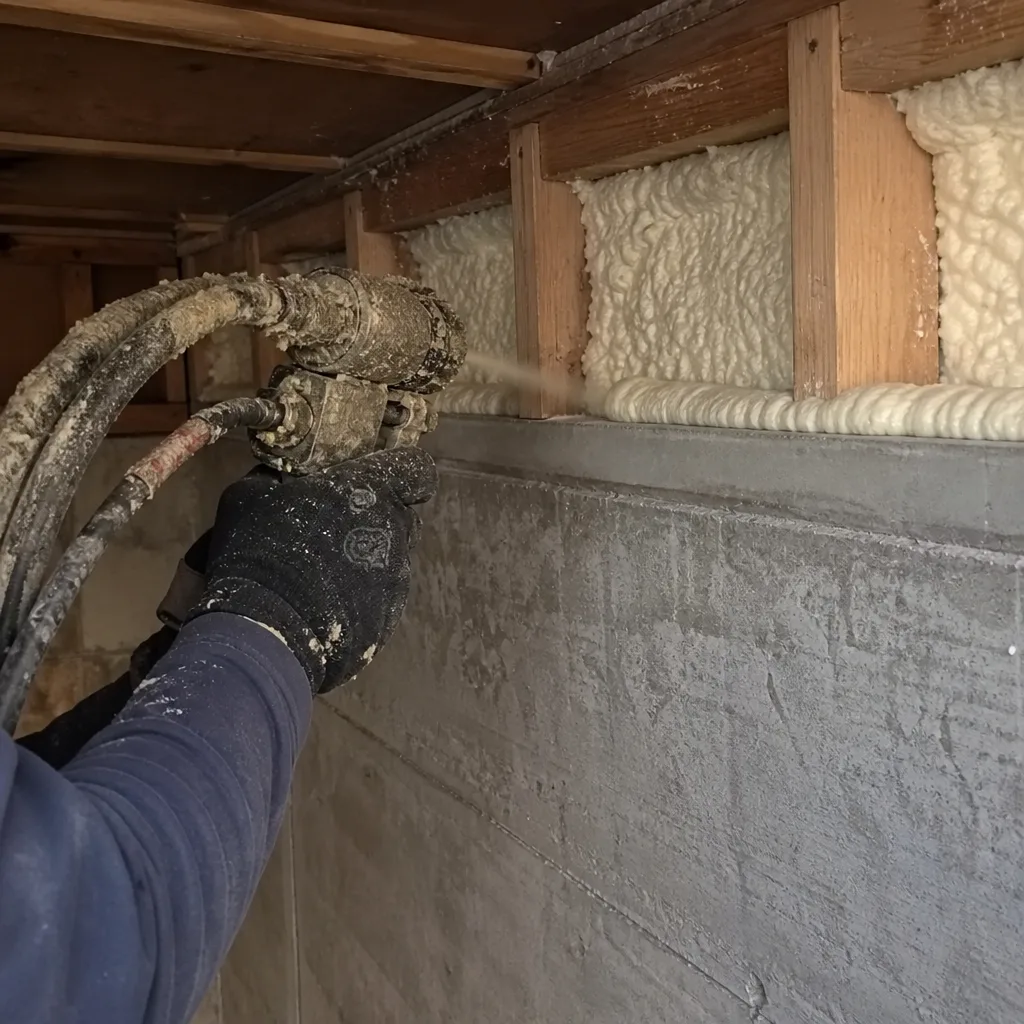
If your Huntington Park garage was converted before the city tightened up ADU and conversion standards, the walls are likely 2×4 framing with original single-pane windows and no insulation. Spray foam is the fastest way to insulate those cavities correctly without tearing out drywall, because it’s applied as a liquid through small holes or directly into open framing. What we look for before spraying is moisture. In a converted garage with an unpermitted addition, we’ve seen traps where foam over single-pane glass creates condensation on the interior pane and blisters paint. We’ll tell you if we see that risk, and we’ll recommend the right open-cell or closed-cell product accordingly.
Call us at (855) 382-3451 and we’ll walk through your garage’s specific condition. Don’t guess at it; a thirty-minute inspection answers the question.
Trusted Brands We Service in Huntington Park
The brands we carry are chosen for the problems Huntington Park actually has. We install Icynene and Demilec spray foam because they cover both open-cell and closed-cell applications at consistent quality, and they perform reliably against aged lumber. We carry Owens Corning, Johns Manville, and Knauf fiberglass for batt and blown-in applications where spray foam would be overpriced or over-specified, and we stock Rockwool mineral wool for applications that need fire resistance or better moisture behavior, like furnace closets and shared walls in older apartments. If you’re within 90255 or the surrounding blocks near Walnut Park and Bell, we can have the right product on your job site quickly, without waiting on a distributor. Our depth of inventory means same-week installations in most cases.
Common Spray Foam Insulation Problems We See in Huntington Park Homes
- Foam pulling away from aged plank sheathing. In 1920s-1940s bungalows, the original sheathing boards have cupped and shrunken over 70 to 100 years of heat cycles. If a crew sprays foam directly against those cupped boards without preparing the surface or choosing the right foam density, the material cures unevenly and leaves hidden air channels running to the attic. Those channels let street noise and heat right back through, which defeats the point of the job.
- Closed-cell foam trapping moisture over single-pane windows and added-on walls. Many Huntington Park homes were expanded without permits, and the added-on framing doesn’t have the same air movement as the original structure. When closed-cell foam is applied over original single-pane window framing or against unvented cold surfaces in those additions, it can trap condensation and cause interior paint blistering within a year or two. The fix is choosing open-cell in those areas or addressing the window itself first.
- Sealing off foundation vents in the chase for sound control. On the industrial-corridor blocks, sound control becomes the priority, and it’s tempting to spray so much density into the crawl space that every foundation vent gets covered. That turns the crawl space into a moisture trap under the plank subfloor. We’ve had to re-open vents on jobs done by others. The correct approach seals the rim joist and subfloor while leaving the established ventilation path intact, or reconfiguring it properly.
- Foam over knob-and-tube or cloth wiring without assessment. In the earliest of these bungalows, original knob-and-tube or early cloth wiring still runs through wall and attic cavities. Spray foam over that wiring creates a fire and code issue if the wiring is still live and unrated for insulation contact. We inspect for this before we spray. If we find it, we’ll tell you what needs to happen before insulation goes in, and we’ll coordinate with an electrician if you need one.
Huntington Park’s Legacy Plank Sheathing and Why It Changes the Job
Here’s something you won’t see discussed on any generic spray foam website. Huntington Park’s 1920s-1960s stucco bungalows were framed with true-dimension plank sheathing rather than the modern plywood or OSB you find in newer construction. Those boards run one-by-six or one-by-eight, laid diagonally across the studs. They’ve spent decades drying out, shrinking, and pulling away from each other. That means when we spray foam into the wall cavities or against the attic deck, the foam bonds to aged, dust-saturated lumber that moves and gaps far more than a new home’s framing would.
This matters because it changes which foam we choose and how much surface preparation the job requires. On a 1948 single-story stucco bungalow off Florence Avenue near the rail corridor, our crew foamed the open attic deck where the original plank sheathing had shrunk and left visible daylight gaps at the soffit line. We sealed those gaps with closed-cell Icynene, capped the top plates, and the homeowner, who had been waking to freight trains, reported the rumble cut noticeably along with the afternoon heat gain. That kind of result comes from knowing the framing is the variable, not just picking a foam brand. Ruben Castellano and the crew at Thermal Insulation Co have done these old houses enough times to know what we’re walking into before the ladder goes up.
In a narrow-lot apartment building nearby, we used Demilec in the crawl space to block both ground moisture and street noise coming up through the floor. The tenants in the front unit had complained for years about the trucks idling on the street at 5 a.m. The foam in the crawl space cut most of that low-frequency rumble, and the unit stayed cooler through the afternoon without touching the thermostat. Those are the two problems Huntington Park homes actually have: heat gain through old roof decks and sound transfer through old floors.
Pricing for Spray Foam Insulation in Huntington Park, CA
Here are the ranges we quote on a typical Huntington Park job, and they hold unless your home has a condition we can’t see before we inspect it.
- Open-cell spray foam (attic or ceiling): $2.80 to $4.20 per square foot, or roughly $3,200 to $5,800 for a standard 1,000 square foot attic.
- Closed-cell spray foam (crawl space or rim joist): $3.60 to $5.60 per square foot, or $3,000 to $6,200 for a typical 800 to 1,100 square foot crawl space.
- Garage ceiling and common wall: $1,800 to $4,600 for a standard two-car garage.
- Crawl space sound-control package with closed-cell: $4,800 to $7,800 on industrial-corridor blocks where train and truck noise is the priority.
Your final number depends on square footage, access difficulty, and whether we’re working around old wiring or existing insulation that needs removal first. We give free estimates in Huntington Park, and we’ll put the number in writing before any work starts. Call (855) 382-3451 to schedule one. We won’t push you into a product we don’t think you need.
We Also Serve Cities Near Huntington Park
Our crews work throughout the southeastern LA basin, including Huntington Park and the surrounding communities. You’ll find us in Walnut Park, Bell, Cudahy, and Maywood on a regular basis, and we understand the housing stock and street patterns in these cities just as well as we do in 90255. If you’re a few blocks over the city line, the same pricing and response time apply.
Serving Huntington Park, CA — Our Local Coverage Area
We’re based in the Huntington Park area and know this community well. Use the map below to see our service coverage — if you’re nearby, we can almost certainly help.
FAQs About Spray Foam Insulation in Huntington Park
Yes, closed-cell spray foam is the most effective insulation material we install for reducing low-frequency noise like truck rumble and train horns, because its density and air-sealing properties block sound transmission far better than fiberglass batts. The material doesn’t make the noise disappear completely, but in most cases it brings the interior sound level down noticeably, especially when applied to the crawl space and the roof deck. On the industrial-corridor blocks where noise is the main complaint, we recommend closed-cell over open-cell for this exact reason. Call (855) 382-3451 and we’ll tell you honestly whether foam alone will solve your specific noise problem or whether there’s a window or structural issue we’d also need to address.
Yes, we can spray foam over original plank sheathing, and we do it regularly, but the surface requires assessment and often light preparation first. Aged, dust-saturated lumber needs to be examined for cupping, shrinkage gaps, and any old wiring before we choose the foam and the application approach. We’ve had success using closed-cell Icynene on these old roof decks, but the key is filling the gaps at the soffit line and capping the top plates correctly so the foam doesn’t leave hidden air channels. A crew that doesn’t know these old Huntington Park houses may just spray and walk away. We don’t.
For open-cell foam, the cure time is typically 24 hours or less, and you can usually stay in the building as long as the affected unit or common area is sealed off during application. For closed-cell foam, the recoat and cure window is shorter, and the material off-gasses more intensely for the first few hours, so occupants should be out of the immediate area for that day. In a small multi-family building in Huntington Park, we’ll schedule the work to minimize disruption, but the rule of thumb is: plan for one night away from the unit being sprayed. We’ll give you clear timing before the job starts.
Yes, and the reason is not heating, it’s heat gain and noise. In Huntington Park’s warm, dry summer climate, the crawl space acts as a heat reservoir that pushes hot air up through the floor, which makes any cooling system work harder. Spray foaming the crawl space cuts that heat gain substantially. And if your home is near the industrial or rail corridors, the closed-cell foam also blocks ground-level noise that rises through old plank subfloors. It’s one of the highest-impact upgrades available for these specific older homes.
We can spray foam a converted garage, but the permitting status of the conversion matters for code compliance, and we’ll be upfront about that. The physical work is straightforward: we insulate the walls and ceiling cavities with open-cell or closed-cell foam depending on the existing framing and window situation. What we will not do is pretend the foam solves a non-permitted conversion problem if the building department gets involved later. We’ll advise you on the best approach for the structure as it stands, and we’ll flag any moisture or electrical issues we see before we spray. Call (855) 382-3451 for an honest assessment, not a hard sell.
Get a Straight Answer About Your Huntington Park Home
If you live in Huntington Park and you’re tired of a house that bakes in the afternoon, hears every train that passes, or costs too much to cool in the summer, call us. We’ll send a crew out to look at your attic, your crawl space, or your garage, we’ll tell you what we find, and we’ll give you a written estimate with the foam type and the price range we quoted on this page. No pressure, no generic pitch, just the right insulation for your specific house. Thermal Insulation Co is reachable at (855) 382-3451. Ask for Ruben and tell him where in Huntington Park you are. He’ll know the block.
Written by Ruben Castellano, Owner at Thermal Insulation Co, serving Huntington Park and the surrounding communities.