
Fast, Reliable Spray Foam Insulation Across Desert Hot Springs
Spray foam insulation in Desert Hot Springs typically runs $2.80 to $5.40 per board foot installed, and open-cell attic work in the 92240 and 92241 ZIP codes usually lands between $4,200 and $8,900 for a full single-story home. We schedule most Desert Hot Springs projects within 3 to 5 business days because our crews already work the Coachella Valley corridor weekly. That matters when your attic is hitting 150°F and every unsealed gap is pulling in wind-driven sand. Call us at (855) 382-3451 and we’ll tell you which foam actually belongs in your house, not just which one we happen to have on the truck.
Thermal Insulation Co works from the north face of the valley down through Desert Edge and Garnet, so we know what happens to insulation out here. Not in theory. We see it. When a Santa Ana-style wind event scours the northwest side of a house on Hacienda Avenue, the leeward side looks fine while the windward eaves are packed with fine sand. We build our whole approach around that reality. If you want the tl;dr version: Spray Foam Insulation in the desert is air-sealing work first, foam work second.
Why Thermal Insulation Co Is Desert Hot Springs’s Preferred Spray Foam Insulation Company
Spray foam insulation in Desert Hot Springs is not a side trade for us. Insulation is all we do, which means our crews have pulled more wind-packed fiberglass out of 92240 attics than most general contractors have seen in a career. Ruben Castellano started this company around a simple observation: most insulation failures in the desert aren’t material failures. They’re sequencing failures. Foam sprayed over unsealed top plates. Foam sprayed over collapsed batts. Foam sprayed too thin on a tile roof deck that bakes all afternoon. We fix the order of operations first.
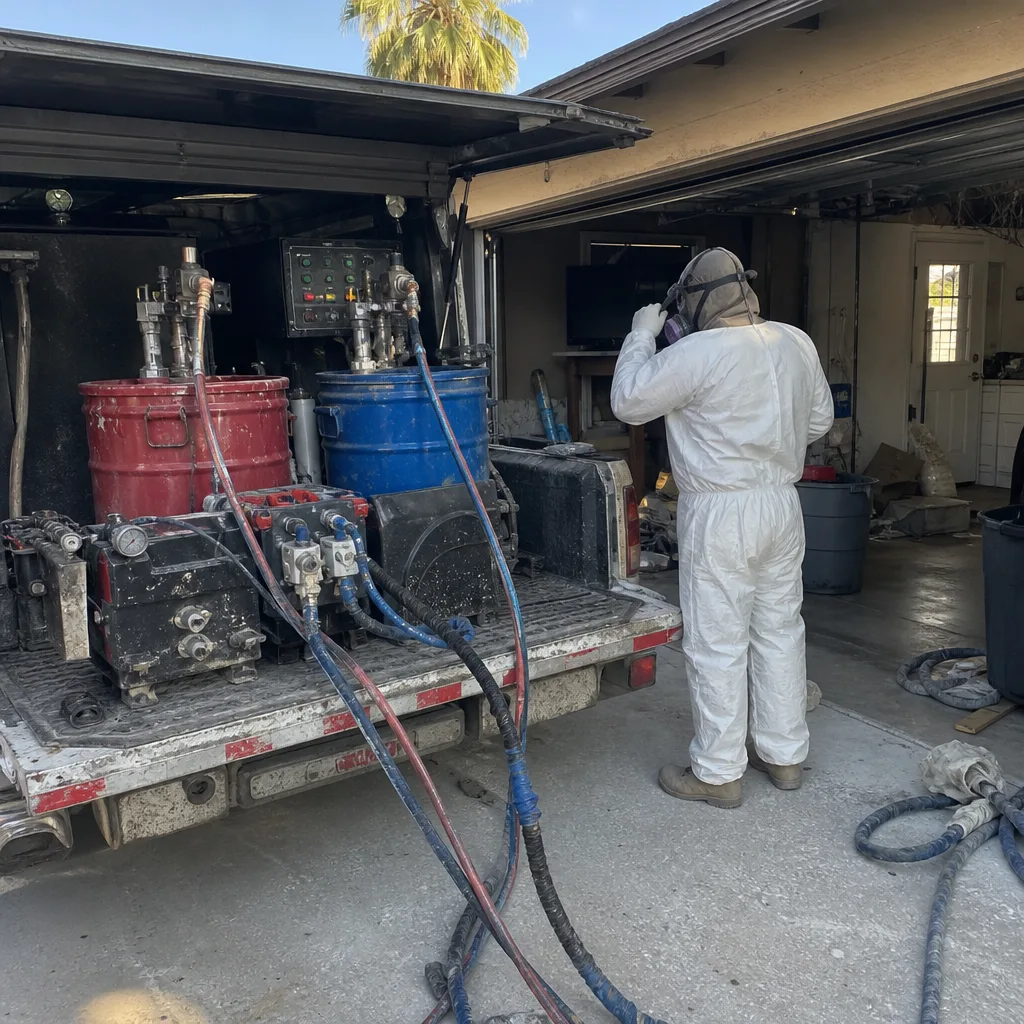
We carry two open- and closed-cell foam systems, Icynene and Demilec, because different parts of a Desert Hot Springs home need different foam. A vaulted roof deck off Miracle Hill Road wants closed-cell against the sheathing. A rim joist in a manufactured home off Dillon Road can do fine with open-cell. Most single-product insulation companies have to make one product fit every situation. We don’t. That’s the difference between a specialist and a generalist, and it shows up in how the house holds temperature come July.
When you call (855) 382-3451, you’re talking to someone who can explain why the foam pulled away from your windward eave. Not someone reading from a script. That local knowledge is what earns us the calls we get from homeowners in Sky Valley and Garnet who’ve already paid someone once for foam that didn’t hold.
Spray Foam Insulation Contractors in Desert Hot Springs
Spray Foam Insulation Contractors in Desert Hot Springs should know what this climate does to foam before they ever open a drum. The job here typically runs $2,800 to $6,700 for a rim joist and band board package on a single-story stucco home, and $5,500 to $12,000 for a full open-cell attic application in the 92240 ZIP. We always remove the old settled fiberglass first, seal the top plates and vent boots, then spray. That sequence is non-negotiable out here.
Windward Eave Repair and Air-Sealing
When foam delaminates on the northwest face of a Desert Hot Springs home, the visible problem is rarely the whole problem. We pull back the foam, inspect the top plate seam, and seal it with canister foam before we re-spray. If we don’t, the next wind event does the same thing. Homeowners off Pierson Boulevard and Mountain View Road call us with exactly this issue every spring.
Closed-Cell Roof Deck Applications
For low-slope and tile roofs that take direct desert sun all day, closed-cell Demilec or Icynene sprayed at a full 3-inch lift at the ridge-to-eave transition is the only foam spec we recommend. Thinner lifts can’t maintain R-value when the deck itself is radiating 150°F into the attic by 2 p.m. Once the deck is foamed and the attic re-vented, the whole west side of the house stops baking.
Spray Foam Attic Insulation in Desert Hot Springs
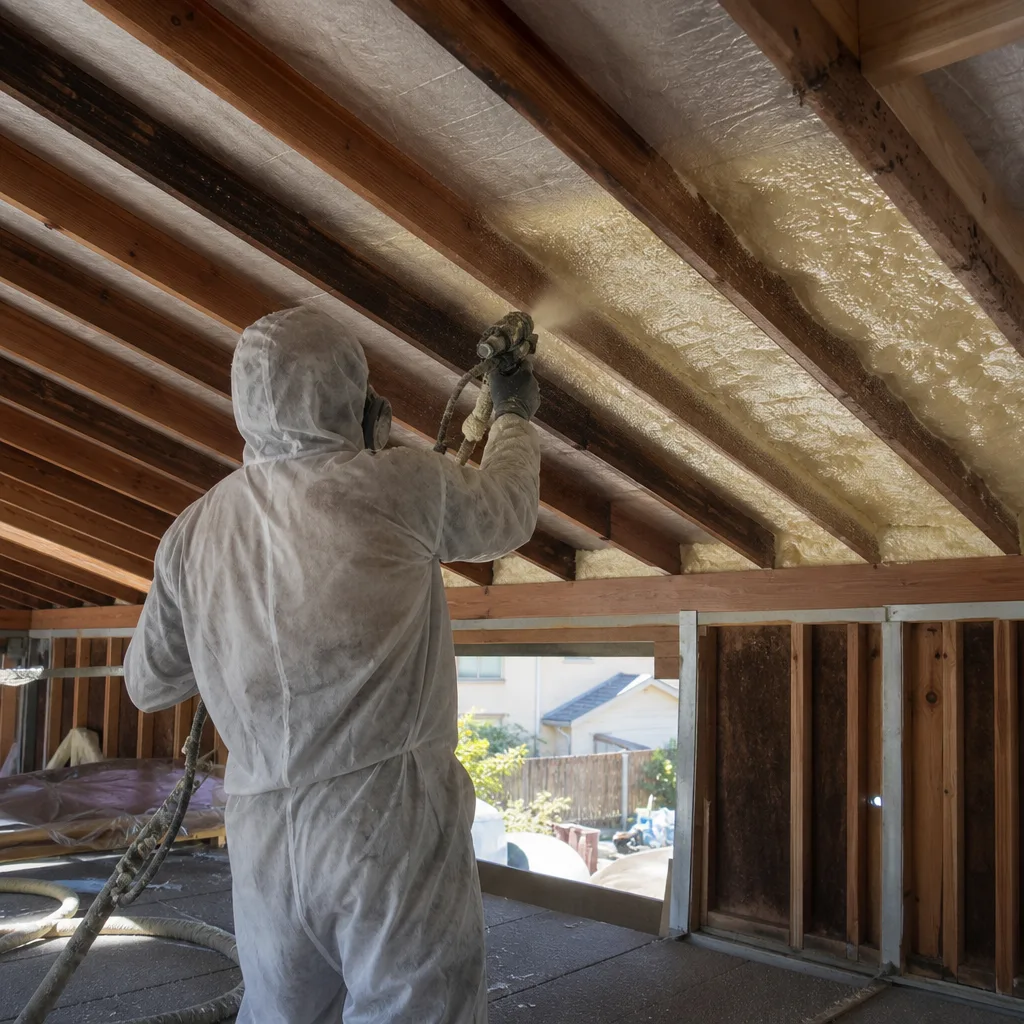
Spray Foam Attic Insulation in Desert Hot Springs often runs $4,200 to $8,900 for a full single-story home, including removal of the old settled batts and air-sealing of every top plate, can light, and vent boot. Most 1980s and 1990s stucco tract homes in 92241 still have their original fiberglass, and by now it’s dust-packed and sagging. We remove it before spraying. You can’t foam over a failed batt and expect the assembly to hold.
The Air-Seal-First Sequence
Here’s what we know from working Desert Hot Springs attics for years: spray foam in this climate succeeds or fails based on what happens before the foam ever leaves the gun. Wind-driven sand finds every unsealed gap along the top plate and vent framing, then the foam loses its bond on the windward eaves within a season or two. We seal every penetration first, with canister foam and mastic where needed, then spray. It’s slower. It’s also the only way that holds.
Radiant Barrier Replacement with Closed-Cell Foam
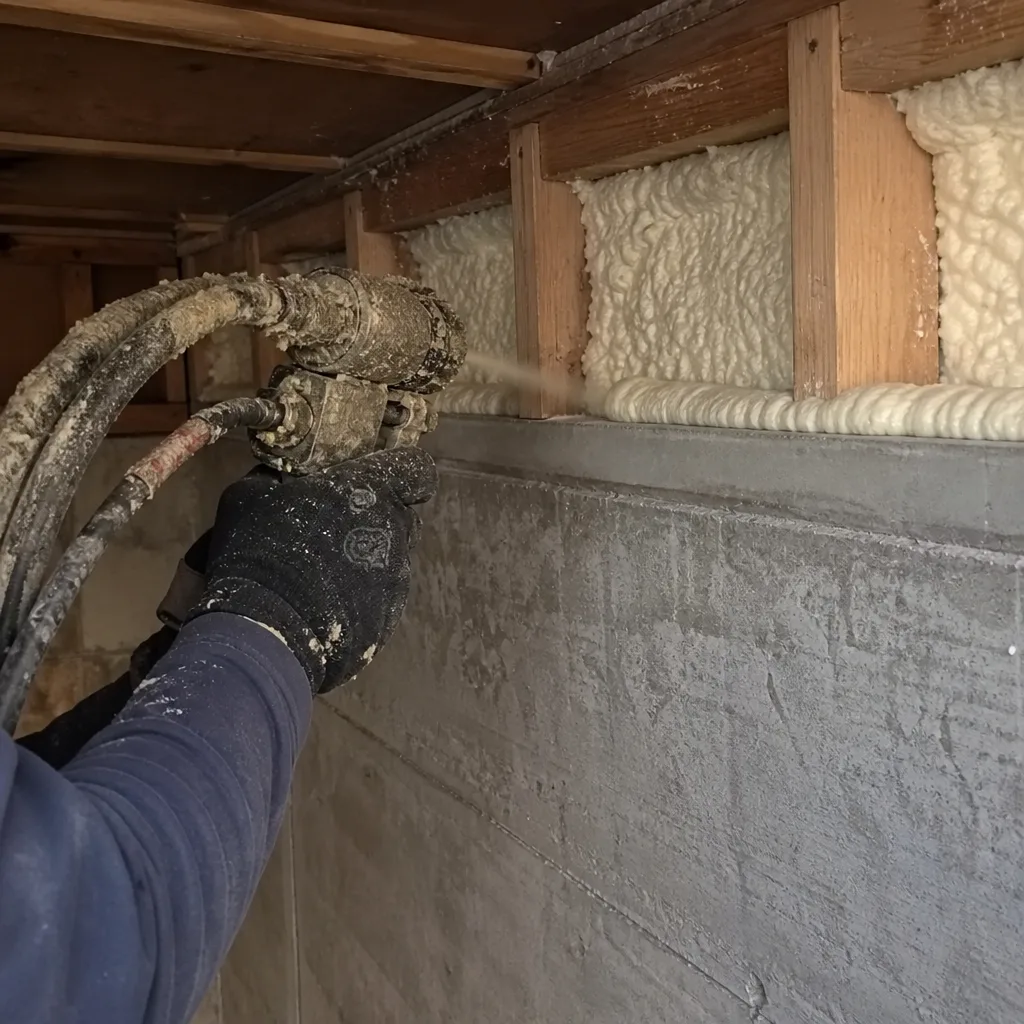
Many Desert Hot Springs homes were built with thin radiant barriers stapled to the rafters, and after 20 or 30 years those barriers are torn, degraded, or missing entirely. We see this constantly off Indian Canyon Drive and Miracle Hill Road. Closed-cell foam at the roof deck does what the radiant barrier did and more, holding surface temps down while adding true R-value at the assembly level.
Trusted Brands We Service in Desert Hot Springs
We stock and install Icynene and Demilec foam systems because they’re proven in high-temperature, high-dust environments like Desert Hot Springs. We also carry Owens Corning and Johns Manville products for the blown-in and batt applications where foam isn’t the right answer, which happens more often than most foam-only contractors want to admit. For Desert Hot Springs customers that means one crew can handle the whole job, from foam on the roof deck to blown-in along the flat ceiling. Ruben Castellano keeps these product lines stocked so we’re not waiting on supply runs when your attic is already cooking at 145°F.
Common Spray Foam Insulation Problems We See in Desert Hot Springs Homes
- Windward-eave delamination. After a Santa Ana-style wind event, foam sprayed over unsealed top plates pulls away from the sheathing on the northwest face first. The leeward side looks untouched. That’s how you know sand got behind the foam at installation.
- Closed-cell sprayed too thin on tile roof decks. When a contractor cuts the lift to save material, the assembly can’t handle 110°F+ solar gain. The attic still pushes 150°F and the foam never does its job.
- Foam over settled fiberglass. We regularly find open-cell sprayed directly over original 1980s batts that had collapsed into the eave bays. The old batt material off-gasses, the foam has voids beneath it, and the whole assembly fails from the inside out.
- Open-cell foam in vented attics with big day-night swings. Desert Hot Springs winter nights can drop near freezing. Open-cell on the cold-side surface of a vented attic picks up condensation, which degrades the foam bond over time. Closed-cell belongs on the roof deck here.
Pricing for Spray Foam Insulation in Desert Hot Springs, CA
Open-cell spray foam in Desert Hot Springs typically runs $2.80 to $4.30 per board foot installed, while closed-cell runs $3.90 to $5.40 per board foot. A full attic in a single-story 92240 home lands between $4,200 and $8,900 depending on square footage and how much old insulation has to come out first. Rim joist and band board packages run $2,800 to $6,700. Roof deck applications for vaulted or low-slope assemblies run higher because the prep is more involved. Call (855) 382-3451 for an exact number on your house. The estimate is free and we’ll tell you honestly whether foam is even the right material for your situation, which is more than a foam-only shop will do.
We Also Serve Cities Near Desert Hot Springs
Our crews cover Desert Edge, Sky Valley, Garnet, and Thousand Palms every week, and we know all of them the way we know Desert Hot Springs. If you live just off Dillon Road in Desert Edge or up in Sky Valley near the wind farms, call us. Same crews, same air-seal-first approach, same free estimate.
Serving Desert Hot Springs, CA — Our Local Coverage Area
We’re based in the Desert Hot Springs area and know this community well. Use the map below to see our service coverage — if you’re nearby, we can almost certainly help.
FAQs About Spray Foam Insulation in Desert Hot Springs
Air-sealing comes first because Desert Hot Springs wind drives fine sand through every unsealed top plate seam and vent boot, and that sand breaks the foam’s bond at the windward eaves within one or two seasons. We seal all penetrations with canister foam before we spray, then apply the foam. It’s the only sequence that holds in this climate. Call (855) 382-3451 to schedule an attic inspection and we’ll show you exactly what’s happening up there.
Closed-cell foam makes more sense for a vaulted roof deck in Desert Hot Springs because it gives you more R-value per inch, adds structural bond to the sheathing, and handles the condensation risk from cold winter nights. Open-cell is better for interior walls and rim joist cavities where vapor drive is lower. For a roof deck assembly on a custom home, closed-cell Icynene or Demilec is the right call. We’ll walk you through the numbers when you call (855) 382-3451.
We schedule Desert Hot Springs attic work for early morning starts, use ventilation fans during the prep and removal phase, and set the foam equipment to compensate for heat so the chemical reaction stays stable. Prep, removal, and air-sealing happen in those first cool hours, then we spray. The work gets done even in July, and we haven’t found an attic too hot for us to handle safely.
Yes. We foam the rough openings around windward windows and doors with low-expansion canister foam, which seals the gap between the frame and the rough framing. That stops sand intrusion at the source. We’ve seen houses on the northwest side of Desert Hot Springs where the windward sills packed with sand every spring until we foamed the rough openings. It works, and it’s part of our standard prep.
R-value alone is not enough in Desert Hot Springs, because the day-night swing here is brutal and air leaks move heat faster than insulation stops it. Spray foam does both: it adds meaningful R-value and it air-seals the attic plane at the same time. That combination is what stabilizes indoor temperatures through those big 40-degree swings. Call (855) 382-3451 and we’ll assess your attic honestly, including whether foam is even the right solution for your roof assembly.
If your Desert Hot Springs attic is hitting 150°F and the west-facing rooms cook every afternoon, don’t wait for another wind event to make it worse. We foamed the vaulted ceiling of a custom single-story stucco home off Miracle Hill Road whose 1980s fiberglass batts had collapsed into the windward eave bays, leaving the great-room soffit hot to the touch by mid-afternoon. After air-sealing the top plates and can lights, we sprayed closed-cell Icynene directly to the roof deck at the ridge-to-eave transition and re-vented the attic. The homeowner reported the west-facing room finally holding through July afternoons, and the window rough openings we foamed stopped the sand at the sills. That’s the work we do out here. Call Thermal Insulation Co at (855) 382-3451 for a free estimate on your Desert Hot Springs home.
Written by Ruben Castellano, Owner at Thermal Insulation Co, specializing in attic, blown-in, and spray foam insulation across the Coachella Valley for Desert Hot Springs homeowners.