
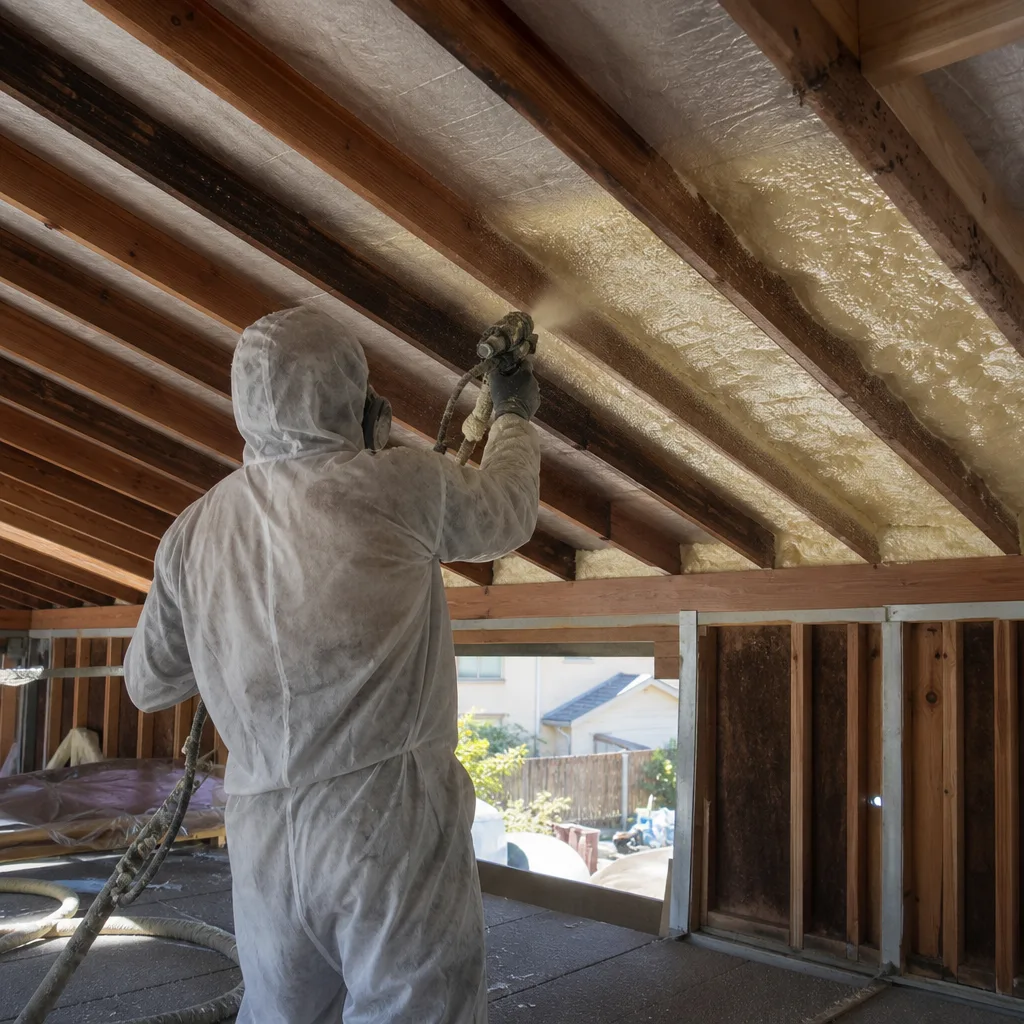
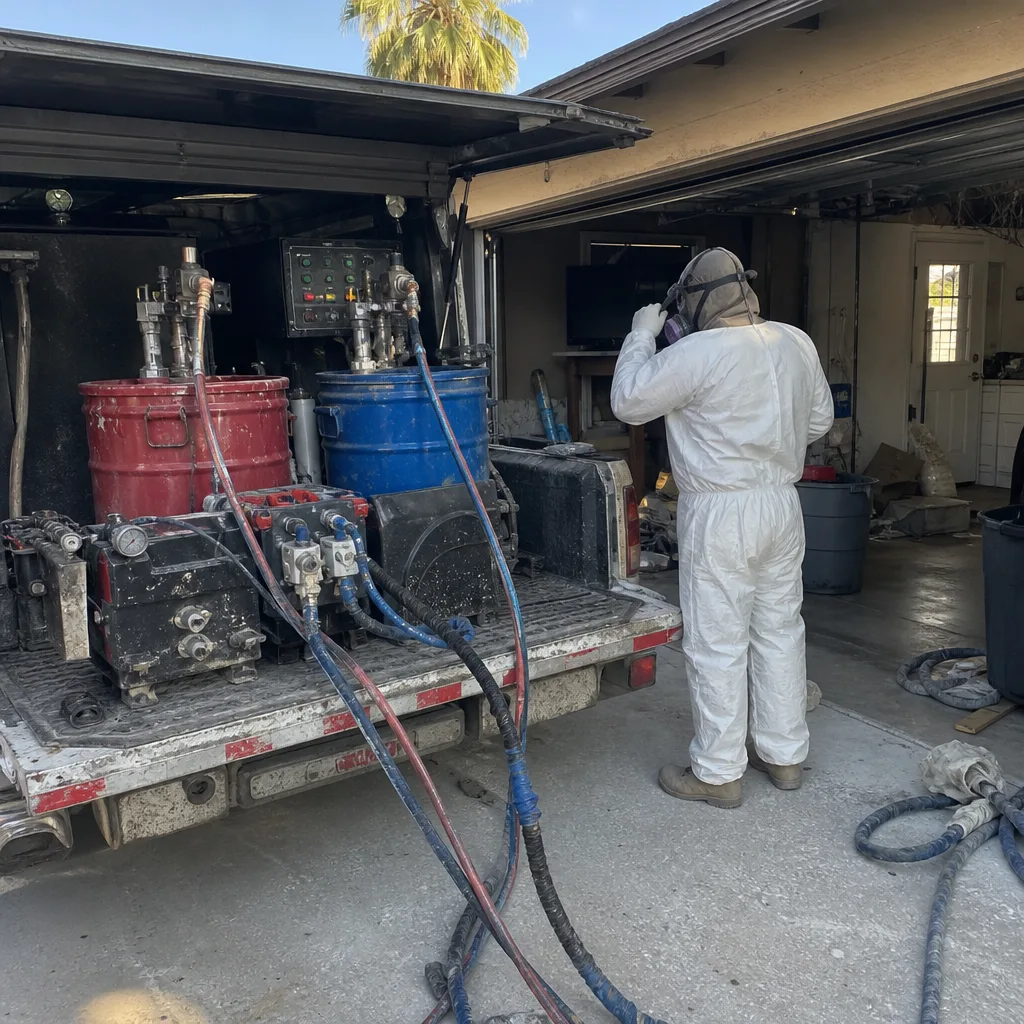
Fast, Reliable Spray Foam Insulation Across Commerce
Spray foam insulation in Commerce typically costs $2.50 to $6.50 per board foot installed, with most residential rim joist work landing between $1,200 and $3,800 and full attic projects running $4,000 to $9,500 depending on square footage and whether you choose open-cell or closed-cell foam. We’re a dedicated insulation contractor, not a generalist, and we work throughout Commerce and the surrounding industrial corridor. If you’re dealing with a hot upstairs, diesel noise from the rail yard, or an energy bill that climbs every August, call us at (855) 382-3451 and we’ll talk through what your house actually needs.
Commerce sits a little differently than most Los Angeles Basin cities. Roughly four square miles, ringed by warehouses, trucking operations, and rail lines, with a working-class residential core of mid-century stucco homes near Rosewood Park and Bandini. That mix shapes every spray foam decision we make here. Your house isn’t getting the same treatment as a Downey rancher or a Bell Gardens bungalow. The thermal load is different, the noise profile is different, and the building code requirements in a city this industrialized are different too.
Why Thermal Insulation Co Is Commerce’s Preferred Spray Foam Insulation Company
We’ve spent enough time in Commerce attics and rim joists to know exactly what this city’s housing stock throws at you. The 1950s and 1960s stucco homes off Eastern Avenue and south of Washington Boulevard have shallow attics, minimal original insulation, and air sealing that was never done right in the first place. Our crews know those houses. We know where the heat builds up, where the dust from the freight corridors creeps in, and where spray foam delivers the fastest return.
As a dedicated insulation contractor, we stock eight insulation brands: Owens Corning, Johns Manville, Knauf, Rockwool, CertainTeed, Icynene, Demilec, and GreenFiber. But for spray foam specifically, we carry two of the industry’s most trusted lines, Icynene and Demilec, in both open-cell and closed-cell formulations. That matters in Commerce because the margin between an open-cell attic application and a closed-cell rim joist application is not a coin flip. It’s a technical decision based on moisture conditions, fire-rating requirements, and what the space is actually being asked to do. Most single-trade contractors carry one foam line. We carry two so we’re never forcing a square peg into a round hole.
Ruben Castellano, who runs our operation, has built a team that treats every Commerce job as a building-science problem first and a material sale second. When you call, you’re not getting a pitch for whatever product happens to be sitting in a warehouse. You’re getting a walk-through of why a specific foam, at a specific depth, in a specific location, makes sense for your building.
Rim Joist Spray Foam in Commerce
Rim joist spray foam in Commerce is often the single highest-impact air sealing job we do in this city. The rim joist is the band of framing where your floor meets your foundation wall, and in the 1950s and 1960s homes around Rosewood Park and south Commerce, it’s almost always unsealed. That gap pulls in whatever is outside: diesel particulate from the Santa Ana Freeway corridor, dust from the rail yards off Eastern, and a steady draft of hot summer air. Closed-cell spray foam applied to the rim joist seals that boundary, stops the infiltrating air, and adds two inches of insulating value in one pass.
What a Commerce homeowner pays for rim joist spray foam depends on the perimeter length of the home and access. Most mid-century single-family homes here run 120 to 200 linear feet of rim joist. At typical closed-cell rates, that puts the job between $1,500 and $3,400. Crawl-space access, tight clearance under a raised foundation, or existing batt insulation that needs removal will push that number higher. We give you an exact number before we start, and the estimate is free.
When Closed-Cell Foam Is the Right Call
In Commerce, we generally reach for closed-cell foam on rim joists for two reasons. First, it acts as a vapor retarder at two inches, which matters in a hot, dry climate where indoor humidity from showers and cooking can otherwise condense inside open-cell foam. Second, closed-cell foam adds structural rigidity to the rim band, which older homes with original framing genuinely benefit from. If a property sits near a regularly wet condition, like a raised foundation with poor drainage off Telegraph Road, closed-cell is almost always the better recommendation.
Signs Your Rim Joist Needs Attention
You may notice a persistent dusty layer on the floor along exterior walls, even in rooms you seldom open. Or a cold draft at the baseboards in winter, though Commerce winters are mild enough that heat loss is less apparent than the dust and noise. If you hear truck traffic from the Bandini corridor as clearly inside your living room as you do outside, your rim joist is likely part of the problem. Sealing it with closed-cell foam quiets that transmission more than most people expect.
Crawl Space Spray Foam Insulation in Commerce
Crawl space spray foam insulation in Commerce solves a set of problems that show up in the older homes here with raised foundations and ventilated crawl voids. The soil under these houses is dry and powdery through much of the year, and the air moving through a vented crawl space carries that dust, plus whatever the surrounding industrial zones put in the air, directly into the home through floor gaps and plumbing penetrations. Sealing the crawl space with spray foam on the subfloor and band area cuts that pathway off.
Most crawl space work in Commerce falls between $2,200 and $7,000, and the spread comes down to square footage, clearance height, and whether we’re insulating just the subfloor or also the foundation walls. A 1,000-square-foot raised home with 24 inches of clearance is a very different job than a 1,400-square-foot home with a tight crawl you can barely belly through. We’ll tell you which situation you have and what it means for the price.
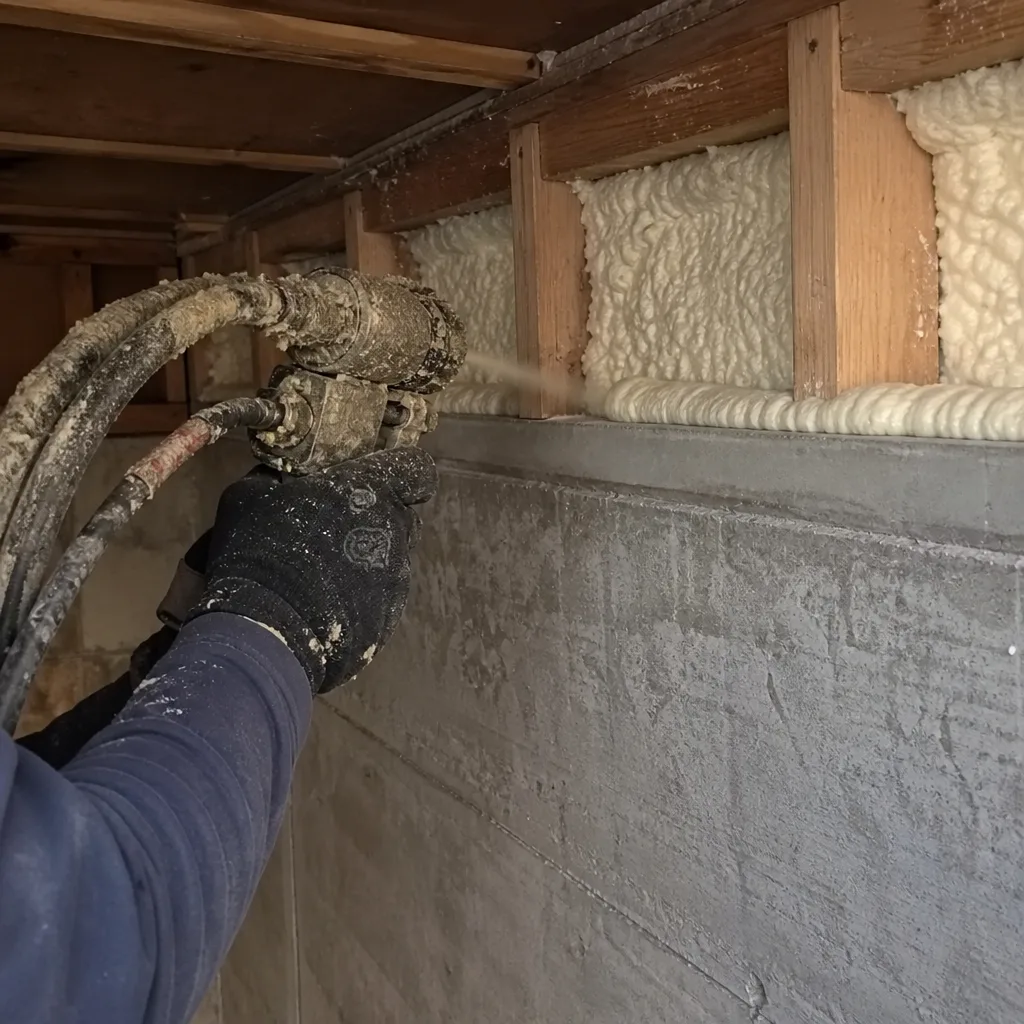
Subfloor Application With Closed-Cell Foam
On the subfloor, closed-cell foam gives you insulation plus a vapor barrier in one layer. For Commerce homes near the freight rail or heavy truck routes, it also dampens the low-frequency rumble that travels up through the framing. We’ve found that homeowners near the Union Pacific line running along the city’s south edge notice the change immediately, often more than the temperature difference.
Foundation Wall Encapsulation
Encapsulating the crawl space by spraying the foundation walls and sealing the vents converts a dusty, drafty void into a conditioned space. In Commerce’s climate, that means the crawl space stays cooler and drier than the outside air, and the house stops pulling humidity and particulates upward. It’s a bigger job than subfloor-only work, but for homes where dust from industrial neighbors is a chronic complaint, it’s often the only fix that actually works.
Trusted Brands We Service in Commerce
We install Icynene and Demilec spray foam systems because both companies make open-cell and closed-cell products that hold their specs in the field, not just in a lab report. For Commerce customers who also need conventional insulation in addition to foam, we carry Owens Corning, Johns Manville, and Knauf fiberglass, plus Rockwool mineral wool for fire-resistance applications that code sometimes requires in mixed-use and attached-garage situations. Because we stock parts and materials from multiple manufacturers, we aren’t waiting on a single supplier when your Commerce job is scheduled. That keeps turnaround faster and means we can match the foam to the requirement, not the requirement to whatever one brand we happen to sell.
Common Spray Foam Insulation Problems We See in Commerce Homes
- Foam over knob-and-tube wiring in shallow attics. Many Commerce homes from the 1950s still have remnants of knob-and-tube wiring buried under old insulation or dust. Encapsulating live knob-and-tube in spray foam is a code violation and a fire hazard. We inspect for this before any attic foam job.
- Poor surface prep on mid-century stucco walls. Dust, old paint, and decades of soot on stucco walls cause poor foam adhesion and eventual delamination. In a city with this much diesel particulate in the air, proper cleaning and priming is non-negotiable, and we do it on every job.
- Open-cell foam on rim joists without a vapor retarder. In Commerce’s hot, dry climate, open-cell foam at the rim joist can allow interior moisture to reach the rim band and condense against the cooler foundation. We specify closed-cell for nearly all rim joist work here.
- Ignoring Title 24 fire-rated assembly requirements. When foam is applied in an attached garage, a commercial warehouse office, or any separation wall, California energy and fire codes require specific assembly ratings. Some contractors skip this. We don’t, because a failed inspection costs more than doing it right the first time.
Pricing for Spray Foam Insulation in Commerce, CA
Here are the ranges we typically see in Commerce for residential spray foam work. Open-cell attic applications run $2.50 to $3.90 per board foot. Closed-cell runs $3.50 to $6.50 per board foot depending on depth and surface area. A typical shallow-attic job on a 1,100-square-foot mid-century home using open-cell foam across the ceiling deck lands between $3,800 and $6,800. Rim joist work, as noted, usually sits between $1,500 and $3,400. Garage ceiling spray foam in an attached garage with a bedroom above typically runs $1,800 to $4,000. Roof deck applications under a flat or low-slope roof, common on some Commerce commercial buildings and a few residential additions, are priced after a site inspection because they often involve fire-rated assembly requirements. Call (855) 382-3451 and we’ll schedule a walk-through and give you a written estimate, free.
We Also Serve Cities Near Commerce
While this page is written for Commerce, our crews work the surrounding communities every week. We handle spray foam jobs in Maywood, Bell, Cudahy, and Bell Gardens, and because those cities share Commerce’s mid-century housing stock and industrial noise exposure, our approach translates directly. If you’re a property owner in one of those areas and want the same level of building-science rigor, call the same number: (855) 382-3451. You can also learn more about our broader Spray Foam Insulation services.
Serving Commerce, CA — Our Local Coverage Area
We’re based in the Commerce area and know this community well. Use the map below to see our service coverage — if you’re nearby, we can almost certainly help.
FAQs About Spray Foam Insulation in Commerce
Yes, spray foam reduces airborne noise transmission through walls, floors, and rim joists, but it is not a standalone soundproofing solution. Closed-cell foam is denser and blocks more low-frequency rumble, while open-cell foam is better at absorbing mid-range and high-frequency sound. In a Commerce home near the Union Pacific line or the Bandini truck routes, sealing the rim joist and spray-foaming the attic deck meaningfully cuts road and rail noise, though windows and doors remain weak points. Call (855) 382-3451 and we’ll assess where your noise is actually entering.
Most residential spray foam work in Commerce does not require a separate insulation permit when the work is a retrofit inside an existing conditioned space. However, if the foam is part of a larger remodel, a commercial project, or an application that touches a fire-rated assembly like an attached garage separation wall, the city’s building department will require the relevant permits and inspections. We handle permitting on commercial jobs and flag any residential project where you’d need to pull paper. It’s rare for a simple attic or rim joist job, but we’ll tell you before work starts, not after.
Open-cell foam is lighter, less expensive, and has an R-value around R-3.5 to R-3.8 per inch, making it suitable for attic decks and interior walls where air sealing matters more than maximum insulation. Closed-cell foam is denser, costs more, and delivers roughly R-6.5 to R-7 per inch, plus it acts as a vapor retarder, making it the right choice for rim joists, crawl space subfloors, and any Commerce application where moisture or structural rigidity is a concern. For most mid-century homes here, the best answer is a combination: open-cell in the attic, closed-cell at the rim and crawl.
In Commerce, commercial warehouse owners navigating Title 24 energy compliance often find that spray foam can satisfy both mandatory insulation minimums and air-barrier requirements in a single application. When foam is applied to the roof deck or perimeter walls, it reduces air infiltration, hits the required R-values, and can contribute to meeting the building’s overall energy budget. However, Title 24 also carries fire-rated assembly requirements for foam in certain commercial applications, and the Commerce building department enforces those closely. We install foam on commercial projects to the specs that pass inspection the first time. Call us at (855) 382-3451 to talk through your building.
No, spray foam should not be applied directly over existing fiberglass or cellulose. The foam needs to bond to a clean substrate, the attic floor or roof deck, and old insulation sitting between the foam and that surface prevents adhesion and traps dust and moisture. For Commerce attics with old, compressed batt insulation, we remove the existing material before spraying. We recommend the same for any job with rodent activity or heavy soot accumulation, both of which we see regularly in this city’s older homes.
If your Commerce home or commercial building has the insulation problems we’ve described: hot rooms, dusty air, rattling windows when a train goes by, or an attic that never got properly sealed, call us. We’ll send a crew to assess the space, tell you exactly what it needs, and give you a written price. Thermal Insulation Co works in Commerce every week. Reach us at (855) 382-3451.
Written by Ruben Castellano, Owner at Thermal Insulation Co, serving Commerce and the surrounding Los Angeles Basin with dedicated insulation expertise.