
Fast, Reliable Attic Insulation Across Whittier
Attic insulation in Whittier has to do two jobs at once: hold back 130°F+ attic heat on summer afternoons when the San Gabriel Valley bakes, and keep warm air inside during the mild but real winter nights. We’re Thermal Insulation Co, a dedicated insulation contractor led by Ruben Castellano, and we work in Whittier neighborhoods every week. We know which homes here were built before wall insulation existed and which ones just never got enough in the attic. Call (855) 382-3451 for a free estimate, and we’ll tell you straight what your attic actually needs.
Our Attic Insulation team covers every ZIP in Whittier, from 90601 and 90602 around Uptown to the 90603 through 90606 tract neighborhoods to the south and east. Response time to most Whittier homes runs same-day for inspections and within a few days for full installs. If your upstairs rooms are hot by mid-afternoon or your furnace runs constantly in winter, the attic is almost always where the problem starts.
Key Takeaways
- Whittier’s biggest insulation problem: attic heat that pushes past 130°F in summer, soaking through ceilings in older homes with thin or settled insulation.
- Two housing stocks, two strategies: Uptown’s pre-war bungalows need air-sealing before blowing anything in; southeast tracts need more R-value and sometimes radiant barrier.
- We carry eight insulation brands and install three methods, so the material matches the house, not our inventory.
- Free estimates, straightforward pricing, and a team that shows up when we say we will.
Why Thermal Insulation Co Is Whittier’s Preferred Attic Insulation Company
Whittier homeowners call us because we’re an insulation-only contractor. We don’t do roofs on Tuesday and windows on Thursday. Attic insulation, blown-in, spray foam, batt, radiant barrier, ventilation – that’s the entire job description. When we show up at a 1920s Craftsman on a Uptown street or a 1960s ranch in the 90604 tract, we’re looking at the attic, the ceiling plane, and the thermal boundary. Nothing else pulls our attention away.
Local reputation matters in Whittier. Homeowners talk. When one neighbor’s upstairs rooms stop baking in July after we add a radiant barrier and high-R blown-in fill, the next house on the block calls us. We don’t advertise much. The work tends to advertise itself. Ruben Castellano has built the company around honest recommendations rather than pushing whatever product sits in the warehouse, and that approach works in a city where half the housing stock needs a different solution than the other half.
We carry products from eight nationally recognized manufacturers: Owens Corning, Johns Manville, Knauf, CertainTeed, Rockwool, Icynene, Demilec, and GreenFiber. Most insulation crews in the Whittier area stock one or two. We carry competing brands so we can recommend what the house needs, not what we happen to have on the truck. That means a 1920s bungalow with plaster walls gets a different recommendation than a 1965 ranch with blown-in material that settled to three inches decades ago.
Attic Ventilation in Whittier
Attic Ventilation is the difference between an insulation job that works and one that just costs money. In Whittier, where the hills below the Puente Hills create still, hot afternoons with little breeze, a poorly vented attic can hit 150°F inside. That heat radiates through the ceiling, makes the air conditioner work harder, and shortens the life of whatever insulation sits below. We check for working intake and exhaust venting before we add any insulation – because stacking more R-value onto a sealed-up, superheated attic solves nothing.
Intake and Exhaust Balance
Most Whittier tract homes from the 1950s through 1970s have minimal venting: maybe a couple of static roof vents and no soffit intakes. That means hot air rises to the ridge and just sits there. We rebalance the system, adding soffit vents if the eaves allow, or a ridge or powered vent where the design calls for it. A balanced attic runs 30°F to 40°F cooler in summer, which keeps the insulation doing its actual job of resisting heat transfer, not baking in it.
Moisture and Winter Condensation
Winter nights in Whittier drop into the 40s, and when warm indoor air leaks into a chilly attic, condensation forms on roof decking and insulation. In older Uptown homes, unsealed balloon-frame cavities feed warm moist air straight up from the living space into the attic. Proper ventilation gives that moisture a path out instead of a place to soak. Covered, damp insulation loses R-value and can eventually rot framing sheathing. We’d rather ventilate correctly the first time than come back to remediate a mold issue later.
Radiant Barrier in Whittier
Radiant Barrier is the single highest-impact upgrade for Whittier’s summer attic heat problem. Radiant heat is the dominant transfer mode when attic temperatures climb past 120°F, and regular mass insulation does almost nothing against it. A radiant barrier – a reflective foil layer installed under the roofline or over the existing insulation – reflects the roof’s heat back out instead of letting it radiate downward into your ceiling. Given how many Whittier homes cook after lunch in July and August, this is not an add-on here. It’s often the first thing we recommend.
Roofline vs. Floor-of-Attic Application
In a vented attic, we install the barrier on the floor of the attic, draped over the existing insulation with the reflective side up. That blocks radiant heat before it ever reaches the insulation mass below. In an unvented or cathedral-type attic, we apply it under the roofline, creating a low-emissivity surface that keeps the roof deck’s heat from radiating inward. The application changes. The physics doesn’t. For Whittier homes, the floor-of-attic method is the most common and usually the best value.
What Radiant Barrier Costs in Whittier
A radiant barrier installation in a single-story Whittier home typically runs $1,200 to $2,400, depending on attic size and whether we need to top up the existing insulation first. Two-story homes or complicated rooflines run higher. The payback shows up fastest in homes with central air conditioning – the AC simply cycles less when the ceiling isn’t acting as a radiator. Call (855) 382-3451 and we’ll give you an exact number after we measure the attic.
Trusted Brands We Service in Whittier
We carry GreenFiber because it’s a dense-pack recycled cellulose that air-seals as well as it insulates, which matters in those Uptown attics where air leaks through every plaster crack. We carry Owens Corning and Johns Manville because their fiberglass batts and blown-in products have long, documented R-value stability, which matters in Whittier’s swing between hot-dry summers and cool-damp winters. And we stock enough material locally for our Whittier routes that we rarely need more than two days to schedule an install after the estimate.
Common Attic Insulation Problems We See in Whittier Homes
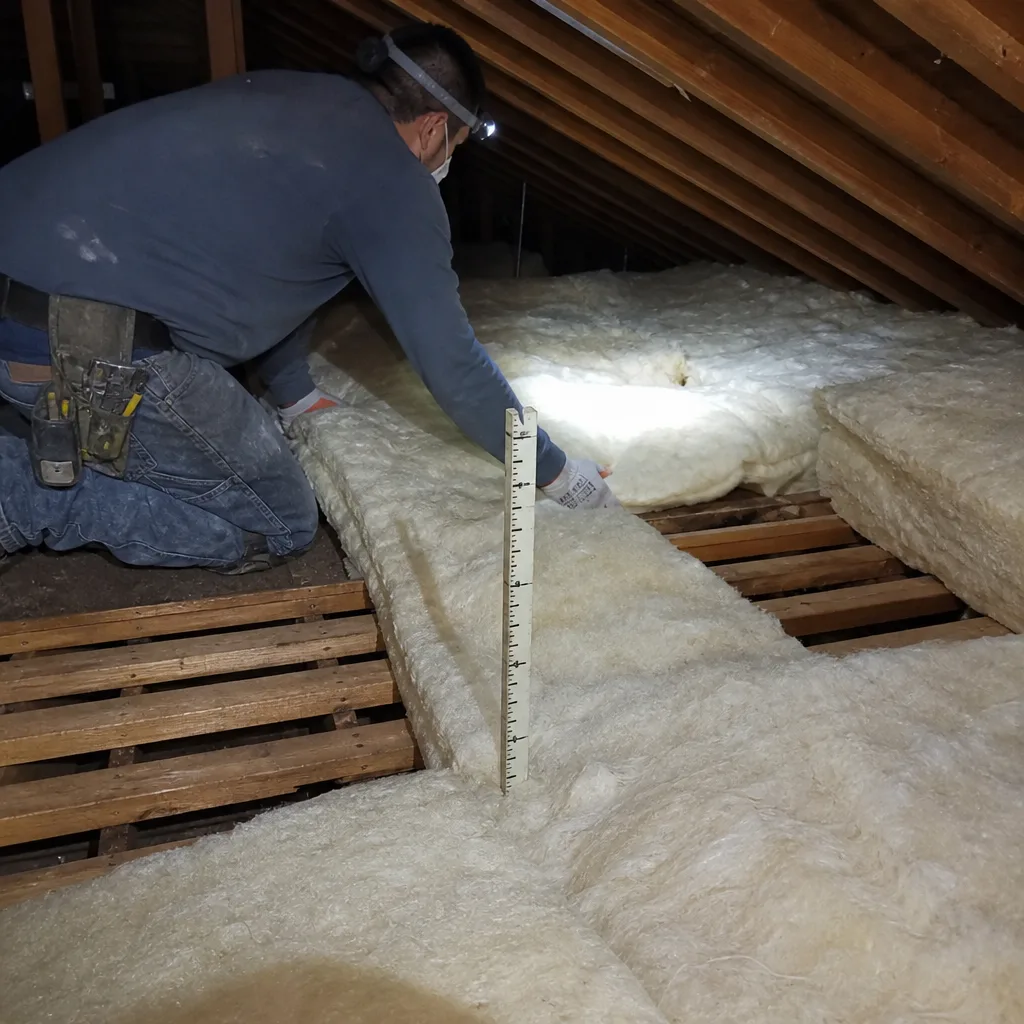
- Settled, thin 1950s – 1970s fiberglass in the southeast tracts (90603 – 90606). Those homes often have R-11 to R-19 when the climate here calls for R-38 to R-60. The insulation compacts over decades, and what’s left can’t handle a 130°F attic. The result is a ceiling that feels hot to the touch by 3 p.m.
- Unsealed balloon-frame cavities in Uptown bungalows (90601/90602). The wall stud bays in those pre-war homes run continuously from foundation to attic. Any blown-in attic material dropped on top of those open cavities lets air move freely from crawlspace to attic, bypassing the insulation entirely. Air-seal first, then insulate.
- Missing or blocked attic venting. We find soffit vents painted over, ridge vents missing entirely, and gable vents stuffed with old insulation. A sealed-up attic turns into a heat box. No amount of R-value fixes that. Ventilation and insulation work together or not at all.
- Radiant-barrier foil installed wrong. Some homeowners or handymen staple foil directly to the roof deck in a vented attic, which traps heat and moisture against the sheathing. We’ve been called to fix more than one of those jobs in the Whittier Hills. The barrier has to sit with an air gap on the reflective side to actually work.
Pricing for Attic Insulation in Whittier, CA
Blown-in attic insulation in Whittier typically runs $1,800 to $4,200 for a 1,200-square-foot attic area, depending on existing conditions, target R-value, access, and whether air-sealing is included. A top-up over existing insulation starts closer to $1,200. Attic batt insulation lands in a similar range, $1,500 to $3,800 for most homes. Full replacement, where we remove and dispose of old degraded material before reinstalling, adds $500 to $1,200. Air-sealing, which is non-negotiable in Uptown-era homes, runs $800 to $1,800. Radiant barrier, as noted above, adds $1,200 to $2,400 in most cases. The biggest cost driver in Whittier is access: some Uptown homes have tiny attic hatches and steep, tight interior stairwells, while the 1960s tracts usually have open, walkable attics. Call (855) 382-3451 for a free, exact quote. There’s no cost to have us out, and the estimate is itemized so you can see what you’re paying for and why.
We Also Serve Cities Near Whittier
Our crews work throughout the eastern San Gabriel Valley and the nearby corridor cities. If you’re in Whittier‘s neighboring communities, we cover South Whittier, West Whittier-Los Nietos, East La Mirada, and Santa Fe Springs with the same response times and the same eight-brand material selection. Insulation problems don’t respect city lines, and neither do our routes.
Serving Whittier, CA — Our Local Coverage Area
We’re based in the Whittier area and know this community well. Use the map below to see our service coverage — if you’re nearby, we can almost certainly help.
FAQs About Attic Insulation in Whittier
Because in balloon-frame construction, the wall cavities run unbroken from foundation to attic, and the previous installer likely blew insulation over those open cavities without air-sealing them first. You can have R-49 in the attic and still feel drafts at the baseboards and by the windows, because air is moving through the walls, bypassing the insulation entirely. We fix this by sealing the top plates and blocking each stud bay from the attic side before any material goes in. That’s not optional in a pre-war Uptown home. It’s step one. Call (855) 382-3451 and we’ll inspect the attic and tell you exactly what’s happening in your walls.
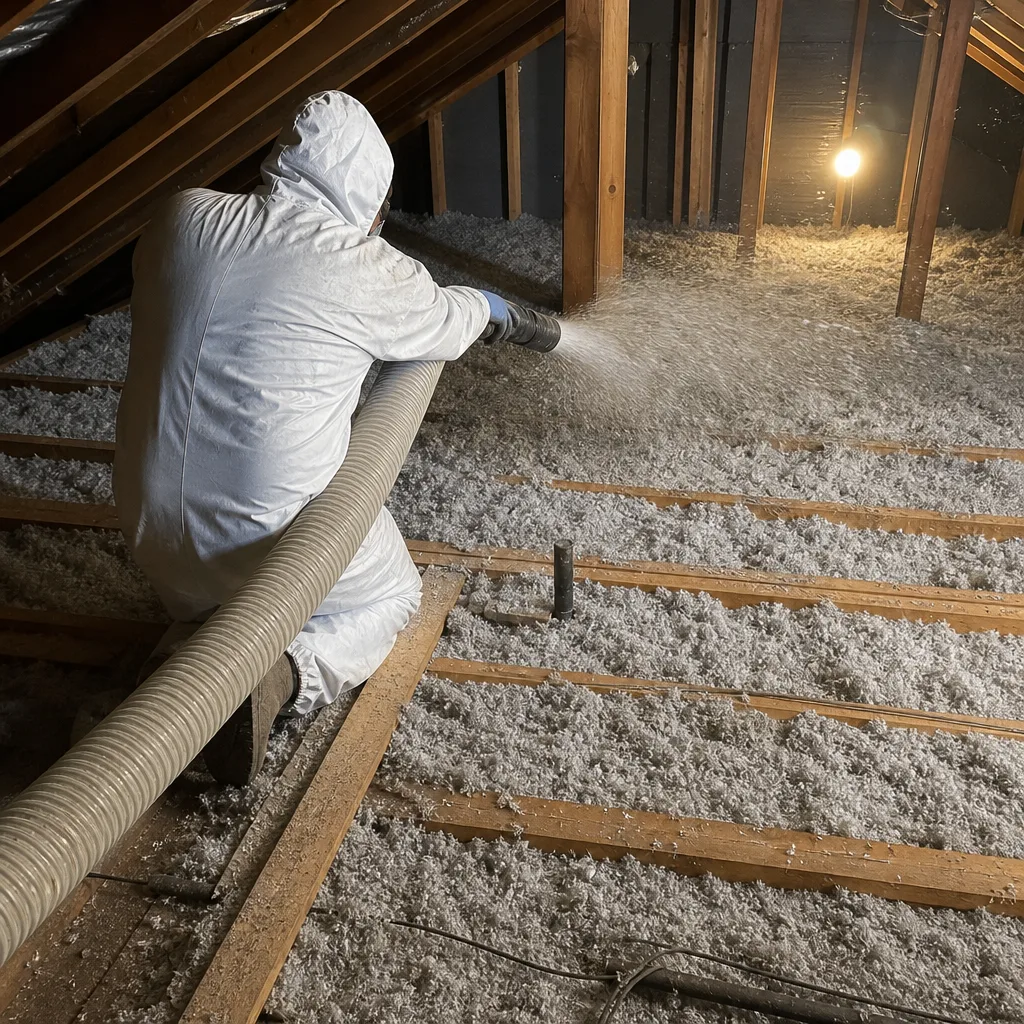
Most of those homes need R-38 to R-60 total. The 1950s – 1970s tract builds in 90603 through 90606 usually have R-11 to R-19 up there, and it’s settled and compressed by now. That’s roughly half of what the climate demands, given how hot those attics get in summer. We recommend topping up to R-60 for maximum cooling-season benefit, using blown-in fiberglass or GreenFiber cellulose. The material cost difference between R-38 and R-60 is small. The performance difference in a 130°F attic is not.
It makes more sense in Whittier than in most Southern California cities. The eastern San Gabriel Valley heat is real. Attic temps push past 130°F for weeks every summer. A radiant barrier specifically resists that radiant heat transfer, which dominates once the attic gets that hot. If your home has central AC and you notice upstairs rooms warming up by early afternoon, a radiant barrier is one of the best cost-per-benefit upgrades you can make. It’s not overkill. It’s the correct tool for what this climate does to an attic.
In most cases, yes. If the knob-and-tube wiring is active, we do not bury it in insulation. We’ll route insulation around it and, where necessary, work with a licensed electrician to address any sections that can’t safely remain in contact with insulation. Many Uptown homes still carry knob-and-tube circuits, and we’ve worked on enough of them to know what the wiring routes look like before we start. We’ll flag any concerns during the estimate, so you know exactly what we can and can’t do safely.
Because a poorly vented attic turns into a heat and moisture trap, and insulation can’t perform in those conditions. On a still-hot afternoon in the Whittier Hills, an unvented attic can hit 150°F or more, turning your ceiling into a radiant panel. And in winter, moisture from warm indoor air condenses on cold roof decking, soaking insulation and cutting its R-value. Proper ventilation – balanced intake and exhaust – keeps the attic from becoming an oven in summer or a damp cave in winter. It’s the difference between insulation that works for 20 years and insulation that fails in five.
Written by Ruben Castellano, Owner at Thermal Insulation Co, serving Whittier and the wider Los Angeles area.